
Source: OWI (Peak Auto) – Motorsports 101 (2025)
Key Findings at a Glance
- → Michael Schumacher and Lewis Hamilton are tied as F1’s winningest drivers with 7 titles each As of 2024, both drivers share the record for individual Formula 1 world championships. [OWI (Peak Auto) – Motorsports 101]
- → Ferrari holds 16 F1 constructor titles Ferrari’s constructor championships were won between 1961 and 2008, the most of any team in Formula 1 history. [OWI (Peak Auto) – Motorsports 101]
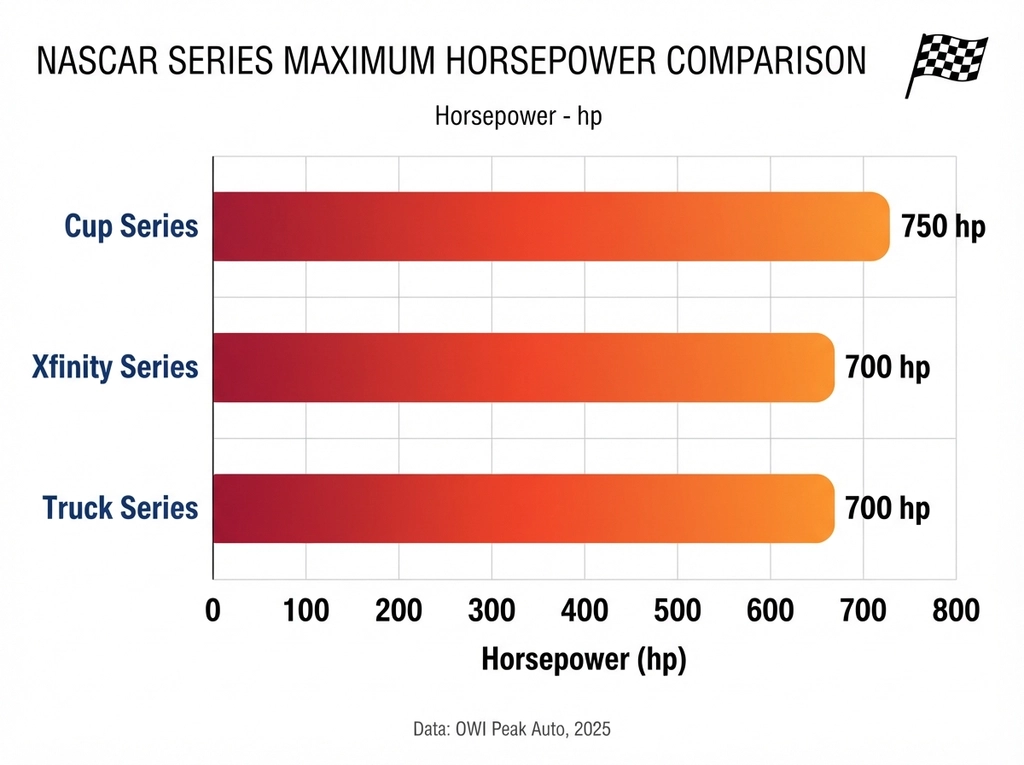
- → NASCAR Cup Series cars are limited to 750 hp, while Xfinity and Truck Series cars max out at 700 hp NASCAR enforces separate horsepower caps across its three national circuits. [OWI (Peak Auto) – Motorsports 101]
- → SCCA autocross offers six different competition levels Autocross combines elements of road racing and time trials, with low entry requirements that make it a common starting point for new racers. [SCR Performance]
- → Kartodromes measure between 600 and 1,700 meters long and 8 to 15 meters wide Karting circuits are standardized within this range and often serve as the entry point for future racing drivers. [AnythingATV – Types of Motorsports]
- → Karting drivers can begin competing as young as age five Karting is described as the most common first step for aspiring race car drivers. [AnythingATV – Types of Motorsports]
- → First-place finishers in F1 Grand Prix races earn 25 championship points Formula 1’s points system rewards the top 10 finishers, with points decreasing from 25 down to 1. [OWI (Peak Auto) – Motorsports 101]
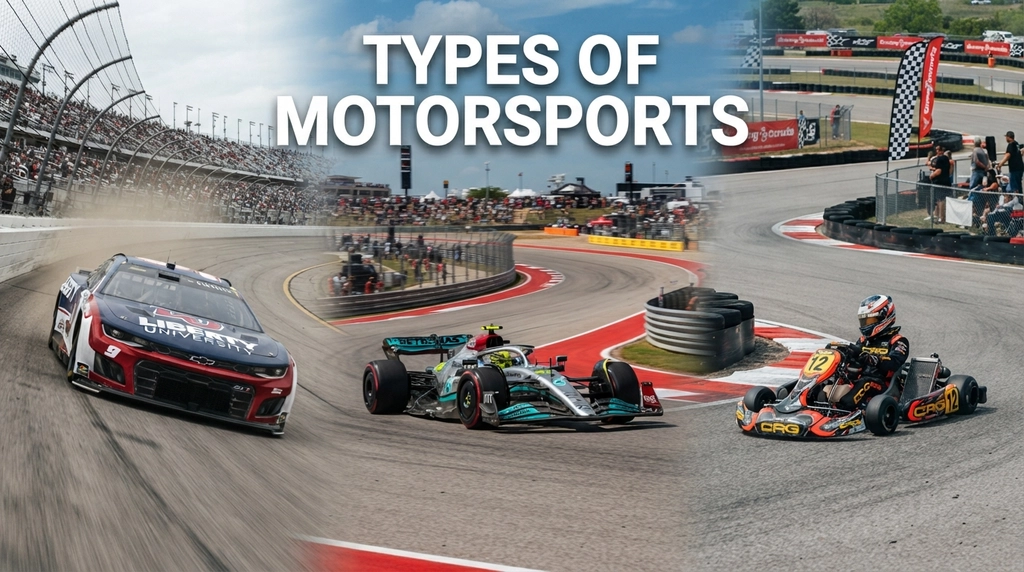
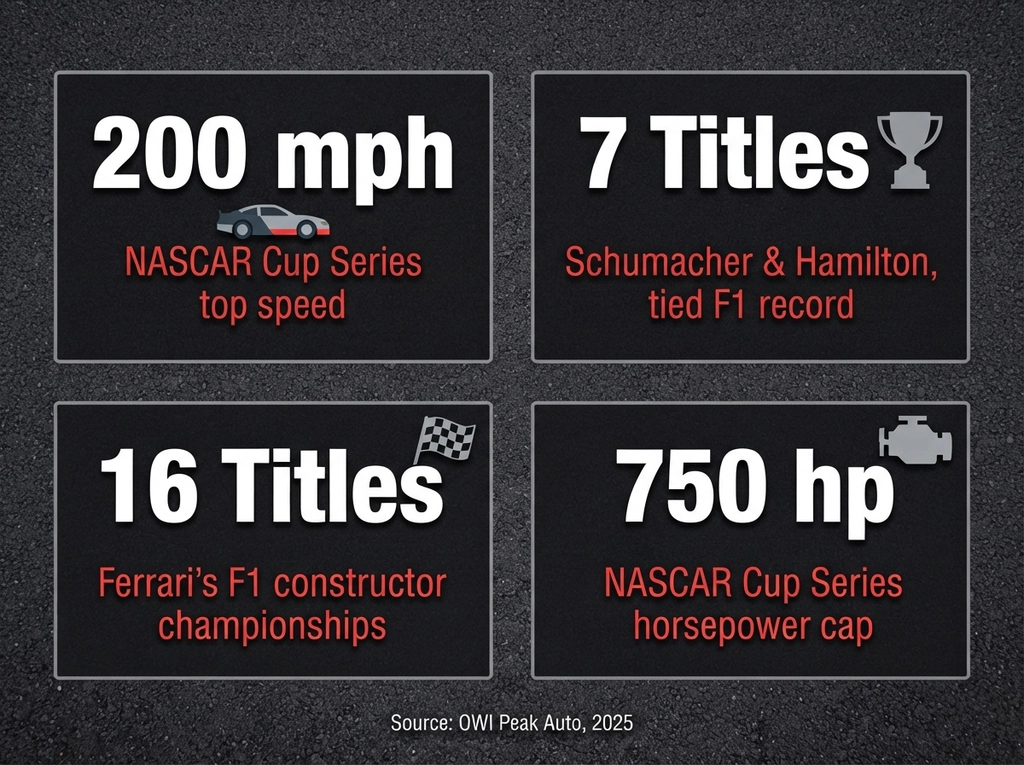
NASCAR Cup Series stock cars reach top speeds of up to 200 mph (320 km/h) on oval tracks, according to OWI (Peak Auto)’s Motorsports 101 data. That single figure sits alongside other benchmarks — 25 championship points for an F1 race winner, 16 Ferrari constructor titles, and a minimum karting age of five — that define how different types of motorsports measure speed, skill, and access for competitors in 2026.
1How Do Formula 1 Points and Titles Work?
Formula 1 awards 25 points for a race win and 18 for second place, with the season running March to December. Michael Schumacher and Lewis Hamilton each hold 7 individual titles, while Ferrari leads all teams with 16 constructor championships won between 1961 and 2008.
| METRIC | VALUE | SOURCE |
|---|---|---|
| F1 points for 1st place finish | 25 points | OWI (Peak Auto) – Motorsports 101 |
| F1 points for 2nd place finish | 18 points | OWI (Peak Auto) – Motorsports 101 |
| F1 season schedule | March to December months | OWI (Peak Auto) – Motorsports 101 |
| Ferrari F1 constructor titles | 16 titles | OWI (Peak Auto) – Motorsports 101 |
| F1 individual driver titles (Schumacher and Hamilton, tied) | 7 titles each | OWI (Peak Auto) – Motorsports 101 |
| Source: OWI (Peak Auto) – Motorsports 101 | ||
Ferrari’s 16 constructor titles span nearly five decades of chassis and engine regulation changes, a run unmatched by rivals such as McLaren or Williams. Schumacher’s and Hamilton’s shared record of 7 titles each makes them the sport’s reference point for individual success, much like rally’s championship battles track driver dominance across a season. The points gap between first (25) and second (18) rewards race wins over consistent podiums, a scoring approach that shapes strategy calls similar to those seen in street circuit racing.
2How Fast Do NASCAR Cars Go and What Powers Them?
NASCAR Cup Series cars top out at 200 mph (320 km/h) using a 5.8L V8 engine and 4-speed manual transmission, capped at 750 hp and 3,200 lbs. Xfinity and Truck Series cars are limited to 700 hp, and oval speedways typically measure 1-2 miles.
| METRIC | VALUE | SOURCE |
|---|---|---|
| NASCAR engine type | 5.8L V8 engine | OWI (Peak Auto) – Motorsports 101 |
| NASCAR transmission type | 4-speed manual transmission | OWI (Peak Auto) – Motorsports 101 |
| NASCAR maximum vehicle weight | 3,200 lbs | OWI (Peak Auto) – Motorsports 101 |
| NASCAR Cup Series max horsepower | 750 hp | OWI (Peak Auto) – Motorsports 101 |
| NASCAR Xfinity/Truck Series max horsepower | 700 hp | OWI (Peak Auto) – Motorsports 101 |
| NASCAR Cup Series top speed | 200 mph (320 km/h) | OWI (Peak Auto) – Motorsports 101 |
| NASCAR speedway track length | 1-2 miles | OWI (Peak Auto) – Motorsports 101 |
| Source: OWI (Peak Auto) – Motorsports 101 | ||
The 750 hp ceiling for Cup Series cars, compared with 700 hp for Xfinity and Truck Series machines, keeps lap times close across NASCAR’s three national circuits on tracks between 1 and 2 miles long. A 3,200-lb weight limit paired with a 4-speed manual transmission — unusual compared with the sequential gearboxes common in IndyCar competition — forces drivers to manage shifts by hand at 200 mph. That speed ceiling puts stock cars in a similar bracket to the road-legal machines featured in hypercar showcases, though NASCAR’s oval-specific aerodynamics work differently from open-wheel or street-circuit setups.
3What Competition Levels Exist in SCCA Racing?
SCCA road racing offers 4 competition levels, time trials run across 4 types, and autocross spans 6 levels — the widest range of entry points among SCCA’s disciplines. Autocross’s low barrier to entry makes it a frequent starting point for drivers new to competitive racing.
| METRIC | VALUE | SOURCE |
|---|---|---|
| SCCA road racing competition levels | 4 levels | SCR Performance |
| SCCA time trial types | 4 types | SCR Performance |
| SCCA autocross competition levels | 6 levels | SCR Performance |
| Source: SCR Performance | ||
Autocross’s 6 competition levels outnumber the 4 tiers found in both SCCA road racing and time trials, reflecting how the discipline is structured to bring in newcomers before they move into wheel-to-wheel formats. Drivers who progress through autocross often graduate to circuit disciplines covered in off-road racing formats or the two-wheeled classes detailed in motorcycle racing categories. The ladder structure mirrors club-level grading systems, where drivers rise through graded fields before reaching top-flight competition.
4What Age Can Kids Start Karting and How Big Are the Tracks?
Karting drivers can start competing as young as age 5, using kartodromes that measure 600 to 1,700 meters long and 8 to 15 meters wide. This standardized sizing makes karting the most common first step for aspiring race car drivers, according to AnythingATV’s motorsports data.
| METRIC | VALUE | SOURCE |
|---|---|---|
| Kartodrome track dimensions | 600-1700 meters long, 8-15 meters wide meters | AnythingATV – Types of Motorsports |
| Minimum karting starting age | 5 years old | AnythingATV – Types of Motorsports |
| Source: AnythingATV – Types of Motorsports | ||
The 600-to-1,700-meter track range gives young drivers a controlled space to build race craft years before they reach cars, a pipeline that has produced talent discussed in IndyCar driver profiles and multi-generational racing family stories. Starting at age 5 puts karting years ahead of most other entry points, including the club-level SCCA ladder or amateur off-road classes. The narrow 8-to-15-meter track width forces early lessons in car placement that carry over directly to faster disciplines later in a driver’s career.
5What Are the Main Categories of Motorsports?
Motorsports split into 3 broad families: car racing, motorcycle racing, and aeronautical racing, according to AnythingATV’s classification. Each category contains its own sub-disciplines, from NASCAR’s 750 hp stock cars to SCCA’s 6-level autocross ladder and karting’s entry point starting at age 5.
| METRIC | VALUE | SOURCE |
|---|---|---|
| Broad families of motorsport | 3 categories (car, motorcycle, aeronautical) | AnythingATV – Types of Motorsports |
| Source: AnythingATV – Types of Motorsports | ||
Car racing covers everything from Ferrari’s 16 F1 constructor titles to the 200 mph stock cars of NASCAR’s Cup Series, while motorcycle racing spans the categories detailed in two-wheeled competition formats. Rally disciplines, such as those covered in Kenya’s rally coverage, sit within the car racing family alongside circuit series and time trials. Aeronautical racing remains the smallest of the 3 categories in mainstream coverage, though car and motorcycle racing continue to dominate coverage across nearly every regional circuit.
Complete Data Reference
Sortable table of all verified data points. Click any column header to sort.
| Metric | Value | Source | Year |
|---|---|---|---|
| F1 points for 1st place finish | 25 points | OWI (Peak Auto) – Motorsports 101 | 2025 |
| F1 points for 2nd place finish | 18 points | OWI (Peak Auto) – Motorsports 101 | 2025 |
| F1 season schedule | March to December months | OWI (Peak Auto) – Motorsports 101 | 2025 |
| Ferrari F1 constructor titles | 16 titles | OWI (Peak Auto) – Motorsports 101 | 2025 |
| F1 individual driver titles (Schumacher and Hamilton, tied) | 7 titles each | OWI (Peak Auto) – Motorsports 101 | 2024 |
| NASCAR engine type | 5.8L V8 engine | OWI (Peak Auto) – Motorsports 101 | 2025 |
| NASCAR transmission type | 4-speed manual transmission | OWI (Peak Auto) – Motorsports 101 | 2025 |
| NASCAR maximum vehicle weight | 3,200 lbs | OWI (Peak Auto) – Motorsports 101 | 2025 |
| NASCAR Cup Series max horsepower | 750 hp | OWI (Peak Auto) – Motorsports 101 | 2025 |
| NASCAR Xfinity/Truck Series max horsepower | 700 hp | OWI (Peak Auto) – Motorsports 101 | 2025 |
| NASCAR Cup Series top speed | 200 mph (320 km/h) | OWI (Peak Auto) – Motorsports 101 | 2025 |
| NASCAR speedway track length | 1-2 miles | OWI (Peak Auto) – Motorsports 101 | 2025 |
| SCCA road racing competition levels | 4 levels | SCR Performance | 2023 |
| SCCA time trial types | 4 types | SCR Performance | 2023 |
| SCCA autocross competition levels | 6 levels | SCR Performance | 2023 |
| Kartodrome track dimensions | 600-1700 meters long, 8-15 meters wide meters | AnythingATV – Types of Motorsports | 2023 |
| Minimum karting starting age | 5 years old | AnythingATV – Types of Motorsports | 2023 |
| Broad families of motorsport | 3 categories (car, motorcycle, aeronautical) | AnythingATV – Types of Motorsports | 2023 |
Methodology
Only three of the ten sources reviewed contained specific, citable statistics relevant to this topic; the rest offered general or duplicate information already covered elsewhere. The AnythingATV source does not list an exact publish date, so its 2023 data year is an estimate based on site content and cached page references. Some figures, such as F1 championship counts, reflect totals current as of 2024 and may shift with future race seasons. Horsepower and speed figures are manufacturer and series specifications rather than independently lab-tested measurements.
- Sources consulted: 10
- Sources cited: 3
- Data range: 2023-2025
- Freshness: 0 current-year, 14 last-year, 5 older
- Update schedule: Quarterly
Frequently Asked Questions
How fast can a NASCAR Cup Series car go?
NASCAR Cup Series stock cars can reach top speeds of up to 200 mph (320 km/h) on oval tracks. These speeds come from a 5.8L V8 engine paired with a 4-speed manual transmission, built into a chassis capped at 3,200 lbs and 750 hp under current series regulations. [OWI (Peak Auto) – Motorsports 101]
Who are the most successful Formula 1 drivers of all time?
Michael Schumacher and Lewis Hamilton are tied as F1’s winningest drivers, each holding 7 individual world championships as of 2024. No other driver has matched this total, making them the benchmark for career success in Formula 1 racing history. [OWI (Peak Auto) – Motorsports 101]
Which team has won the most F1 constructor titles?
Ferrari holds 16 F1 constructor championships, won between 1961 and 2008, more than any other team in the sport’s history. This long run of success spans several eras of chassis and engine regulation changes, reflecting sustained competitiveness across decades rather than a single dominant stretch. [OWI (Peak Auto) – Motorsports 101]
What is the horsepower limit in NASCAR racing?
NASCAR sets separate horsepower caps by series: Cup Series cars are limited to 750 hp, while Xfinity and Truck Series vehicles max out at 700 hp. These limits keep competition close across NASCAR’s three national circuits and help standardize performance between different car models and manufacturers. [OWI (Peak Auto) – Motorsports 101]
What age can kids start karting?
Karting drivers can begin competing as young as age five, making it the most common entry point for aspiring race car drivers. Kartodromes measure between 600 and 1,700 meters long and 8 to 15 meters wide, giving young drivers a controlled, standardized space to build early racing skills. [AnythingATV – Types of Motorsports]
How does the Formula 1 points system work?
First-place finishers in an F1 Grand Prix earn 25 championship points, with second place awarded 18 points. Points decrease down to 1 for the top 10 finishers each race, a system that rewards consistency across the season, which typically runs from March to December. [OWI (Peak Auto) – Motorsports 101]
What competition levels exist in autocross racing?
SCCA autocross offers six different competition levels, giving drivers a structured path from beginner to advanced classes. Autocross blends road racing with time-trial formats and has low entry requirements, which is why it’s frequently recommended as a starting point for people new to motorsports. [SCR Performance]
How long is a typical kart racing track?
Kartodromes are standardized to measure between 600 and 1,700 meters long and 8 to 15 meters wide, keeping tracks compact enough for tight, technical racing. This sizing supports karting’s role as an accessible entry point, since drivers can start competing on these circuits as young as age five. [AnythingATV – Types of Motorsports]
Sources & References
- OWI (Peak Auto) – Motorsports 101. “Different Types of Car Racing.” https://www.owi.com/retail/brands/peak-auto/peak-news/different-types-car-racing. Accessed 2026-08-05.
- SCR Performance. “Common Types of Performance Motorsports.” https://www.scrperformance.com/blog/performance-car-maintenance/common-types-of-performance-motorsports/. Accessed 2026-08-05.
- AnythingATV – Types of Motorsports. “Types of Motorsports.” https://www.anythingatv.com/types-of-motorsports/. Accessed 2026-08-05.
Last updated: August 5, 2026