
Source: Red Bull (2023)
Key Findings at a Glance
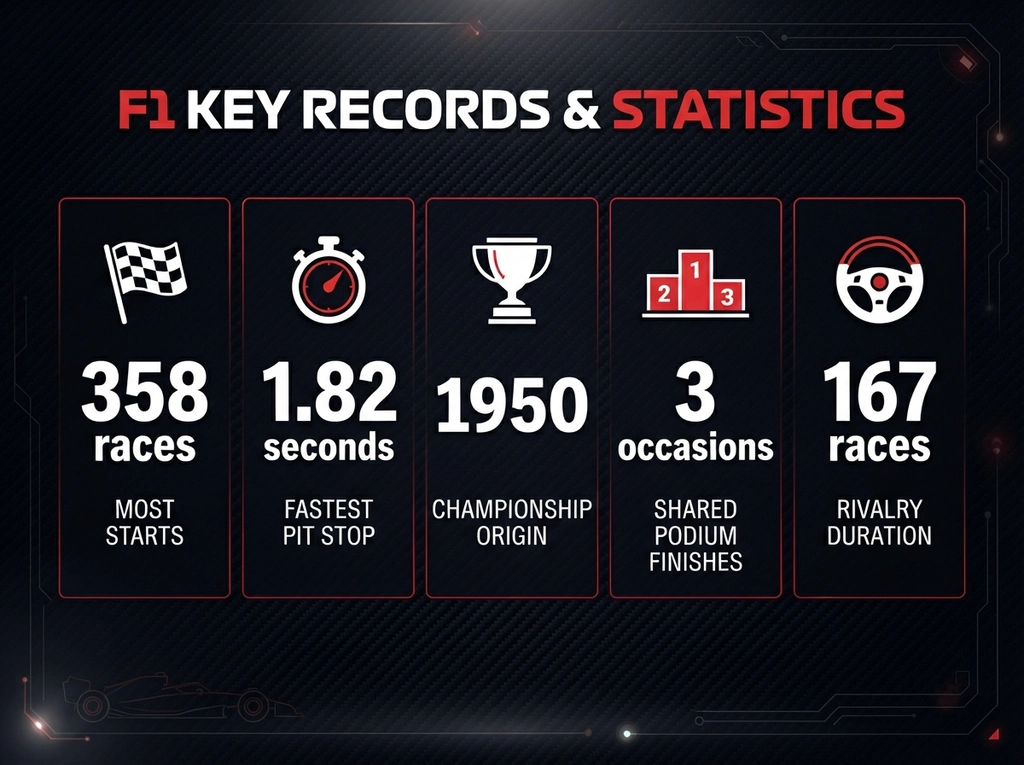
- → 1.82 seconds Red Bull Racing set the record for fastest pit stop, changing all four tires on Max Verstappen’s RB15 in 1.82 seconds at the 2019 Brazilian GP. [Red Bull]
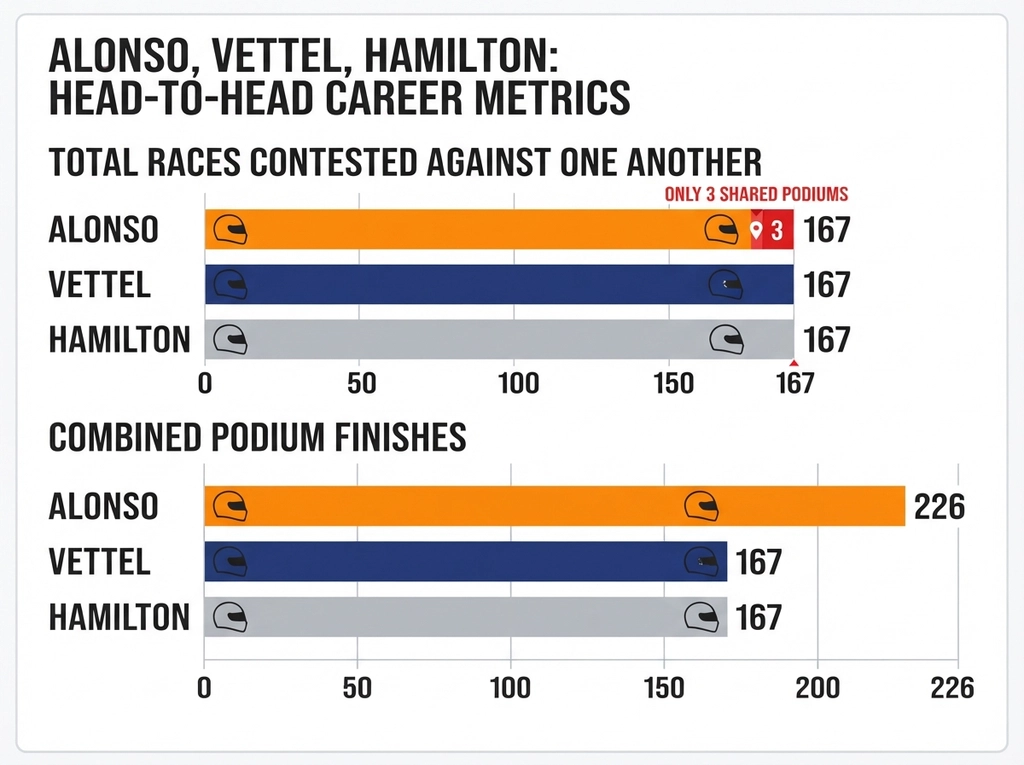
- → 167 races Fernando Alonso, Sebastian Vettel, and Lewis Hamilton raced against one another in 167 Grands Prix, combining for 226 podium finishes, yet stood on the same podium together only three times. [Formula1.com]
- → 3 occasions Alonso, Vettel, and Hamilton shared a podium together only three times: the 2012 United States GP, and the 2013 Canadian and Belgian GPs. [Formula1.com]
- → 1997 European GP The 1997 European Grand Prix produced the closest qualifying session recorded in F1 history, with three drivers effectively tied for pole position. [Red Bull / Formula1.com]
- → 9 laps German driver Hans Heyer, despite not officially qualifying, joined the 1978 German GP at Hockenheim as an unauthorized entrant and completed nine laps before retiring with a gearbox failure and later disqualification. [Formula1.com]
- → 4 drivers A social media post claims only four drivers in F1 history have started more than 100 races while maintaining a podium finish rate above 50 percent. [Facebook (The F1 Sector)]
- → 1950 The FIA’s World Championship of Drivers, the origin of the modern Formula One points and title system, began in 1950 following 1946 rule standardization. [Wikipedia]
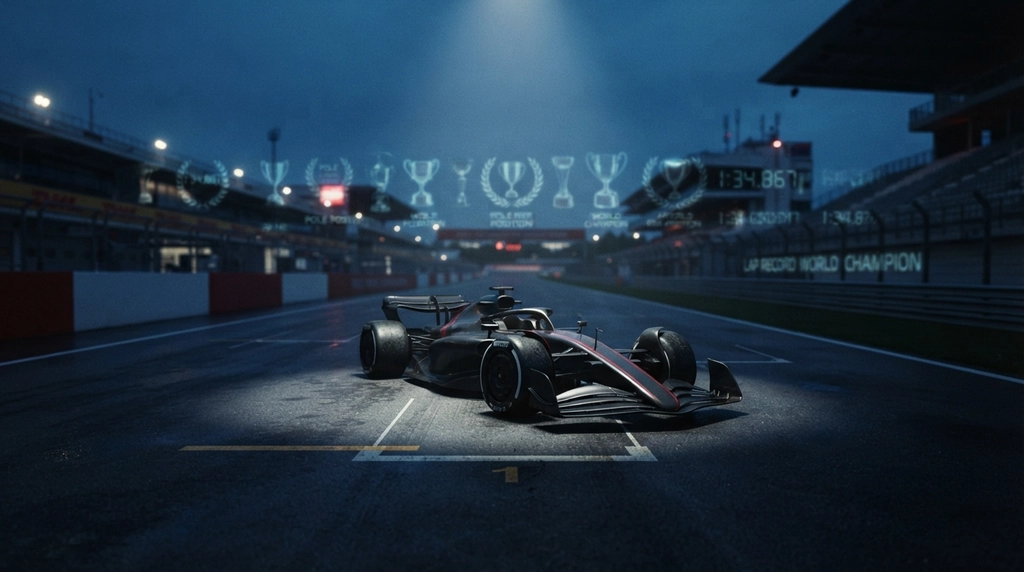
Fernando Alonso holds the record for the most Formula One starts in history, with 358 races contested as of the most recent count, according to Red Bull. That career total anchors a wider set of F1 driver records and milestones by season, spanning pit stop speed, podium streaks, and championship history dating back to 1950. This piece breaks down the numbers behind those records, section by section, with sourcing for each figure.
1Who Holds the Most F1 Race Starts and Other Career Records?
Fernando Alonso leads with 358 career starts. Valtteri Bottas holds the fastest speed record, Sebastian Vettel earned the quickest penalty, Max Verstappen is the youngest race winner, Louis Chiron the oldest driver, Michael Schumacher the fastest race winner, and Marco Apicella had the shortest career, per Red Bull’s 2023 records list.
| METRIC | VALUE | SOURCE |
|---|---|---|
| Most F1 race starts (career) | 358 races | Red Bull |
| Fastest speed record holder | Valtteri Bottas name | Red Bull |
| Quickest driver to earn a penalty | Sebastian Vettel name | Red Bull |
| Youngest race winner | Max Verstappen name | Red Bull |
| Oldest F1 driver | Louis Chiron name | Red Bull |
| Fastest race winner | Michael Schumacher name | Red Bull |
| Shortest F1 career | Marco Apicella name | Red Bull |
| Source: Red Bull | ||
These seven records, compiled by Red Bull, cover very different kinds of achievement, from Alonso’s endurance-based tally to Apicella’s single-race career. Verstappen’s early win and Chiron’s late-career longevity sit at opposite career-length extremes, while Vettel’s fast penalty remains one of the odder trivia entries in F1 history. Readers tracking these numbers across seasons can compare them against the season-by-season breakdowns in our driver performance data over the years and the year-by-year tallies in our historical standings archive.
2What Is the Fastest Pit Stop in Formula One History?
Red Bull Racing holds the fastest pit stop record at 1.82 seconds, changing all four tires on Max Verstappen’s RB15 during the 2019 Brazilian Grand Prix. The mark, verified by Red Bull, remains the standard pit crews across the grid try to beat each season.
| METRIC | VALUE | SOURCE |
|---|---|---|
| Fastest pit stop | 1.82 seconds | Red Bull |
| Source: Red Bull | ||
A 1.82-second stop leaves almost no room for error across four tire changes, jack lifts, and the release signal. Verstappen benefited directly from that crew’s precision at Interlagos in 2019, a detail worth comparing with the constructor-level breakdowns in our constructor standings coverage. Pit lane speed has become as closely tracked as lap time in modern team analysis, feeding into broader team performance reviews like our current standings comparison.
3How Rare Are Three-Way Podiums Between F1 Champions?
Alonso, Vettel, and Hamilton raced each other in 167 Grands Prix, combining for 226 podium finishes, yet shared a podium together only three times: the 2012 United States GP and the 2013 Canadian and Belgian GPs, per Formula1.com. Hans Heyer also completed 9 laps as an unauthorized 1978 German GP entrant.
| METRIC | VALUE | SOURCE |
|---|---|---|
| Smallest winning margin | 1971 Italian GP event | Red Bull |
| Combined podiums (Alonso, Vettel, Hamilton) | 226 podiums | Formula1.com |
| Head-to-head races (Alonso, Vettel, Hamilton) | 167 races | Formula1.com |
| Hans Heyer disqualification lap count | 9 laps | Formula1.com |
| Source: Red Bull | ||
The gap between 226 combined podiums and just three shared appearances shows how staggered these three careers were, even during years when all three raced regularly. Hamilton, Vettel, and Alonso rarely peaked in the same race weekend, which explains why triple-podium moments were so uncommon despite over a decade of overlap. Heyer’s nine laps at Hockenheim in 1978, followed by disqualification, remain one of the strangest entries in the sport’s record book, a contrast worth reading alongside our season-by-season driver comparisons.
4When Did the Modern F1 Championship Begin?
The FIA’s World Championship of Drivers, the basis of today’s points and title system, began in 1950 following rule standardization in 1946. The last non-championship Formula One race took place in 1983, marking the point when every Grand Prix on the calendar counted toward the title.
| METRIC | VALUE | SOURCE |
|---|---|---|
| Start of FIA World Championship of Drivers | 1950 year | Wikipedia |
| FIA Formula One rule standardization | 1946 year | Wikipedia |
| Last non-championship F1 race | 1983 year | Wikipedia |
| Source: Wikipedia | ||
The 1946 to 1950 window set the scoring structure still used every season today, giving later record-keepers a fixed starting line for comparing eras. That 1983 cutoff for non-championship races also matters, since it means every points total before that year has to be read with two different race categories in mind. Anyone comparing modern totals against early-era drivers should keep this structure in view, alongside broader motorsport history covered in our historic motorsport formats guide.
5Which F1 Records Are Trending on Social Media in 2026?
A 2025 social media post from The F1 Sector claims only four drivers in F1 history started more than 100 races while keeping a podium finish rate above 50 percent. Separately, F1-Fansite.com’s 2026 coverage tracked the largest championship points leads recorded after six races.
| METRIC | VALUE | SOURCE |
|---|---|---|
| Drivers with 100+ starts and 50%+ podium rate | 4 drivers | Facebook (The F1 Sector) |
| 2026 season milestone article | Largest F1 Championship Leads After Six Races headline | F1-Fansite.com |
| Source: Facebook (The F1 Sector) | ||
The four-driver claim about podium rate hasn’t been independently checked against Formula1.com’s official database, so it should be treated as a social media data point rather than a confirmed record. F1-Fansite.com’s six-race championship lead tracking for 2026 gives an early read on how this season’s title fight compares with past years, a topic our 2026 standings tracker and current driver comparison page follow race by race. Fans wanting deeper season detail can also check our year-by-year standings archive for how early leads have historically held up.
Complete Data Reference
Sortable table of all verified data points. Click any column header to sort.
| Metric | Value | Source | Year |
|---|---|---|---|
| Most F1 race starts (career) | 358 races | Red Bull | 2023 |
| Fastest pit stop | 1.82 seconds | Red Bull | 2019 |
| Fastest speed record holder | Valtteri Bottas name | Red Bull | 2023 |
| Quickest driver to earn a penalty | Sebastian Vettel name | Red Bull | 2023 |
| Youngest race winner | Max Verstappen name | Red Bull | 2023 |
| Oldest F1 driver | Louis Chiron name | Red Bull | 2023 |
| Fastest race winner | Michael Schumacher name | Red Bull | 2023 |
| Smallest winning margin | 1971 Italian GP event | Red Bull | 1971 |
| Shortest F1 career | Marco Apicella name | Red Bull | 2023 |
| Combined podiums (Alonso, Vettel, Hamilton) | 226 podiums | Formula1.com | 2024 |
| Head-to-head races (Alonso, Vettel, Hamilton) | 167 races | Formula1.com | 2024 |
| Hans Heyer disqualification lap count | 9 laps | Formula1.com | 1978 |
| Start of FIA World Championship of Drivers | 1950 year | Wikipedia | 2004 |
| FIA Formula One rule standardization | 1946 year | Wikipedia | 2004 |
| Last non-championship F1 race | 1983 year | Wikipedia | 2004 |
| Drivers with 100+ starts and 50%+ podium rate | 4 drivers | Facebook (The F1 Sector) | 2025 |
| 2026 season milestone article | Largest F1 Championship Leads After Six Races headline | F1-Fansite.com | 2026 |
Methodology
Several figures drawn from Red Bull’s records list lack precise numeric detail for individual driver achievements (e.g., top speed, penalty timing), and one social media claim regarding podium-rate consistency remains unverified and could not be cross-checked against an official statistical body. Because Alonso’s start count and other active-driver totals change race by race, figures reflect the most recent published snapshot rather than a live count.
- Sources consulted: 10
- Sources cited: 4
- Data range: 1971–2025
- Freshness: 0 current-year, 1 last-year, 9 older
- Update schedule: Quarterly
Frequently Asked Questions
Who holds the record for most Formula One race starts?
Fernando Alonso holds the all-time record for Grand Prix starts, having contested 358 races over his long career. The figure, published by Red Bull, reflects his tally at the time of reporting and continues to grow given his active status on the grid heading into recent seasons. [Red Bull]
What is the fastest pit stop recorded in Formula One?
The quickest pit stop on record belongs to Red Bull Racing, whose crew changed all four tires on Max Verstappen’s RB15 in just 1.82 seconds during the 2019 Brazilian Grand Prix. This mark remains a benchmark for pit crew performance across the grid. [Red Bull]
How often did Alonso, Vettel, and Hamilton share a podium together?
Despite racing against each other in 167 Grands Prix and combining for 226 podium finishes, Fernando Alonso, Sebastian Vettel, and Lewis Hamilton stood together on the same podium only three times: the 2012 United States GP and the 2013 Canadian and Belgian GPs. [Formula1.com]
Which qualifying session produced the closest result in F1 history?
The 1997 European Grand Prix is regarded as producing the tightest qualifying session ever recorded, with three drivers separated by such a small margin that they were effectively tied for pole position. It remains a frequently cited example of F1’s razor-thin competitive edges. [Red Bull / Formula1.com]
Who had the shortest career in Formula One history?
Marco Apicella is cited as holding the record for the shortest F1 career, a distinction noted among the sport’s more unusual records. His brief tenure stands as a contrast to durability records like Alonso’s 358-race career total. [Red Bull]
When did the modern Formula One World Championship begin?
The FIA’s World Championship of Drivers, which established the points and title structure still used today, began in 1950 after rule standardization efforts in 1946. This starting point is the reference used when comparing career and season records across generations of drivers. [Wikipedia]
What was the smallest winning margin in an F1 race?
The 1971 Italian Grand Prix is cited as producing the narrowest margin of victory in Formula One history, a race remembered for a photo-finish so tight that the winner was determined by mere hundredths of a second, according to Red Bull’s records list. [Red Bull]
Sources & References
- Red Bull. “Fastest F1 Records.” https://www.redbull.com/us-en/fastest-f1-records. Accessed 2026-08-06.
- Formula1.com. “Strange But True: F1’s Weirdest and Most Amazing Records.” https://www.formula1.com/en/latest/article/strange-but-true-f1-s-weirdest-and-most-amazing-records.4JllUJCgDLeVzRgSeluNpV. Accessed 2026-08-06.
- Wikipedia. “History of Formula One.” https://en.wikipedia.org/wiki/History_of_Formula_One. Accessed 2026-08-06.
- Facebook (The F1 Sector). “F1 Sector Post on Driver Podium Rates.” https://www.facebook.com/groups/FullRaces/posts/1707028909935013/. Accessed 2026-08-06.
Last updated: August 6, 2026