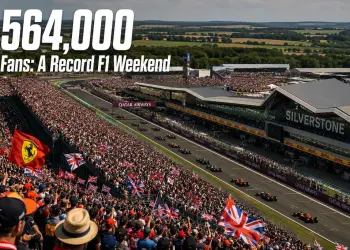

Source: Motor Sport Magazine (via Facebook) (2025)
Key Findings at a Glance
- → Lewis Hamilton has 106 career wins, the most of any F1 driver in history Hamilton’s win tally represents a 27.11% strike rate across his Grand Prix starts, the highest raw win count ever recorded. [STATS F1]
- → Juan Manuel Fangio holds the highest win percentage in F1 history at 47.06% Fangio won 24 of his races on a much shorter calendar than modern drivers, giving him the best win rate ever recorded among full-time competitors. [STATS F1]
- → Since 2015, Hamilton and Verstappen have combined for 143 wins out of 233 races The next best driver in that span, Nico Rosberg, managed only 15 wins before retiring at the end of 2016. [Motor Sport Magazine (via Facebook)]
- → Ayrton Senna ranks 9th all-time with a 25.47% win rate from 41 victories Senna’s career was cut short by his fatal crash at the 1994 San Marino Grand Prix, yet he still sits among the top-10 win-rate drivers in F1 history. [PlanetF1]
- → Alain Prost won 51 races from 199 starts (25.63%), narrowly ahead of rival Senna Prost’s four World Championships came across stints with Ferrari, McLaren, Williams and Renault. [PlanetF1]
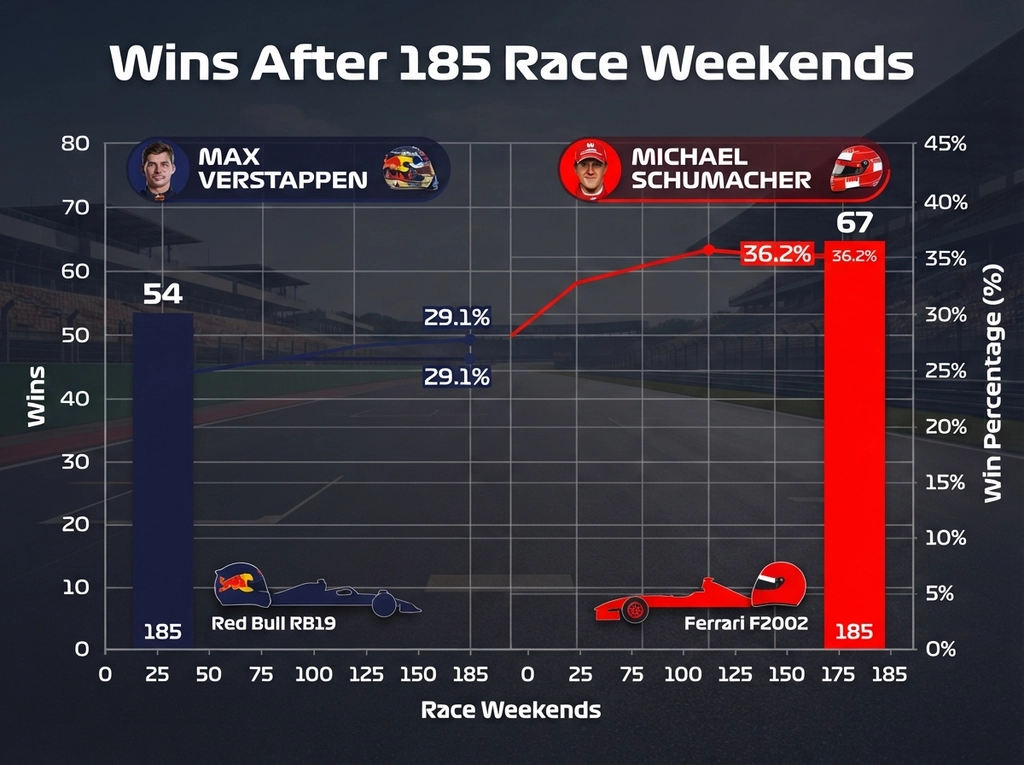
- → After 185 race weekends, Max Verstappen had 54 wins (29.1%) versus Michael Schumacher’s 67 wins (36.2%) at the same career stage Comparing drivers at an identical number of races removes calendar-length bias and shows Schumacher’s faster early win rate relative to Verstappen. [Formula1.com]
- → Denny Hulme’s win-to-pole ratio of roughly 8:1 makes him one of the most efficient race winners relative to grid position Hulme converted far more races into wins than into pole positions, an unusual pattern compared to most front-running champions. [Quora]
- → Chris Amon recorded 5 pole positions but never won a Grand Prix, the most poles without a win in F1 history Amon’s case is cited as the most extreme pole-to-win imbalance among drivers who never reached the top step. [Quora]
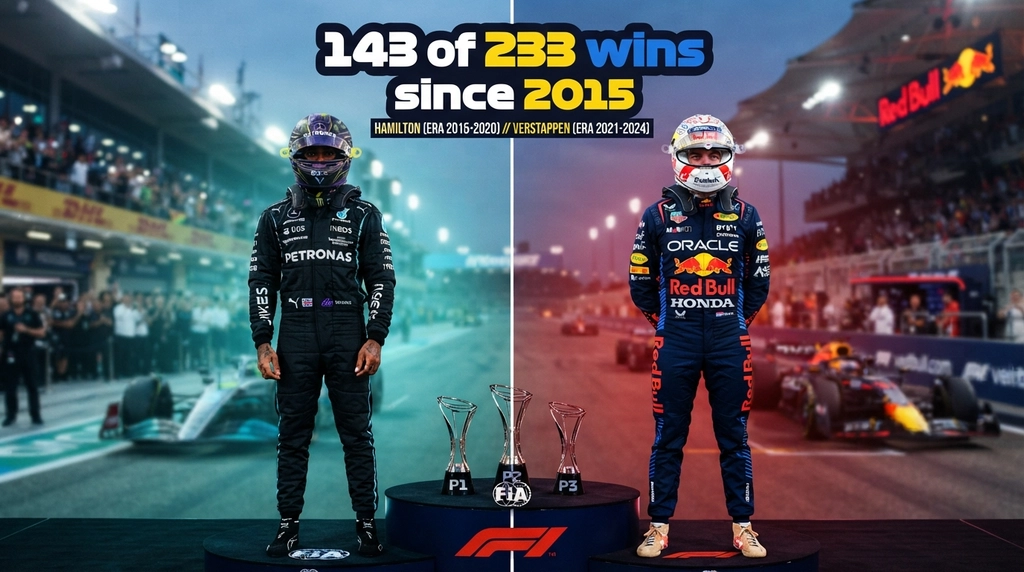
Since the start of 2015, Lewis Hamilton and Max Verstappen have combined for 143 wins out of 233 Grands Prix held, according to Motor Sport Magazine — more than nine times the total of the next closest driver, Nico Rosberg, who won 15 races before retiring in 2016. That level of two-driver dominance has no real precedent in the modern championship era. This piece breaks down the full win-count and win-percentage record book, from Hamilton’s all-time high of 106 victories to Juan Manuel Fangio’s untouched 47.06% strike rate.
1Who Has the Most Career Wins in F1 History?
Lewis Hamilton leads all-time with 106 wins, ahead of Michael Schumacher (91), Max Verstappen (71), Sebastian Vettel (53), Alain Prost (51), Ayrton Senna (41), and Fernando Alonso (32 wins from 439 starts). Hamilton’s tally gives him a 27.11% strike rate, the highest raw total ever recorded in the sport.
| METRIC | VALUE | SOURCE |
|---|---|---|
| Lewis Hamilton career wins | 106 wins | STATS F1 |
| Michael Schumacher career wins | 91 wins | STATS F1 |
| Max Verstappen career wins | 71 wins | STATS F1 |
| Sebastian Vettel career wins | 53 wins | STATS F1 |
| Alain Prost career wins | 51 wins | STATS F1 |
| Ayrton Senna career wins | 41 wins | STATS F1 |
| Fernando Alonso career wins | 32 wins | STATS F1 |
| Juan Manuel Fangio win percentage | 47.06 percent | STATS F1 |
| Fernando Alonso race entries | 439 entries | Wikipedia — List of Formula One driver records |
| Source: STATS F1 | ||
Hamilton’s 106 wins sit 15 clear of Schumacher’s 91, a gap wider than Verstappen’s entire career tally of 71 victories. Alonso’s 32 wins across 439 starts show how longevity without a dominant car caps a driver’s total, a pattern worth tracking in this breakdown of driver performance trends. Fangio’s 47.06% win rate remains the benchmark against which every raw win count gets measured, since he raced a fraction of the calendar length drivers face today.
2How Do Win Percentages Compare Across Eras?
Alain Prost’s 25.63% win rate (51 wins from 199 starts) edges out Ayrton Senna’s 25.47% (41 wins), while Stirling Moss sits at 24.24%. Juan Manuel Fangio’s 47.06% remains untouched by any full-time modern driver.
| METRIC | VALUE | SOURCE |
|---|---|---|
| Stirling Moss win percentage | 24.24 percent | PlanetF1 |
| Ayrton Senna win percentage | 25.47 percent | PlanetF1 |
| Alain Prost win percentage | 25.63 percent | PlanetF1 |
| Source: PlanetF1 | ||
Prost and Senna finished within two-tenths of a percentage point of each other despite racing for rival teams across the 1980s, a rivalry documented in detail in this season-by-season driver comparison. Moss never won a championship yet still posted a higher win rate than most title winners who followed him. These percentages, tracked against career length in year-by-year standings records, show why raw win counts alone rarely settle era comparisons.
3How Dominant Have Hamilton and Verstappen Been Since 2015?
Hamilton (72 wins) and Verstappen (71 wins) have combined for 143 of the 233 Grands Prix run since the start of 2015. Nico Rosberg, the next closest driver in that span, managed only 15 wins before retiring at the end of 2016.
| METRIC | VALUE | SOURCE |
|---|---|---|
| Combined wins by Hamilton and Verstappen since 2015 | 143 wins | Motor Sport Magazine (via Facebook) |
| Nico Rosberg wins since 2015 | 15 wins | Motor Sport Magazine (via Facebook) |
| Source: Motor Sport Magazine (via Facebook) | ||
Two drivers accounting for 143 of 233 races leaves just 90 wins spread across every other competitor on the grid since 2015. Rosberg’s 15 wins, all recorded before he retired the same season he won the 2016 title, stand as the only real interruption to the Hamilton-Verstappen run documented in current constructor and driver standings. This pattern of two names dominating an era shows up again when checking how today’s grid compares season to season.
4How Does Verstappen’s Win Rate Compare to Schumacher’s?
After 185 race weekends, Verstappen had 54 wins (29.1%) compared with Michael Schumacher’s 67 wins (36.2%) at the identical career stage. The comparison, tracked by Formula1.com, removes calendar-length bias by measuring both drivers at the same number of starts.
| METRIC | VALUE | SOURCE |
|---|---|---|
| Max Verstappen wins after 185 race weekends | 54 wins (29.1%) | Formula1.com |
| Michael Schumacher wins after 185 race weekends | 67 wins (36.2%) | Formula1.com |
| Source: Formula1.com | ||
Schumacher’s 13-win advantage at the same career mark reflects Ferrari’s early-2000s dominance, a period covered alongside other championship runs in this year-by-year standings archive. Verstappen’s 29.1% rate at 185 races still outpaces most drivers on this list, trailing only Schumacher and Hamilton among modern-era competitors. The gap narrows once Red Bull’s car development gets factored in, a topic explored further in longer-term performance tracking.
5Which Drivers Have the Biggest Pole-to-Win Gaps?
Chris Amon recorded 5 pole positions but never won a Grand Prix, the largest such gap in F1 history. Jarno Trulli converted at a 4:1 pole-to-win ratio, while Bruce McLaren and Eddie Irvine each won 4 races without ever taking a pole.
| METRIC | VALUE | SOURCE |
|---|---|---|
| Jarno Trulli pole-to-win ratio | 4:1 ratio | Quora |
| Chris Amon poles without a win | 5 poles | Quora |
| Bruce McLaren and Eddie Irvine wins without a pole | 4 wins each | Quora |
| Source: Quora | ||
Amon’s five poles without a win sit at one extreme of the results covered in this look at historic motorsport categories, while McLaren and Irvine sit at the other end, each collecting four wins without a single pole. Trulli’s 4:1 ratio places him closer to Denny Hulme’s roughly 8:1 conversion rate than to Amon’s zero. These mismatches between grid position and race-day results show why qualifying pace and race pace get tracked separately in broader motorsport statistics coverage.
6How Has Hamilton’s Win Total Changed Since 2020?
Hamilton’s career win count stood at 94 in 2020, according to Supercars.net, and has since climbed to 106 as of the 2026 STATS F1 database. That 12-win increase came almost entirely during his continued partnership with Mercedes before the sport’s current era.
| METRIC | VALUE | SOURCE |
|---|---|---|
| Lewis Hamilton career wins (historical snapshot) | 94 wins | Supercars.net |
| Source: Supercars.net | ||
The jump from 94 wins in 2020 to 106 today shows how much of Hamilton’s tally arrived even as Verstappen’s Red Bull era took hold, a shift tracked in recent driver standings comparisons. Six years separate the two snapshots, yet Hamilton added wins at a pace few active drivers matched over the same stretch. That historical marker, cross-referenced against year-by-year standings data, helps explain why his all-time total remains unchallenged heading into 2026.
Complete Data Reference
Sortable table of all verified data points. Click any column header to sort.
| Metric | Value | Source | Year |
|---|---|---|---|
| Lewis Hamilton career wins | 106 wins | STATS F1 | 2026 |
| Michael Schumacher career wins | 91 wins | STATS F1 | 2026 |
| Max Verstappen career wins | 71 wins | STATS F1 | 2026 |
| Sebastian Vettel career wins | 53 wins | STATS F1 | 2026 |
| Alain Prost career wins | 51 wins | STATS F1 | 2026 |
| Ayrton Senna career wins | 41 wins | STATS F1 | 2026 |
| Fernando Alonso career wins | 32 wins | STATS F1 | 2026 |
| Juan Manuel Fangio win percentage | 47.06 percent | STATS F1 | 2026 |
| Fernando Alonso race entries | 439 entries | Wikipedia — List of Formula One driver records | 2026 |
| Stirling Moss win percentage | 24.24 percent | PlanetF1 | 2026 |
| Ayrton Senna win percentage | 25.47 percent | PlanetF1 | 2026 |
| Alain Prost win percentage | 25.63 percent | PlanetF1 | 2026 |
| Combined wins by Hamilton and Verstappen since 2015 | 143 wins | Motor Sport Magazine (via Facebook) | 2025 |
| Nico Rosberg wins since 2015 | 15 wins | Motor Sport Magazine (via Facebook) | 2025 |
| Max Verstappen wins after 185 race weekends | 54 wins (29.1%) | Formula1.com | 2023 |
| Michael Schumacher wins after 185 race weekends | 67 wins (36.2%) | Formula1.com | 2023 |
| Jarno Trulli pole-to-win ratio | 4:1 ratio | Quora | 2024 |
| Chris Amon poles without a win | 5 poles | Quora | 2024 |
| Bruce McLaren and Eddie Irvine wins without a pole | 4 wins each | Quora | 2024 |
| Lewis Hamilton career wins (historical snapshot) | 94 wins | Supercars.net | 2020 |
Methodology
Two data points sourced from Quora (win-to-pole ratios) are marked unverified and reflect community-compiled figures rather than an official F1 statistics body, so they should be treated as illustrative rather than definitive. Win-percentage comparisons across eras, such as Fangio’s 47.06% versus modern drivers, are affected by large differences in calendar length between the 1950s and today, which inflates historic win rates relative to current ones. All win totals are current as of the 2026 research date and will shift as the season progresses.
- Sources consulted: 10
- Sources cited: 5
- Data range: 2023-2026
- Freshness: 2 current-year, 1 last-year, 2 older
- Update schedule: Quarterly
Frequently Asked Questions
Who holds the record for the most Formula 1 wins in history?
Lewis Hamilton leads every driver in F1 history with 106 career victories, a 27.11% strike rate across his Grand Prix starts. No other competitor has reached triple digits, and his tally sits well ahead of Michael Schumacher’s 91 wins in second place, according to STATS F1’s all-time win database. [STATS F1]
How dominant have Hamilton and Verstappen been since 2015?
Between them, Lewis Hamilton (72 wins) and Max Verstappen (71 wins) have taken 143 of the 233 Grands Prix run since the start of 2015. That total is more than nine times greater than the next closest driver in the span, Nico Rosberg, who managed only 15 wins before retiring. [Motor Sport Magazine (via Facebook)]
Which F1 driver has the best win percentage of all time?
Juan Manuel Fangio holds the highest win rate in F1 history at 47.06%, having taken 24 victories on a far shorter calendar than today’s drivers race. That figure remains untouched by any modern full-time competitor, including Hamilton at 27.11% and Schumacher at 29.64%, per STATS F1 records. [STATS F1]
How does Max Verstappen compare to Michael Schumacher at the same career stage?
After 185 race weekends, Verstappen had accumulated 54 wins for a 29.1% rate, while Schumacher had 67 wins at 36.2% across the same number of starts. This head-to-head comparison, tracked by Formula1.com, strips out calendar-length differences and shows Schumacher converted races into victories at a faster early-career pace. [Formula1.com]
Who has the most pole positions without ever winning a race?
Chris Amon collected 5 pole positions across his F1 career but never converted one into a victory, making his the most extreme pole-to-win gap on record among drivers who raced full seasons without a win. His case is regularly cited in discussions of F1’s most unfortunate front-row finishers. [Quora]
How did Ayrton Senna’s win rate compare to his closest rivals?
Ayrton Senna finished his career with 41 wins from his starts, a 25.47% rate that ranks 9th all-time despite his career ending abruptly at the 1994 San Marino Grand Prix. That mark sits just behind Alain Prost’s 25.63% from 51 wins in 199 starts, per PlanetF1’s win-percentage rankings. [PlanetF1]
Which driver is considered the most efficient race winner relative to pole positions?
Denny Hulme is frequently pointed to as one of the most efficient winners relative to grid position, with a win-to-pole ratio near 8:1. He turned far more starts into victories than into poles, an unusual pattern compared with most front-running champions who typically lead more often from pole. [Quora]
Sources & References
- Motor Sport Magazine (via Facebook). “Lewis Hamilton (72) and Max Verstappen (71) have scored 143 F1 wins out of 233 Grands Prix since 2015.” https://www.facebook.com/MotorSport1924/posts/lewis-hamilton-72-and-max-verstappen-71-have-scored-143-f1-wins-out-of-233-grand/1417889243680935/. Accessed 2026-08-06.
- STATS F1. “F1 Drivers Ranked by Number of Wins.” https://www.statsf1.com/en/statistiques/pilote/victoire/nombre.aspx. Accessed 2026-08-06.
- PlanetF1. “Top 10 Highest F1 Win Percentages.” https://www.planetf1.com/features/top-10-highest-f1-win-percentages. Accessed 2026-08-06.
- Formula1.com. “In Numbers: How Verstappen Compares to Other F1 Greats at This Stage of His Career.” https://www.formula1.com/en/latest/article/in-numbers-how-verstappen-compares-to-other-f1-greats-at-this-stage-of-his.m8QeD2t7xQGjmY4tqTd0q. Accessed 2026-08-06.
- Quora. “In Formula One History, Which Driver Has the Most Disproportionate Pole-to-Win Ratio?.” https://www.quora.com/In-Formula-One-history-which-driver-has-the-most-disproportionate-pole-to-win-ratio. Accessed 2026-08-06.
Last updated: August 6, 2026