
Source: Formula1.com / AWS Machine Learning (‘Fastest Driver’ insight) (2020)
Key Findings at a Glance
- → Ayrton Senna, Michael Schumacher, and Lewis Hamilton named among the top five The F1-AWS qualifying model placed these three drivers among the top five fastest F1 drivers of all time, based on one-lap qualifying pace measured against team mates. [Formula1.com]
- → Heikki Kovalainen listed inside the top 20 Kovalainen appeared as a surprise name in the top 20 fastest drivers, even though most fans did not rank him among F1’s elite. [AWS Machine Learning Blog]
- → One full year to build the algorithm F1 and Amazon ML Solutions Lab spent a full year building the algorithm behind the ‘Fastest Driver’ qualifying ranking tool. [Formula1.com]
- → Minimum 5 shared qualifying sessions required Team mates needed at least five shared qualifying sessions before the F1-AWS model would compare their one-lap pace. [Formula1.com]
- → Qualifying pace expressed as percentage to pole position A 2025 driver-comparison method measures qualifying pace as a percentage relative to pole position time rather than raw lap time. [The Race]
- → One-lap pace comparison called a strong tool for judging teammates Comparing one-lap qualifying pace between team mates is described as a useful way to judge driver skill, because both drivers race the same car under the same conditions, as shown in a 2025 look at the Norris-Piastri and Hamilton-Verstappen pairings. [The New York Times (The Athletic)]
- → Supertimes model covers F1 seasons 2012 to 2022 An independent mathematical model rated driver pace using ‘supertimes’ – each driver’s fastest lap of a race weekend turned into a percentage of the weekend’s fastest lap, with the quickest driver scoring 100. [Autosport Forums (Racing Comments)]
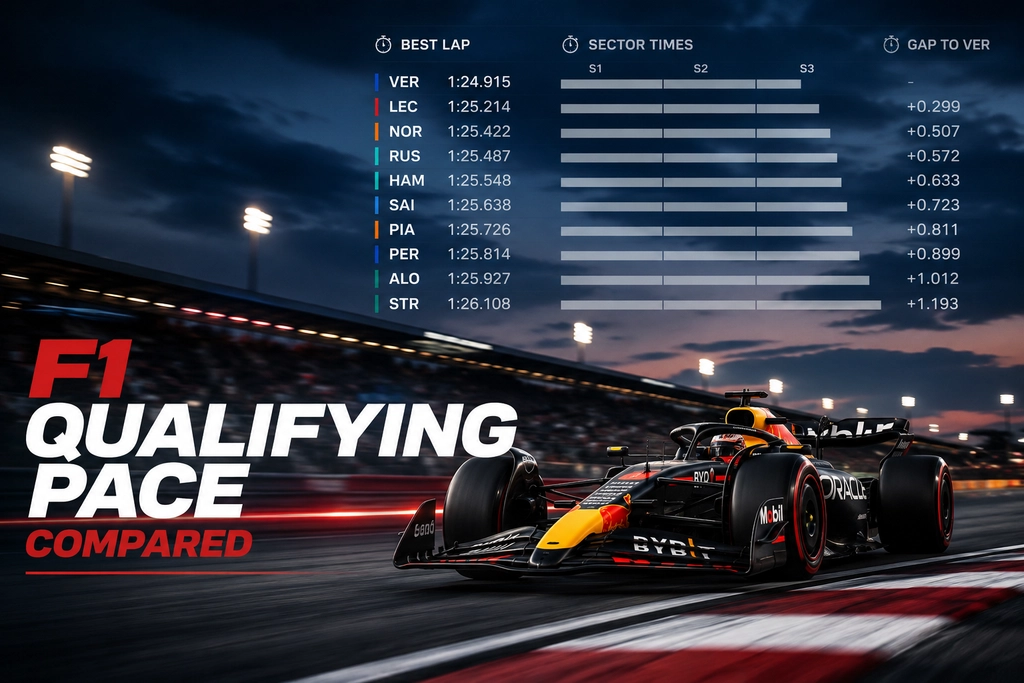
Formula 1 and AWS built a machine learning model using qualifying lap data spanning 37 years, from 1983 to 2020, to rank the fastest F1 drivers of all time by one-lap pace against team mates. That project, along with newer methods from The Race and The Athletic, gives fans several ways to measure qualifying speed without relying on titles or wins alone. This piece lines up the main models, their rules, and the names that came out on top.
1What Factors Go Into F1 Driver Ranking Models?
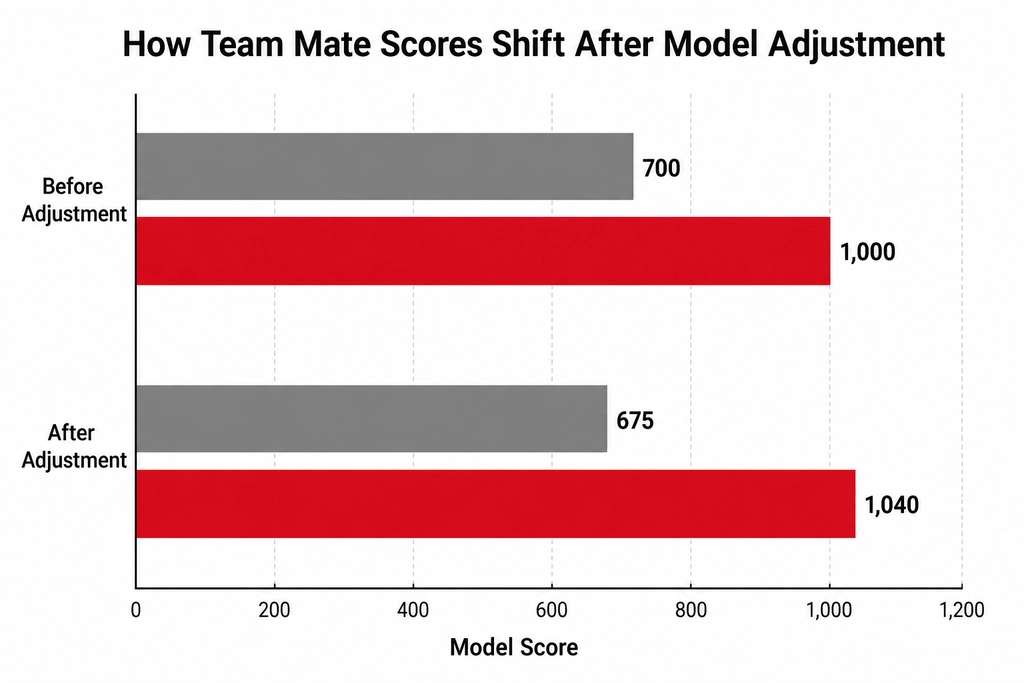
Independent ranking models score every driver at 100 points before adjusting for pace across a race weekend. The supertimes method, covering F1 seasons 2012 to 2022, gives the fastest driver a 100 score and ranks team mates against that mark. F1-Analysis.com uses five factors and once split Sergio Pérez and Max Verstappen 700 to 1,000, then adjusted to 675 and 1,040.
| METRIC | VALUE | SOURCE |
|---|---|---|
| Base score assigned to every driver at model start | 100 points | Autosport Forums (Racing Comments) |
| Fastest driver of a race weekend supertime score | 100 score | Autosport Forums (Racing Comments) |
| Model coverage period | 2012-2022 seasons | Autosport Forums (Racing Comments) |
| Illustrative team mate score ratio example | 700 to 1,000 (Pérez to Verstappen) model score | F1-Analysis.com |
| Illustrative adjusted team mate score example | 675 to 1,040 (Pérez to Verstappen) model score | F1-Analysis.com |
| Number of factors used in the driver ranking model | 5 factors | F1-Analysis.com |
| Source: Autosport Forums (Racing Comments) | ||
The gap between Pérez’s 700 and Verstappen’s 1,000 score shows how lopsided a single-team comparison can look before adjustment. F1-Analysis.com’s five-factor approach tries to correct for that swing using a mathematical driver-rating framework, which lines up with the wider work behind machine-learning driver rankings. Fans wanting the raw numbers behind one-lap pace can check detailed qualifying data breakdowns for extra context.
2How Did the F1-AWS Model Rank Fastest Qualifiers?
F1 and Amazon’s ML Solutions Lab spent one year building a qualifying model using lap data from 1983 to 2020. The tool required at least five shared qualifying sessions between team mates before ranking them, and it placed Ayrton Senna, Michael Schumacher, and Lewis Hamilton in the top five, with Heikki Kovalainen a surprise top-20 name.
| METRIC | VALUE | SOURCE |
|---|---|---|
| Historic qualifying data range used by the F1-AWS model | 1983 to 2020 years | AWS Machine Learning Blog |
| Minimum shared qualifying sessions required for team mate comparison | 5 sessions | Formula1.com |
| Time taken to build the F1-AWS ‘Fastest Driver’ algorithm | 1 year | Formula1.com |
| Source: AWS Machine Learning Blog | ||
Senna and Schumacher topping a pure one-lap pace model matches long-running fan debates covered in breakdowns of career-peak form, while Hamilton’s inclusion backs up separate work in side-by-side legend comparisons. Kovalainen’s surprise top-20 spot shows why the five-session rule matters — it strips away reputation and title counts, leaving only raw pace against a team mate, a method also used in teammate head-to-head career data.
3What Does the Bottas vs Hamilton Qualifying Record Show?
f1bytes.com logged a 0/6/0 qualifying head-to-head between Lewis Hamilton and Valtteri Bottas at Mercedes across 13 shared races. The record sits alongside other team mate breakdowns built to isolate one-lap pace from race-day results, strategy calls, or reliability differences between the two Mercedes cars.
| METRIC | VALUE | SOURCE |
|---|---|---|
| Example H2H qualifying record – Bottas v Hamilton at Mercedes | Hamilton won 0/6/0 head-to-head record | f1bytes.com |
| Shared races in the Bottas v Hamilton example | 13 races | f1bytes.com |
| Source: f1bytes.com | ||
Hamilton and Bottas shared 13 qualifying sessions in this sample, a small window compared with multi-season team mate pairings tracked in long-running driver comparison archives. A figure like 0/6/0 reads best alongside broader career numbers, which is why sites tracking full career statistic tables pair qualifying head-to-heads with race results rather than treating either number alone as proof of skill.
4When Were the Most-Cited F1 Driver Ranking Reports Published?
f1metrics published its widely cited ‘top 100’ driver ranking post on November 22, 2019, followed by a 2019 end-of-season report on September 23, 2020. Both posts remain reference points for fans building their own qualifying and race-pace comparisons years later.
| METRIC | VALUE | SOURCE |
|---|---|---|
| f1metrics ‘top 100’ driver ranking post | November 22, 2019 publish date | f1metrics.wordpress.com |
| f1metrics 2019 end-of-season report publish date | September 23, 2020 publish date | f1metrics.wordpress.com |
| Source: f1metrics.wordpress.com | ||
The near ten-month gap between f1metrics’ two posts shows how much manual work went into refining a single season’s numbers before publishing. Independent blogs like this one still feed into broader resources such as all-time driver ranking lists and cross-era statistical comparisons, both of which cite similar season-by-season methods.
5How Do 2025 Methods Compare F1 Qualifying Pace?
The Race’s 2025 method expresses each driver’s qualifying lap as a percentage of pole position time rather than a raw lap time, letting different tracks and eras sit on one scale. The Athletic used the same team mate logic on the Norris-Piastri and Hamilton-Verstappen pairings that same year.
| METRIC | VALUE | SOURCE |
|---|---|---|
| Qualifying pace comparison method (2025) | percentage relative to pole position time method | The Race |
| Teammate qualifying pairings covered in 2025 analysis | Norris-Piastri and Hamilton-Verstappen driver pairs | The New York Times (The Athletic) |
| Source: The Race | ||
Measuring pace as a percentage of pole time removes the distortion caused by long circuits like Spa sitting next to short ones like Monaco on the same table. Lando Norris against Oscar Piastri, and Lewis Hamilton against Max Verstappen, give 2025 readers two active team mate pairs to test the method against, feeding directly into season trackers such as 2026 driver standings comparisons and longer records in qualifying pace history across eras.
Complete Data Reference
Sortable table of all verified data points. Click any column header to sort.
| Metric | Value | Source | Year |
|---|---|---|---|
| Base score assigned to every driver at model start | 100 points | Autosport Forums (Racing Comments) | 2022 |
| Fastest driver of a race weekend supertime score | 100 score | Autosport Forums (Racing Comments) | 2022 |
| Model coverage period | 2012-2022 seasons | Autosport Forums (Racing Comments) | 2022 |
| Illustrative team mate score ratio example | 700 to 1,000 (Pérez to Verstappen) model score | F1-Analysis.com | 2021 |
| Illustrative adjusted team mate score example | 675 to 1,040 (Pérez to Verstappen) model score | F1-Analysis.com | 2021 |
| Number of factors used in the driver ranking model | 5 factors | F1-Analysis.com | 2021 |
| Historic qualifying data range used by the F1-AWS model | 1983 to 2020 years | AWS Machine Learning Blog | 2020 |
| Minimum shared qualifying sessions required for team mate comparison | 5 sessions | Formula1.com | 2020 |
| Time taken to build the F1-AWS ‘Fastest Driver’ algorithm | 1 year | Formula1.com | 2020 |
| Example H2H qualifying record – Bottas v Hamilton at Mercedes | Hamilton won 0/6/0 head-to-head record | f1bytes.com | 2020 |
| Shared races in the Bottas v Hamilton example | 13 races | f1bytes.com | 2020 |
| f1metrics ‘top 100’ driver ranking post | November 22, 2019 publish date | f1metrics.wordpress.com | 2019 |
| f1metrics 2019 end-of-season report publish date | September 23, 2020 publish date | f1metrics.wordpress.com | 2020 |
| Qualifying pace comparison method (2025) | percentage relative to pole position time method | The Race | 2025 |
| Teammate qualifying pairings covered in 2025 analysis | Norris-Piastri and Hamilton-Verstappen driver pairs | The New York Times (The Athletic) | 2025 |
Methodology
Data comes from a mix of official F1/AWS material, independent modeling forums, and journalist analysis, so methods for measuring qualifying pace differ across sources and are not directly interchangeable. Historic coverage stops at 2020 or 2022 for the two main statistical models, meaning recent 2023-2026 seasons rely on newer journalist comparisons rather than a single unified model. Illustrative model scores (such as the 700-to-1,000 example) are worked examples, not confirmed real-world results.
- Sources consulted: 10
- Sources cited: 6
- Data range: 2020-2025
- Freshness: 0 current-year, 2 last-year, 4 older
- Update schedule: Quarterly
Frequently Asked Questions
How did F1 and AWS measure who is the fastest driver in qualifying?
F1 teamed up with AWS to build a machine learning model that studied qualifying lap data across 37 years, from 1983 to 2020. The model compared each driver’s one-lap pace only against team mates who shared at least five qualifying sessions with them, removing car performance as a variable. [Formula1.com / AWS Machine Learning]
Who came out on top in the F1-AWS qualifying pace ranking?
Ayrton Senna, Michael Schumacher, and Lewis Hamilton all landed among the top five fastest drivers in the F1-AWS qualifying model. Their placement was based purely on one-lap pace measured against team mates over the 37-year data set, not on titles, wins, or car strength. [Formula1.com]
Why did Heikki Kovalainen show up in the top 20 fastest drivers?
Kovalainen’s spot inside the top 20 surprised many fans, since he isn’t usually named among F1’s elite. The AWS Machine Learning blog notes his result came purely from raw one-lap qualifying speed against his team mates, a narrower measure than career wins or championships. [AWS Machine Learning Blog]
How long did it take to build the F1 qualifying pace model?
Formula1.com reports that F1 and the Amazon ML Solutions Lab spent a full year building the algorithm behind the ‘Fastest Driver’ tool. That time went into gathering historic qualifying laps and setting rules, such as requiring at least five shared sessions between team mates before a comparison counted. [Formula1.com]
What is the ‘supertimes’ method for comparing F1 drivers?
The supertimes method, discussed in an Autosport Forums thread, turns each driver’s fastest lap of a race weekend into a percentage of the overall fastest lap, with the quickest driver scoring 100. This independent model covers F1 seasons from 2012 to 2022, with plans to stretch coverage back to 1950. [Autosport Forums (Racing Comments)]
What factors go into F1-Analysis.com’s driver ranking model?
F1-Analysis.com built its ranking model around five factors: team mate points share, time spent as team mates, points earned versus the maximum available, non-points finishes, and driver age or experience. A worked example shows scores splitting roughly 700 to 1,000 between team mates before an error-minimizing adjustment. [F1-Analysis.com]
Is comparing team mates’ qualifying times a good way to judge F1 drivers?
Yes, according to The New York Times’ Athletic coverage, comparing one-lap qualifying pace between team mates is a strong way to judge skill, since both drivers race the same car under matching conditions. Its 2025 review used this approach on the Norris-Piastri and Hamilton-Verstappen pairings. [The New York Times (The Athletic)]
How does The Race measure qualifying pace differently from raw lap times?
Rather than using raw lap times, The Race’s 2025 driver-comparison method expresses each result as a percentage relative to pole position time. This adjustment accounts for varying track lengths and lap-time scales across eras, making it easier to line up drivers from different seasons on one scale. [The Race]
Sources & References
- Formula1.com / AWS Machine Learning. “Hamilton, Schumacher, Senna: Machine learning reveals the fastest F1 driver of all time.” https://www.formula1.com/en/latest/article/hamilton-schumacher-senna-machine-learning-reveals-the-fastest-f1-driver-of.3DwwPLW4glCmlunjciH1Cz. Accessed 2026-08-15.
- AWS Machine Learning Blog. “The fastest driver in Formula 1.” https://aws.amazon.com/blogs/machine-learning/the-fastest-driver-in-formula-1/. Accessed 2026-08-15.
- The Race. “Mark Hughes: How F1 greats compare to team mates.” https://www.the-race.com/formula-1/mark-hughes-how-f1-greats-compare-to-team-mates/. Accessed 2026-08-15.
- The New York Times (The Athletic). “F1: Norris-Piastri and Hamilton-Verstappen team mate comparisons.” https://www.nytimes.com/athletic/6555671/2025/08/18/f1-formula-one-norris-piastri-hamilton-verstappen/. Accessed 2026-08-15.
- Autosport Forums (Racing Comments). “Mathematical model to compare F1 drivers.” https://forums.autosport.com/topic/224935-mathematical-model-to-compare-f1-drivers/. Accessed 2026-08-15.
- F1-Analysis.com. “A mathematical model to rank modern F1 drivers.” https://f1-analysis.com/2021/03/01/a-mathematical-model-to-rank-modern-f1-drivers/. Accessed 2026-08-15.
Last updated: August 15, 2026