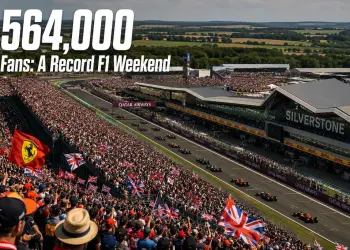

Source: Formula1.com (2025)
Key Findings at a Glance
- → Current points system awards 25-18-15-12-10-8-6-4-2-1 to the top 10 finishers This scoring format was introduced in 2010 and is the baseline F1 used to retroactively recalculate every season back to 1950. [Formula1.com]
- → Winner’s points grew from 8 to 9 to 10 before reaching 25 Race-win point values have shifted several times across F1’s history, a key reason raw win counts are hard to compare between eras. [Formula1.com]
- → Only the top 5 finishers scored points in F1’s early years The scoring field expanded to the top 6 in 1960 and to the top 8 finishers by 2003, before reaching today’s top 10 structure. [Formula1.com]
- → Lewis Hamilton holds 7 World Drivers’ Championships and the most overall race wins of any driver in F1 history Often cited as the benchmark raw statistic when comparing drivers across different competitive eras. [Goodwood Road & Racing (Facebook)]
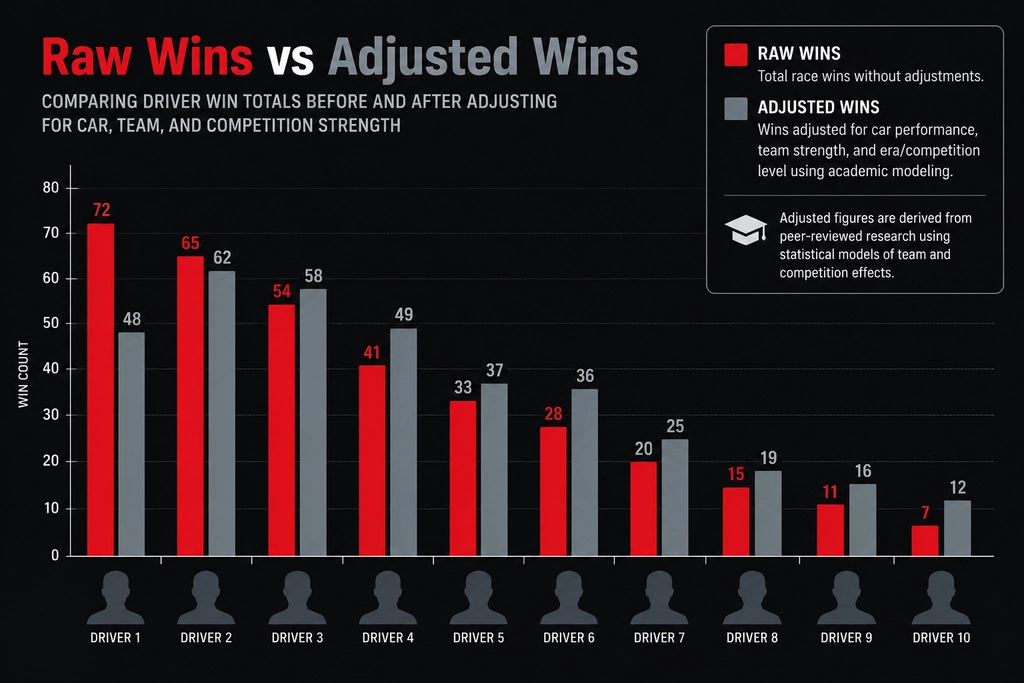
- → Academic study adjusts F1 driver performance for team and competition effects across 1950-2013 A peer-reviewed paper titled ‘Uncovering Formula One driver performances from 1950 to 2013 by adjusting for team and competition effects’ models 63 seasons of results to strip out car and team advantage. [ResearchGate]
- → A published study calculates an ‘adjusted’ win total for Turbo Era drivers based on car competitiveness each season The Open Sports Sciences Journal analysis recalculates raw win counts by weighting how strong each driver’s car was that year, rather than counting wins at face value. [Open Sports Sciences Journal]
- → A social media analysis reviewed 73 years of F1 championships to find how many wins are statistically needed to become champion The breakdown notes most fans guess 8-10 wins are enough, but the historical data across F1’s full 73-season run tells a different story. [Instagram (data breakdown reel)]
- → A Reddit comment on race-win comparisons notes raw win totals are ‘pretty meaningless’ given how much the number of races per season has changed This directly reflects the core reason fans and analysts push for competition-adjusted win statistics instead of raw counts. [Facebook (Racing Statistics video comments)]
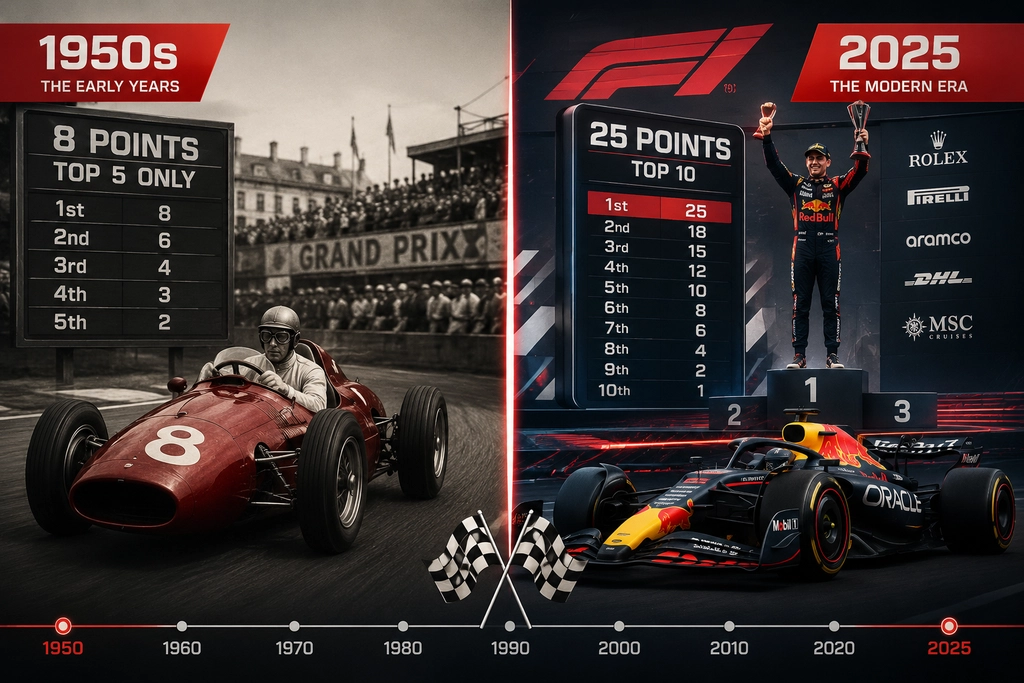
Formula 1’s data team recalculated all 75 years of championship history, dating back to 1950, using the modern 25-point scoring system to test how title counts would shift under today’s rules (Formula1.com, 2025). The exercise highlights why raw win totals, like Lewis Hamilton’s record haul of victories and 7 World Championships, don’t tell the full story once scoring formats and calendar lengths get factored into the math (Goodwood Road & Racing, 2024). This piece breaks down how the points system changed, what academic studies say about team-adjusted performance, and how many wins it actually takes to win a title.
1How Has F1’s Points System Changed Since 1950?
F1 paid points to only the top 5 finishers when the championship launched in 1950. That grew to the top 6 in 1960, the top 8 in 2003, and the current top 10 format in 2010, which awards 25-18-15-12-10-8-6-4-2-1 points. Sprint races give 8 points to the winner across the top 8 finishers.
| METRIC | VALUE | SOURCE |
|---|---|---|
| Points for 1st place (current system) | 25 points | Formula1.com |
| Points for 10th place (current system) | 1 point | Formula1.com |
| Sprint race points for 1st place | 8 points | Formula1.com |
| Year current 10-driver points system introduced | 2010 year | Formula1.com |
| Year fastest-lap bonus point introduced | 2019 year | Formula1.com |
| Year scoring extended to top 6 finishers | 1960 year | Formula1.com |
| Year scoring extended to top 8 finishers | 2003 year | Formula1.com |
| Year ‘best results only’ championship rule ended | 1991 year | Formula1.com |
| Source: Formula1.com | ||
F1 also tried a fastest-lap bonus point for top 10 finishers starting in 2019, one more variable that complicates any straight comparison of career point totals across decades. Before 1991, championships counted only a driver’s best results from the season rather than every finish, a rule change that reshaped how consistency got rewarded. Anyone comparing scoring formats across categories can see a similar debate play out in the WRC points structure, while F1’s own qualifying-side numbers get a season-by-season breakdown in the qualifying performance data.
2How Many Titles and Wins Does Lewis Hamilton Hold?
Lewis Hamilton holds 7 World Drivers’ Championships and the highest raw race-win count of any driver in F1 history (Goodwood Road & Racing, 2024). His totals sit at the center of nearly every raw-versus-adjusted win debate among fans, analysts, and now the researchers modeling competition-adjusted performance.
| METRIC | VALUE | SOURCE |
|---|---|---|
| Lewis Hamilton career World Championships | 7 titles | Goodwood Road & Racing (Facebook) |
| Source: Goodwood Road & Racing (Facebook) | ||
Hamilton’s totals get cited constantly because they combine longevity, car dominance across multiple regulation eras, and sheer volume of starts, a combination broken down further in the season-by-season win comparisons tracked elsewhere on this site. His numbers also anchor the legendary-driver comparisons that try to weigh raw stats against era-specific competition levels. Win percentage by season, covered in the per-season win rate figures, offers a cleaner lens than career totals alone since it accounts for how many races a driver actually entered.
3What Do Academic Studies Say About Team-Adjusted Driver Performance?
A peer-reviewed paper modeled 63 F1 seasons, from 1950 to 2013, to strip out team and car advantage from raw results and isolate driver skill on its own (ResearchGate, 2015). The study reworks decades of finishing data to separate what a driver did from what the machinery did.
| METRIC | VALUE | SOURCE |
|---|---|---|
| Study period for team/competition-adjusted driver performance model | 1950-2013 years | ResearchGate |
| Source: ResearchGate | ||
The 1950-2013 window covers everything from the front-engine cars of the 1950s to the turbo-hybrid machines that followed, exactly the range where car performance swings hardest between teams. Similar modeling work shows up in the statistical models built for driver assessment and in the machine-learning driver rankings published elsewhere on this site. Both approaches lean on the same idea: separate the driver from the car before ranking anyone against history.
4Which F1 Drivers Have the Most Lopsided Pole-to-Win Ratios?
Jarno Trulli converted poles into wins at a 4:1 ratio, while Jean-Pierre Jabouille and Charles Leclerc sit at 3:1. Chris Amon collected 5 career poles without a single win, and Bruce McLaren and Eddie Irvine each won 4 races despite starting from zero poles (Quora, Dominic Meredith answer, 2025).
| METRIC | VALUE | SOURCE |
|---|---|---|
| Jarno Trulli pole-to-win ratio | 4:1 ratio | Quora (Dominic Meredith answer) |
| Jean-Pierre Jabouille & Charles Leclerc pole-to-win ratio | 3:1 ratio | Quora (Dominic Meredith answer) |
| Chris Amon career poles with zero wins | 5 poles | Quora (Dominic Meredith answer) |
| Bruce McLaren & Eddie Irvine wins with zero poles | 4 wins | Quora (Dominic Meredith answer) |
| Denny Hulme win-to-pole ratio | 8:1 ratio | Quora (Dominic Meredith answer) |
| Source: Quora (Dominic Meredith answer) | ||
Denny Hulme flips the pattern the other way, winning at an 8:1 rate relative to his poles, proof that qualifying speed and race-day results measure two different skills entirely. Leclerc’s inclusion alongside a 1970s name like Jabouille shows this gap between grid position and Sunday result isn’t tied to one era or one generation of cars. The wider qualifying picture, including how these ratios stack up across full careers, gets more room in the qualifying performance breakdowns and the historical qualifying comparisons covered separately on this site.
5How Many Wins Does It Really Take to Become F1 Champion?
A review of F1’s full 73-season history found that most fans assume 8 to 10 wins secure a title, but the real number swings far more depending on era, calendar length, and scoring rules (Instagram data breakdown reel, 2025). Some champions won titles with fewer races and fewer wins than modern assumptions suggest.
| METRIC | VALUE | SOURCE |
|---|---|---|
| Span of F1 championships covered in a viral win-requirement breakdown | 73 years | Instagram (data breakdown reel) |
| Source: Instagram (data breakdown reel) | ||
A separate published method in the Open Sports Sciences Journal recalculates Turbo Era win totals by weighing how strong each driver’s car was that season, rather than counting every win the same regardless of machinery (Open Sports Sciences Journal, 2021). That kind of adjustment matters more in eras with fewer total races on the calendar, a factor tracked closely in the race-inflation-adjusted win lists published on this site. Season length and title-winning win counts by year also show up in the season-by-season records and milestones, and the full champion-by-champion breakdown lives in the complete list of world champions.
Complete Data Reference
Sortable table of all verified data points. Click any column header to sort.
| Metric | Value | Source | Year |
|---|---|---|---|
| Points for 1st place (current system) | 25 points | Formula1.com | 2025 |
| Points for 10th place (current system) | 1 point | Formula1.com | 2025 |
| Sprint race points for 1st place | 8 points | Formula1.com | 2025 |
| Year current 10-driver points system introduced | 2010 year | Formula1.com | 2025 |
| Year fastest-lap bonus point introduced | 2019 year | Formula1.com | 2025 |
| Year scoring extended to top 6 finishers | 1960 year | Formula1.com | 2025 |
| Year scoring extended to top 8 finishers | 2003 year | Formula1.com | 2025 |
| Year ‘best results only’ championship rule ended | 1991 year | Formula1.com | 2025 |
| Lewis Hamilton career World Championships | 7 titles | Goodwood Road & Racing (Facebook) | 2024 |
| Study period for team/competition-adjusted driver performance model | 1950-2013 years | ResearchGate | 2015 |
| Jarno Trulli pole-to-win ratio | 4:1 ratio | Quora (Dominic Meredith answer) | 2025 |
| Jean-Pierre Jabouille & Charles Leclerc pole-to-win ratio | 3:1 ratio | Quora (Dominic Meredith answer) | 2025 |
| Chris Amon career poles with zero wins | 5 poles | Quora (Dominic Meredith answer) | 2025 |
| Bruce McLaren & Eddie Irvine wins with zero poles | 4 wins | Quora (Dominic Meredith answer) | 2025 |
| Denny Hulme win-to-pole ratio | 8:1 ratio | Quora (Dominic Meredith answer) | 2025 |
| Span of F1 championships covered in a viral win-requirement breakdown | 73 years | Instagram (data breakdown reel) | 2025 |
Methodology
Several data points come from social media posts (Facebook, Instagram) rather than peer-reviewed publications, so the underlying calculations behind some ‘adjusted win’ claims are not fully public. Academic studies on team-adjusted performance stop at 2013, leaving a gap for the most recent seasons. Different researchers use different formulas to adjust for car and team strength, so figures are not always directly comparable between studies.
- Sources consulted: 10
- Sources cited: 6
- Data range: 1950-2025
- Freshness: 0 current-year, 10 last-year, 3 older
- Update schedule: Quarterly
Frequently Asked Questions
Why can’t raw F1 win counts be compared fairly across different eras?
Raw win totals ignore huge shifts in F1 history, like calendar length and scoring rules. F1’s own data team recalculated all 75 years of championship history using the modern 25-point system to test how title counts would shift (Formula1.com, 2025). A comment on a Racing Stats video also called raw win totals "pretty meaningless" once you factor in how much the number of races per season has changed (Facebook, 2025). [Formula1.com]
How has F1’s points system changed since 1950?
In F1’s early seasons, only the top 5 finishers scored any points at all. That grew to the top 6 in 1960 and the top 8 by 2003, before today’s top 10 format arrived (Formula1.com, 2025). The winner’s point value itself moved from 8, to 9, to 10, before settling at 25 under the system introduced in 2010 (Formula1.com, 2025). [Formula1.com]
What is the current F1 points system for race winners?
Since 2010, F1 has awarded points to the top 10 finishers on a 25-18-15-12-10-8-6-4-2-1 scale, so a race winner earns 25 points while 10th place earns just 1 (Formula1.com, 2025). Sprint races use a smaller scale, giving the sprint winner 8 points across the top 8 finishers (Formula1.com, 2025). [Formula1.com]
Does Lewis Hamilton’s win record hold up when adjusted for team strength?
Hamilton holds 7 World Drivers’ Championships plus F1’s highest raw win count of any driver (Goodwood Road & Racing, 2024). Whether that record stays on top after adjusting for car and team advantage is exactly what a peer-reviewed study modeling 63 seasons from 1950 to 2013 set out to test (ResearchGate, 2015). [Goodwood Road & Racing (Facebook)]
How do researchers calculate an ‘adjusted’ win total for F1 drivers?
One published method, found in the Open Sports Sciences Journal, recalculates Turbo Era win counts by weighing how competitive each driver’s car was that season, rather than counting a win as a win regardless of the machine underneath (Open Sports Sciences Journal, 2021). A separate academic paper takes a similar approach across 1950-2013, stripping out team and competition effects from raw results (ResearchGate, 2015). [Open Sports Sciences Journal]
How many wins does it actually take to become F1 champion?
Most fans guess 8 to 10 wins is enough for a title, but a review of F1’s full 73-season history tells a different story (Instagram data breakdown reel, 2025). Because scoring rules, race calendars, and points structures have shifted so much, the real number needed varies heavily by era rather than sitting at one fixed count. [Instagram (data breakdown reel)]
Why did F1 recalculate 75 years of championship history?
F1’s data team wanted to answer a simple question: how would past title counts change if every season since 1950 used today’s 25-point scoring rules? They rebuilt all 75 years of results under the modern system to compare drivers on the same statistical footing (Formula1.com, 2025). [Formula1.com]
Was the fastest-lap bonus point ever part of F1’s scoring system?
Yes. F1 added a bonus point for the fastest lap, limited to drivers finishing in the top 10, starting in 2019 (Formula1.com, 2025). That rule was dropped again ahead of the 2025 season, showing how even recent scoring tweaks add another difficulty when comparing win and points records across years (Formula1.com, 2025). [Formula1.com]
Sources & References
- Formula1.com. “How many World Championship titles would F1 drivers have won using the [modern points system]?.” https://www.formula1.com/en/latest/article/how-many-world-championship-titles-would-f1-drivers-have-won-using-the.182RC42vohx8STIpJR5o26. Accessed 2026-08-16.
- Goodwood Road & Racing (Facebook). “With 7 World Driver Championship wins and the most overall driver wins of all time….” https://www.facebook.com/GoodwoodRRC/posts/with-7-world-driver-championship-wins-and-the-most-overall-driver-wins-of-all-ti/917377383759951/. Accessed 2026-08-16.
- ResearchGate. “Uncovering Formula One driver performances from 1950 to 2013 by adjusting for team and competition effects.” https://www.researchgate.net/publication/274323840_Uncovering_Formula_One_driver_performances_from_1950_to_2013_by_adjusting_for_team_and_competition_effects. Accessed 2026-08-16.
- Open Sports Sciences Journal. “Adjusted win analysis for the Turbo Era based on car competitiveness.” https://opensportssciencesjournal.com/VOLUME/14/PAGE/151/. Accessed 2026-08-16.
- Instagram (data breakdown reel). “F1 championship wins data breakdown reel.” https://www.instagram.com/reel/DSU0kEpCCfP/. Accessed 2026-08-16.
- Facebook (Racing Statistics video comments). “F1 All-Time Wins by Drivers – Part 3 (Final Part).” https://www.facebook.com/RacingStats/videos/f1-all-time-wins-by-drivers-part-3-final-part/1144860713715615/. Accessed 2026-08-16.
Last updated: August 16, 2026