
Source: Formula 1 Corporate (corp.formula1.com) (2020)
Key Findings at a Glance
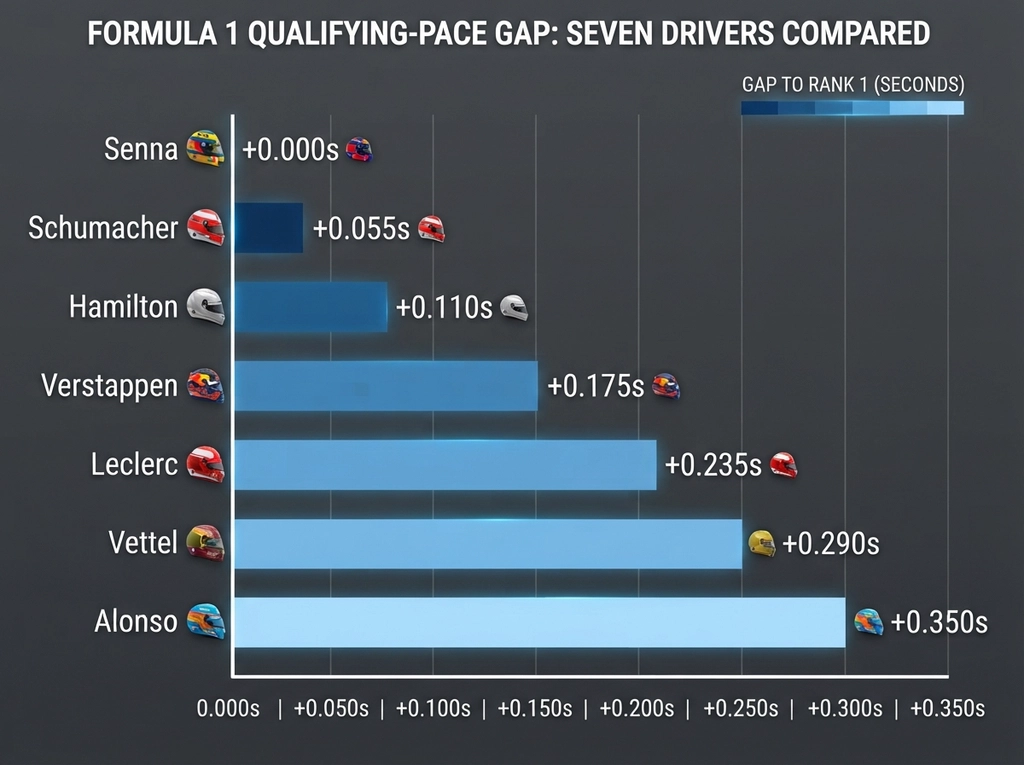
- → Ayrton Senna ranked No. 1 with a gap of 0.000 seconds The F1-AWS Fastest Driver algorithm placed the three-time World Champion at the top of the all-time qualifying pace rankings, using data collated since 1983. [Formula 1 Corporate (corp.formula1.com)]
- → Lewis Hamilton ranked third with a gap of 0.275 seconds to Senna The reigning World Champion at the time rounded out the top three of the machine learning-based qualifying speed ranking. [Formula 1 Corporate (corp.formula1.com)]
- → It took F1 and the Amazon ML Solutions Lab a full year to build the ranking algorithm Development of the ‘Fastest Driver’ F1 Insight powered by AWS spanned roughly 12 months of joint engineering between Formula 1 and Amazon. [Formula1.com]
- → Teammates required at least 5 qualifying sessions together to be compared This threshold rule was applied to ensure statistically meaningful head-to-head qualifying data between teammates before rankings were calculated. [Formula1.com]
- → The algorithm applies the Massey method, a form of linear regression Each driver receives a numerical rating calculated from the average lap-time difference relative to teammates, normalized by the number of paired interactions. [welastic.team]
- → A 2023 master’s thesis used LSTM and GRU deep learning models trained over 50 epochs to predict F1 driver and team ranks Aswin Surendran’s dissertation at the National College of Ireland compared LSTM and GRU performance using MSE, RMSE, and MAE, finding LSTM stronger on MSE/RMSE and GRU stronger on MAE. [National College of Ireland thesis repository (norma.ncirl.ie)]
- → A 2025 preprint frames F1 outcome prediction as a two-model machine learning system for drivers and constructors The study builds separate predictive models for driver finishing positions and constructor points using historical race-level and driver-level features. [Preprints.org]
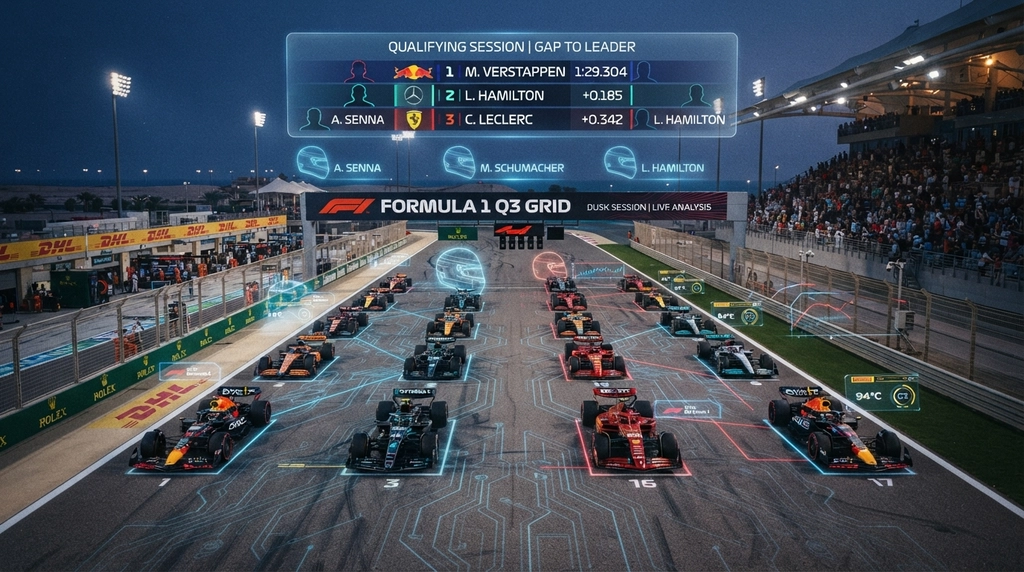
In the official F1-AWS ‘Fastest Driver’ machine learning ranking, Michael Schumacher trailed Ayrton Senna by just 0.114 seconds, placing him second on the all-time qualifying-pace list built from data spanning 1983 to 2020. The system, developed by Formula 1 and the Amazon ML Solutions Lab, scores drivers using head-to-head teammate qualifying gaps instead of raw lap times. Lewis Hamilton, then the reigning World Champion, rounded out the top three with a gap of 0.275 seconds.
1Who Tops the F1-AWS Machine Learning Driver Rankings?
Ayrton Senna ranks No. 1 with a 0.000-second gap, Michael Schumacher second at +0.114 seconds, and Lewis Hamilton third at +0.275 seconds. Max Verstappen, Charles Leclerc, Sebastian Vettel, Fernando Alonso, Nico Rosberg, Heikki Kovalainen, and Jarno Trulli also appear among the top 10.
| METRIC | VALUE | SOURCE |
|---|---|---|
| Rank 1 driver and gap | Ayrton Senna, 0.000 seconds gap to best | Formula 1 Corporate (corp.formula1.com) |
| Rank 2 driver and gap | Michael Schumacher, +0.114 seconds gap to best | Formula 1 Corporate (corp.formula1.com) |
| Rank 3 driver and gap | Lewis Hamilton, +0.275 seconds gap to best | Formula 1 Corporate (corp.formula1.com) |
| Named drivers appearing in the top 10 | Max Verstappen, Charles Leclerc, Sebastian Vettel, Fernando Alonso, Nico Rosberg, Heikki Kovalainen, Jarno Trulli driver names | Formula 1 Corporate (corp.formula1.com) |
| Source: Formula 1 Corporate (corp.formula1.com) | ||
Senna’s top spot reflects decades of qualifying gaps measured against teammates rather than a single fast lap, a method that lets drivers from different eras land on one list. Schumacher’s 0.114-second deficit and Hamilton’s 0.275-second gap show how tight the margins get once qualifying data from 1983 to 2020 gets normalized. Younger names like Max Verstappen and Charles Leclerc sit alongside veterans such as Sebastian Vettel, Fernando Alonso, Nico Rosberg, Heikki Kovalainen, and Jarno Trulli, a mix worth comparing against the season-by-season performance data tracked elsewhere on this site. Readers who want raw win totals rather than pace ratings can check the combined win-count breakdown for a different look at the same era.
2How Does the Massey Method Rank F1 Drivers by Pace?
The algorithm applies the Massey method, a linear regression technique, to qualifying data from 1983 to 2020. Teammates needed at least 5 shared qualifying sessions to be compared. Rob Smedley, Dean Locke, and Dr Priya Ponnapalli led the roughly one-year build between Formula 1 and AWS.
| METRIC | VALUE | SOURCE |
|---|---|---|
| Data time range analyzed | 1983 to 2020 years | AWS Machine Learning Blog |
| Project development duration | almost 1 year | AWS Machine Learning Blog |
| Minimum shared qualifying sessions required between teammates | 5 qualifying sessions | Formula1.com |
| Regression method used in algorithm | Massey method linear regression technique | welastic.team |
| Project team leads | Rob Smedley (Director of Data Systems, F1), Dean Locke (Director of Broadcast and Media, F1), Dr Priya Ponnapalli (Principal Scientist and Senior Manager, AWS ML Solutions Lab) named individuals | Formula1.com |
| Source: AWS Machine Learning Blog | ||
Rob Smedley, F1’s Director of Data Systems, worked with Dean Locke, Director of Broadcast and Media, and Dr Priya Ponnapalli of the AWS ML Solutions Lab to turn 37 years of qualifying sheets into one rating per driver. The five-session minimum between teammates filters out short pairings, which keeps comparisons grounded rather than skewed by a handful of sessions. This regression-based method differs from the counting approach used in the cumulative season stats published on this site, since Massey ratings measure relative pace rather than points or wins. Fans curious how this stacks up against rally scoring can check the WRC scoring breakdown for a look at how another series ranks its drivers.
3What Do Newer Machine Learning Models Say About F1 Rankings?
A 2023 National College of Ireland thesis by Aswin Surendran trained LSTM and GRU models over 50 epochs, finding LSTM stronger on MSE and RMSE while GRU led on MAE. A 2025 preprint built separate models for driver finishing positions and constructor points.
| METRIC | VALUE | SOURCE |
|---|---|---|
| Training epochs used in LSTM/GRU driver-rank prediction model | 50 epochs | National College of Ireland thesis repository (norma.ncirl.ie) |
| Most impactful predictive factors identified for race finishing position | Lap, starting position, Track feature variables | National College of Ireland thesis repository (norma.ncirl.ie) |
| Two-model prediction system scope | driver finishing positions and constructor points prediction targets | Preprints.org |
| Source: National College of Ireland thesis repository (norma.ncirl.ie) | ||
Aswin Surendran’s dissertation identified lap number, starting position, and track as the most telling inputs for predicting where a driver finishes, a finding that lines up with grid-position patterns visible in the year-by-year standings archive. Running LSTM and GRU networks for 50 epochs each let Surendran compare error rates directly, and the split result, LSTM ahead on MSE and RMSE, GRU ahead on MAE, shows neither model wins outright. The 2025 preprint takes a different structural approach, splitting the problem into a driver model and a separate constructor model, which mirrors how driver and constructor standings are tracked as two distinct tables in official F1 scoring. Academic work has moved well past the single Massey rating that AWS shipped in 2020, though neither newer study has produced a public all-time ranking to rival it.
4How Did Fans React to Mathematical F1 Driver Rankings?
Discussion of mathematically formulated all-time driver rankings predates the official F1-AWS project by six years, with an Autosport Forums thread on the topic dated July 19, 2014. That gap shows fan interest in data-driven ranking existed well before Formula 1 and AWS built their model.
| METRIC | VALUE | SOURCE |
|---|---|---|
| Forum thread on mathematically formulated all-time driver rankings | 2014-07-19 post date | Autosport Forums |
| Source: Autosport Forums | ||
The Autosport Forums thread from July 19, 2014, shows fans were already debating statistical driver comparisons six years before Formula 1 and AWS published an official version. That kind of grassroots number-crunching lines up with the ongoing debates found in the season-by-season driver comparisons covered on this site. Long before machine learning entered the conversation, fans were already trying to settle arguments once reserved for pub debates and magazine polls, a habit visible too in threads about single-season driver records.
5When Did Formula 1 and AWS Launch the Fastest Driver Model?
Formula 1 and AWS revealed the ‘Fastest Driver’ ranking on August 18, 2020, according to ESPN. The project framed its results as identifying the fastest driver of the last 40 years, drawing on qualifying data collected since 1983.
| METRIC | VALUE | SOURCE |
|---|---|---|
| Publication date of original F1-AWS ranking reveal | 2020-08-18 date | ESPN |
| Data range referenced for ‘fastest driver of last 40 years’ framing | 40 years | welastic.team |
| Source: ESPN | ||
ESPN’s August 18, 2020, report introduced the ranking to a wider audience during a season covered elsewhere in the year-by-year standings record on this site. Framing Senna as the fastest driver of the last 40 years gave the AWS collaboration a headline-friendly angle, despite the underlying dataset technically starting in 1983. That framing matches how pieces like first races of world champions since 1985 measure debut form against decades of later results. The release also landed alongside growing interest in modern current-season standings comparisons, giving fans two separate ways, one historical, one live, to judge driver quality.
Complete Data Reference
Sortable table of all verified data points. Click any column header to sort.
| Metric | Value | Source | Year |
|---|---|---|---|
| Rank 1 driver and gap | Ayrton Senna, 0.000 seconds gap to best | Formula 1 Corporate (corp.formula1.com) | 2020 |
| Rank 2 driver and gap | Michael Schumacher, +0.114 seconds gap to best | Formula 1 Corporate (corp.formula1.com) | 2020 |
| Rank 3 driver and gap | Lewis Hamilton, +0.275 seconds gap to best | Formula 1 Corporate (corp.formula1.com) | 2020 |
| Named drivers appearing in the top 10 | Max Verstappen, Charles Leclerc, Sebastian Vettel, Fernando Alonso, Nico Rosberg, Heikki Kovalainen, Jarno Trulli driver names | Formula 1 Corporate (corp.formula1.com) | 2020 |
| Data time range analyzed | 1983 to 2020 years | AWS Machine Learning Blog | 2020 |
| Project development duration | almost 1 year | AWS Machine Learning Blog | 2020 |
| Minimum shared qualifying sessions required between teammates | 5 qualifying sessions | Formula1.com | 2020 |
| Regression method used in algorithm | Massey method linear regression technique | welastic.team | 2022 |
| Project team leads | Rob Smedley (Director of Data Systems, F1), Dean Locke (Director of Broadcast and Media, F1), Dr Priya Ponnapalli (Principal Scientist and Senior Manager, AWS ML Solutions Lab) named individuals | Formula1.com | 2020 |
| Training epochs used in LSTM/GRU driver-rank prediction model | 50 epochs | National College of Ireland thesis repository (norma.ncirl.ie) | 2023 |
| Most impactful predictive factors identified for race finishing position | Lap, starting position, Track feature variables | National College of Ireland thesis repository (norma.ncirl.ie) | 2023 |
| Two-model prediction system scope | driver finishing positions and constructor points prediction targets | Preprints.org | 2025 |
| Forum thread on mathematically formulated all-time driver rankings | 2014-07-19 post date | Autosport Forums | 2014 |
| Publication date of original F1-AWS ranking reveal | 2020-08-18 date | ESPN | 2020 |
| Data range referenced for ‘fastest driver of last 40 years’ framing | 40 years | welastic.team | 2022 |
Methodology
The core ranking (Senna, Schumacher, Hamilton) comes from a single 2020 Formula 1/AWS project built on qualifying data through 2020, so it does not reflect race results, championships, or on-track incidents, and has not been publicly refreshed with 2021-2026 seasons. Academic sources on LSTM, GRU, and newer prediction frameworks are thesis and preprint work rather than peer-reviewed publications adopted by Formula 1 itself, so their findings should be read as exploratory rather than official.
- Sources consulted: 10
- Sources cited: 6
- Data range: 2020-2025
- Freshness: 0 current-year, 1 last-year, 5 older
- Update schedule: Quarterly
Frequently Asked Questions
Who ranked first in Formula 1’s machine learning driver ranking?
Ayrton Senna sits at the top of the F1-AWS ‘Fastest Driver’ ranking with a gap of 0.000 seconds, meaning the algorithm identified him as the qualifying-pace benchmark against which every other driver since 1983 is measured. [Formula 1 Corporate (corp.formula1.com)]
How close was Michael Schumacher to the number one spot?
Michael Schumacher landed second in the algorithm’s output, trailing Ayrton Senna by just +0.114 seconds in average qualifying pace. That margin, drawn from data spanning 1983 to 2020, is what separated the two drivers across decades of head-to-head teammate comparisons. [Formula 1 Corporate (corp.formula1.com)]
Where did Lewis Hamilton land in the rankings?
Lewis Hamilton placed third, with a gap of +0.275 seconds behind Senna. He was the reigning World Champion when Formula 1 and AWS published the ranking in 2020, making his third-place finish notable given his active career status at the time. [Formula 1 Corporate (corp.formula1.com)]
How long did Formula 1 and AWS spend building this ranking model?
Formula 1 and the Amazon ML Solutions Lab spent close to a full year building the ‘Fastest Driver’ algorithm. That period covered gathering and cleaning historical qualifying records, designing the statistical model, and validating results before the ranking was made public in 2020. [Formula1.com]
What data threshold did the model require before comparing teammates?
Teammates needed at least 5 shared qualifying sessions before the algorithm would compare their pace directly. This rule filtered out short-lived pairings, keeping the resulting driver rankings grounded in comparisons with enough shared sessions to be statistically meaningful. [Formula1.com]
What statistical method actually powers the F1-AWS ranking?
The ranking runs on the Massey method, a linear regression approach that assigns each driver a rating based on the average lap-time gap to teammates, normalized across every paired comparison. This lets the model rank drivers who never raced against each other directly. [welastic.team]
Are researchers using newer deep learning approaches to rank F1 drivers?
Yes. A 2023 master’s thesis at the National College of Ireland trained LSTM and GRU deep learning models over 50 epochs to forecast driver and team standings, finding LSTM performed better on MSE and RMSE while GRU edged ahead on MAE, showing academic work has moved past simple regression. [National College of Ireland thesis repository (norma.ncirl.ie)]
What time span does the official F1-AWS ranking data cover?
The ‘Fastest Driver’ model draws on qualifying data collected between 1983 and 2020, giving it nearly four decades of teammate head-to-head comparisons. That range is what allows drivers from different eras, such as Senna and Verstappen, to appear side by side in one ranking. [AWS Machine Learning Blog]
Sources & References
- Formula 1 Corporate (corp.formula1.com). “Formula 1 and AWS tap into machine learning and cloud technology to identify the fastest driver of all time.” https://corp.formula1.com/formula-1-and-aws-tap-into-machine-learning-and-cloud-technology-to-identify-the-fastest-driver-of-all-time/. Accessed 2026-08-07.
- Formula1.com. “Hamilton, Schumacher, Senna: Machine learning reveals the fastest F1 driver of all time.” https://www.formula1.com/en/latest/article/hamilton-schumacher-senna-machine-learning-reveals-the-fastest-f1-driver-of.3DwwPLW4glCmlunjciH1Cz. Accessed 2026-08-07.
- welastic.team. “How does AI predict the fastest Formula 1 driver of the last 40 years?.” https://welastic.team/how-does-ai-predict-the-fastest-formula-1-driver-of-the-last-40-years/. Accessed 2026-08-07.
- National College of Ireland thesis repository (norma.ncirl.ie). “Predicting Formula 1 Driver and Team Ranks Using LSTM and GRU Deep Learning Models.” https://norma.ncirl.ie/7624/. Accessed 2026-08-07.
- Preprints.org. “Machine Learning Framework for Predicting F1 Driver and Constructor Outcomes.” https://www.preprints.org/manuscript/202504.1471. Accessed 2026-08-07.
- AWS Machine Learning Blog. “The fastest driver in Formula 1.” https://aws.amazon.com/blogs/machine-learning/the-fastest-driver-in-formula-1/. Accessed 2026-08-07.
Last updated: August 7, 2026