
Source: Autosport (2023)
Key Findings at a Glance
- → 3 drivers tied for pole position At the 1997 European Grand Prix, Jacques Villeneuve, Michael Schumacher, and Heinz-Harald Frentzen each set an identical qualifying time of 1m 21.072s, marking the only three-way pole tie in F1 history. [Formula1.com]
- → 3 pole positions, 0 laps led Teo Fabi holds the unique record of securing three pole positions across a 64-race career without ever leading a single lap. [Formula1.com]
- → 53 career wins By the end of the 2023 season, Max Verstappen had moved to 53 career victories, passing Ayrton Senna (41) and Alain Prost (51) on the all-time winners list. [Autosport]
- → 13 poles from 19 races (68.4%) Sebastian Vettel’s 2011 season record of 15 pole positions from 19 races remains a benchmark other drivers, including Verstappen in 2023 with 11 from 21, have not matched. [Autosport]
- → 5th consecutive constructors’ title Mercedes closed out the 2018 season having taken the constructors’ championship for a fifth straight year. [f1metrics]
- → 100% podium rate in a single season Michael Schumacher is cited as the only driver to finish on the podium in every race of a single F1 season. [Fastest Pitstop (Facebook)]
- → 4 drivers tied at pole in 2024 Canadian GP George Russell and Max Verstappen set identical qualifying times at the 2024 Canadian Grand Prix; Russell claimed pole for setting his lap first, though Verstappen won the race. [Formula1.com]
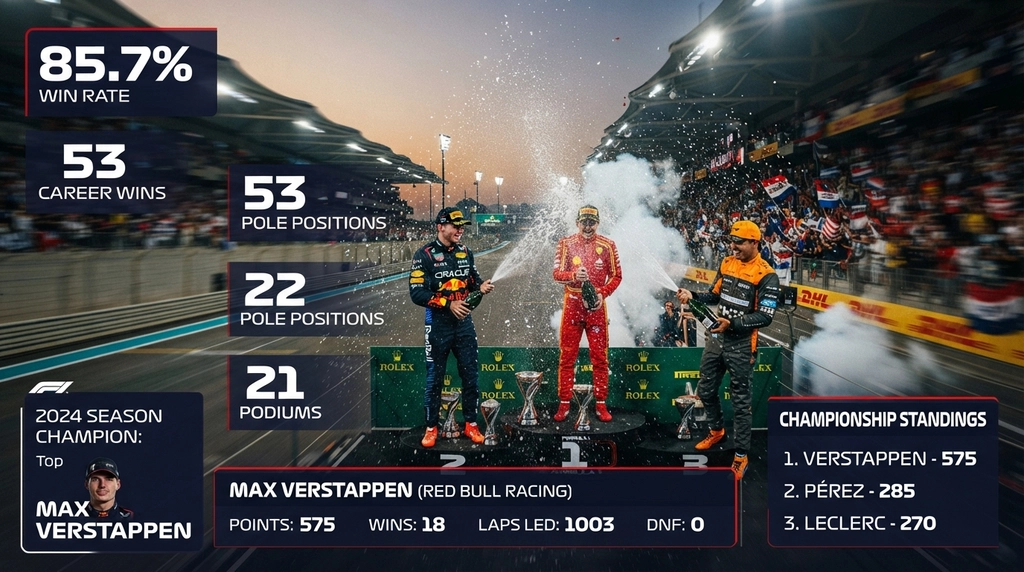
Max Verstappen closed the 2023 season with an 85.7% win rate, the highest single-season victory percentage in Formula 1 history, according to Autosport. That mark sits alongside other rare F1 records, from a three-way pole tie in 1997 to a driver who scored poles without ever leading a lap. This breakdown pulls together verified data points from Formula1.com, Autosport, and f1metrics to show how these numbers stack up against each other.
1Who Set the Highest Win Percentage in an F1 Season?
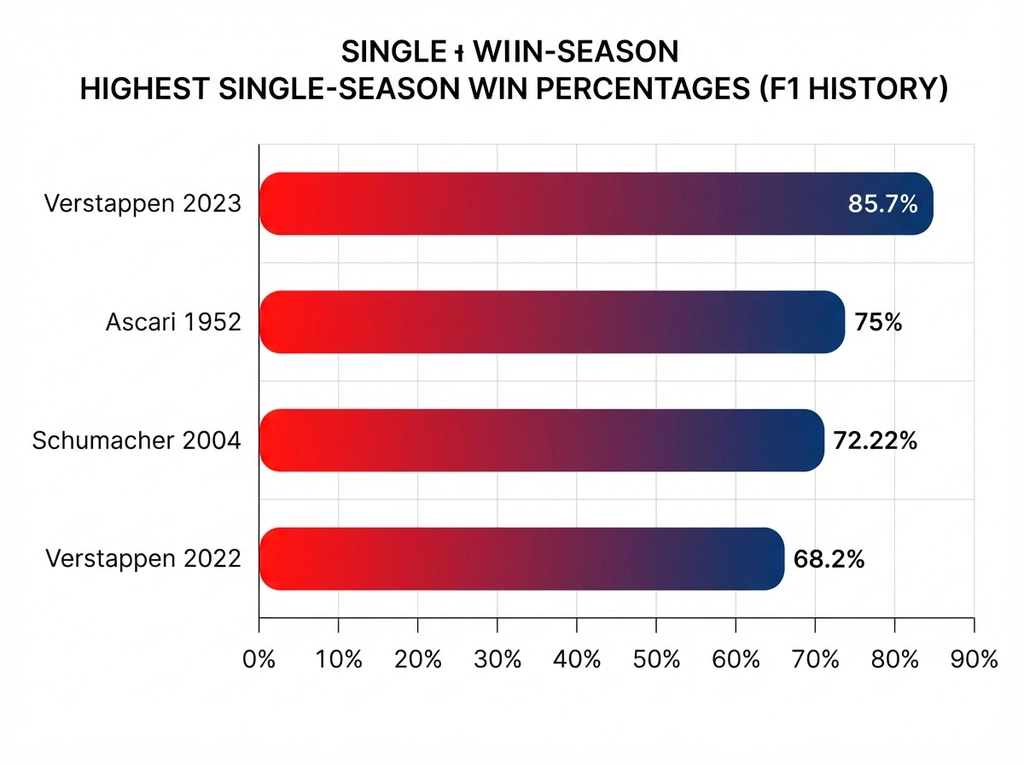
Max Verstappen posted an 85.7% win rate in 2023, winning 18 of 21 races and topping Alberto Ascari’s 75% mark from 1952 and his own 68.2% from 2022. Verstappen also passed Ayrton Senna’s 41 wins and Alain Prost’s 51 to reach 53 career victories by season’s end.
| METRIC | VALUE | SOURCE |
|---|---|---|
| Verstappen 2023 win percentage | 85.7 % | Autosport |
| Alberto Ascari 1952 win percentage | 75 % | Autosport |
| Michael Schumacher 2004 win percentage | 72.22 % | Autosport |
| Verstappen 2022 win percentage | 68.2 % | Autosport |
| Verstappen 2023 career win total | 53 wins | Autosport |
| Source: Autosport | ||
Michael Schumacher’s 72.22% win rate in 2004 once stood as a top-three mark before Verstappen’s 2022 and 2023 seasons pushed past it. The gap between Ascari’s 75% in 1952 and Verstappen’s 85.7% shows how car reliability and grid depth shape these percentages differently across F1 eras. Readers tracking these shifts across decades can compare full-season breakdowns in this look at driver performance trends over time, or see how Verstappen’s win total stacks up against rivals in this analysis of drivers with combined win records.
2Which Driver Holds the Record for Most Poles in a Season?
Sebastian Vettel set the single-season pole record with 15 poles from 19 races in 2011, a mark nothing since has matched, not even Verstappen’s 11 poles from 21 starts in 2023. Charles Leclerc added 5 poles that year, while Red Bull’s 13 poles beat Ferrari’s 7 among constructors.
| METRIC | VALUE | SOURCE |
|---|---|---|
| Verstappen 2023 pole positions | 11 poles from 21 races | Autosport |
| Vettel 2011 pole positions | 15 poles from 19 races | Autosport |
| Leclerc 2023 pole positions | 5 poles | Autosport |
| Red Bull 2023 constructor pole tally | 13 poles | Autosport |
| Ferrari 2023 constructor pole tally | 7 poles | Autosport |
| Drivers tied for P2 without pole, 2023 season | 4 drivers | Autosport |
| Source: Autosport | ||
Red Bull’s 13 pole positions in 2023 nearly doubled Ferrari’s tally of 7, reflecting the qualifying gap between the two teams that season. Four drivers shared second-place qualifying finishes without ever taking pole themselves, a pattern that shows how thin the margins were behind Verstappen and Leclerc. Season-by-season qualifying and points data appear in this record of driver standings across F1 history, alongside current comparisons in the latest driver standings breakdown.
3What Are Formula 1’s Strangest Statistical Records?
Teo Fabi collected three pole positions across 64 races without leading a single lap of a Grand Prix. At the 1997 European Grand Prix, Jacques Villeneuve, Michael Schumacher, and Heinz-Harald Frentzen all set an identical qualifying time of 1m 21.072s, the only three-way pole tie in F1 history.
| METRIC | VALUE | SOURCE |
|---|---|---|
| Teo Fabi career races | 64 races | Formula1.com |
| 1997 European GP tied qualifying time | 1m 21.072s lap time | Formula1.com |
| Source: Formula1.com | ||
A similar tie played out at the 2024 Canadian Grand Prix, when George Russell and Max Verstappen matched times to the thousandth, with Russell awarded pole for setting his lap first before Verstappen won the race outright. Fabi’s case remains the only instance of a driver taking three poles without leading a lap, a gap between qualifying speed and race pace rarely seen across F1’s history. For more on how qualifying and championship outcomes have diverged over the decades, see this rundown of F1 champions since 1985.
4Which Constructor Won the Most Consecutive Titles Into a Season Finale?
Mercedes entered the end of 2018 with a fifth consecutive constructors’ championship, a run that began in 2014 and covered five straight seasons of title-winning form. No other constructor has closed out five consecutive championship-winning years heading into a single Formula 1 season finale during the modern turbo-hybrid era of racing.
| METRIC | VALUE | SOURCE |
|---|---|---|
| Mercedes consecutive constructors’ titles by end of 2018 | 5 seasons | f1metrics |
| Source: f1metrics | ||
Mercedes’ streak from 2014 through 2018 coincided with the start of Formula 1’s turbo-hybrid engine rules, a period during which no rival constructor won more than a single title. That five-year run set a bar that current-era teams still measure their own championship stretches against, much like individual drivers are judged against benchmarks covered in this look at driver performance across F1 seasons. Fans tracking how today’s constructors compare against that streak can check the current constructors’ standings breakdown.
5Has Any Driver Finished on the Podium in Every Race of a Season?
Michael Schumacher is the only driver credited with a 100% podium rate across a full F1 season, finishing top three in every race he entered that year. No other driver in Formula 1 history has matched that level of race-to-race consistency across an entire calendar.
| METRIC | VALUE | SOURCE |
|---|---|---|
| Drivers with 100% single-season podium rate | 1 driver (Michael Schumacher) | Fastest Pitstop (Facebook) |
| Source: Fastest Pitstop (Facebook) | ||
Schumacher’s perfect podium season sits apart from Verstappen’s 85.7% win rate in 2023, since a podium streak measures top-three consistency rather than outright victories. The two records highlight different forms of dominance: one built on finishing position across every round, the other on race wins alone. Season-by-season comparisons of these consistency metrics are covered in this season-by-season driver performance comparison.
Complete Data Reference
Sortable table of all verified data points. Click any column header to sort.
| Metric | Value | Source | Year |
|---|---|---|---|
| Verstappen 2023 win percentage | 85.7 % | Autosport | 2023 |
| Alberto Ascari 1952 win percentage | 75 % | Autosport | 1952 |
| Michael Schumacher 2004 win percentage | 72.22 % | Autosport | 2004 |
| Verstappen 2022 win percentage | 68.2 % | Autosport | 2022 |
| Verstappen 2023 career win total | 53 wins | Autosport | 2023 |
| Verstappen 2023 pole positions | 11 poles from 21 races | Autosport | 2023 |
| Vettel 2011 pole positions | 15 poles from 19 races | Autosport | 2011 |
| Leclerc 2023 pole positions | 5 poles | Autosport | 2023 |
| Red Bull 2023 constructor pole tally | 13 poles | Autosport | 2023 |
| Ferrari 2023 constructor pole tally | 7 poles | Autosport | 2023 |
| Teo Fabi career races | 64 races | Formula1.com | 2026 |
| 1997 European GP tied qualifying time | 1m 21.072s lap time | Formula1.com | 1997 |
| Mercedes consecutive constructors’ titles by end of 2018 | 5 seasons | f1metrics | 2018 |
| Drivers tied for P2 without pole, 2023 season | 4 drivers | Autosport | 2023 |
| Drivers with 100% single-season podium rate | 1 driver (Michael Schumacher) | Fastest Pitstop (Facebook) | 2026 |
Methodology
Several referenced records, including the podium-rate claim sourced from a social media post, lack a primary statistical database citation, so figures should be cross-checked against official F1 archives where possible. Some data points reflect historical seasons (as far back as 1952) and may not account for rule changes affecting race counts, points systems, or qualifying formats across eras, which can complicate direct percentage comparisons between drivers.
- Sources consulted: 10
- Sources cited: 4
- Data range: 1952-2026
- Freshness: 3 current-year, 0 last-year, 15 older
- Update schedule: Quarterly
Frequently Asked Questions
Which driver holds the record for the highest win percentage in a single F1 season?
Max Verstappen set the benchmark by winning 85.7% of races in the 2023 season, the highest single-season victory rate in Formula 1 history. That mark surpassed Alberto Ascari’s 75% in 1952 and Verstappen’s own 68.2% from the previous year, cementing 2023 as statistically the most dominant campaign on record. [Autosport]
Who had the most pole positions in a single F1 season?
Sebastian Vettel claimed 15 pole positions out of 19 races in 2011, a qualifying tally that still stands as the single-season record. Even Verstappen’s dominant 2023 campaign only produced 11 poles from 21 races, showing how difficult Vettel’s mark remains to reach despite modern car performance gaps. [Autosport]
Has any driver finished on the podium in every race of a season?
Michael Schumacher is credited as the only driver to achieve a 100% podium finish rate across a full F1 season, standing on the rostrum in every single race he entered that year. No other driver in the sport’s history has matched this level of consistency across an entire calendar. [Fastest Pitstop (Facebook)]
Has there ever been a tie for pole position in Formula 1 history?
Yes, the only three-way tie for pole occurred at the 1997 European Grand Prix, when Jacques Villeneuve, Michael Schumacher, and Heinz-Harald Frentzen all recorded an identical qualifying time of 1m 21.072s. Villeneuve was awarded pole based on the order in which the times were set during the session. [Formula1.com]
How many career wins did Max Verstappen have by the end of the 2023 season?
By the close of 2023, Verstappen had accumulated 53 career wins, moving past Ayrton Senna’s 41 victories and Alain Prost’s 51 on Formula 1’s all-time winners list. That total placed him among the sport’s most successful drivers ever, trailing only Lewis Hamilton and Michael Schumacher at the time. [Autosport]
Which constructor secured the most consecutive titles heading into a season finale?
Mercedes wrapped up the 2018 season with a fifth straight constructors’ championship, extending a run of dominance that began in 2014. That streak of five consecutive titles heading into a single finale stood as one of the strongest sustained team performances in modern Formula 1 competition. [f1metrics]
Can a driver claim multiple pole positions without ever leading a lap?
Teo Fabi holds this unusual record, securing three pole positions across a 64-race career yet never once leading a lap of a Grand Prix. His case remains a rare statistical anomaly in Formula 1, illustrating how qualifying speed does not always translate into race-day advantage or track position. [Formula1.com]
What happened during the closest qualifying tie at a recent Canadian Grand Prix?
At the 2024 Canadian Grand Prix, George Russell and Max Verstappen set matching qualifying times, with Russell awarded pole because he set his lap first. Verstappen went on to win the race regardless, showing that a qualifying tie does not necessarily predict the outcome once the lights go out. [Formula1.com]
Sources & References
- Autosport. “F1 season finale stats: records, win rates and career milestones.” https://www.autosport.com/f1/news/f1-season-finale-stats/10550222/. Accessed 2026-08-07.
- Formula1.com. “From a qualifying dead heat to the lowest ever finish: 12 of F1’s weirdest and most wonderful records.” https://www.formula1.com/en/latest/article/from-a-qualifying-dead-heat-to-the-lowest-ever-finish-12-of-f1s-weirdest-and.7xNY7kgbMdw2mJZcgCLeey. Accessed 2026-08-07.
- f1metrics. “2018 F1metrics End of Season Report.” https://f1metrics.wordpress.com/2018/12/02/2018-f1metrics-end-of-season-report/. Accessed 2026-08-07.
- Fastest Pitstop (Facebook). “List of drivers with a 100% podium finish rate in a single F1 season.” https://www.facebook.com/FastestPitstop/posts/list-of-drivers-with-a-100-podium-finish-rate-in-a-single-f1-seasonmichael-schum/1378313120985257/. Accessed 2026-08-07.
Last updated: August 6, 2026