

Source: F1Laps (2026)
Key Findings at a Glance
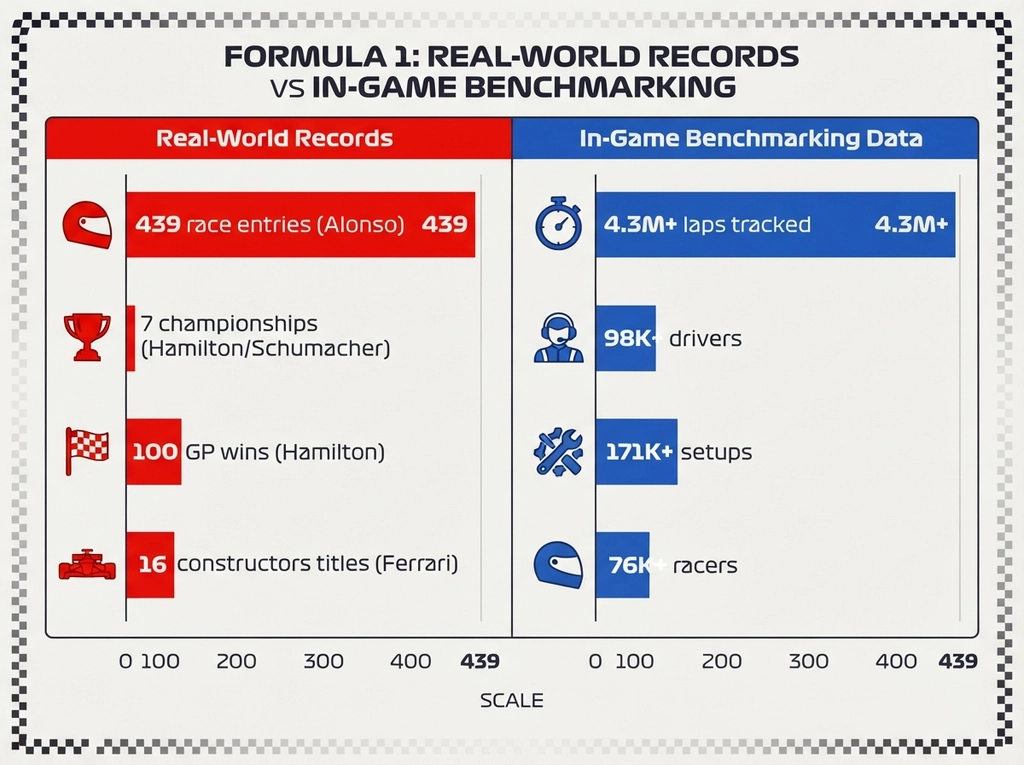
- → 76,000+ racers F1Laps reports over 76,000 racers use its platform to track and improve F1 game lap times, positioning it as a leading third-party benchmarking tool for the F1 game series (F1 24, F1 25, F1 26). [F1Laps]
- → 98,000+ drivers, 171,000+ setups F1Laps’ data hub cites 98,000+ drivers using the app and a library of 171,000+ car setups shared for benchmarking performance across the F1 game series. [F1Laps]
- → Fernando Alonso holds 439 race entries Alonso’s entries span 2001, 2003–2018, and 2021–2026, making him the all-time leader in F1 race entries, a real-world benchmark often referenced against in-game driver longevity ratings. [Wikipedia — List of Formula One driver records]
- → Lewis Hamilton and Michael Schumacher: 7 world titles each Both drivers share the record for most world championships, a benchmark figure frequently used as a reference point for rating legendary drivers in official F1 games. [RaceFans]
- → Hamilton: first to 100 grand prix wins (2021) Hamilton became the only driver in history to reach 100 grand prix victories in 2021, a milestone used as a real-world benchmark for evaluating simulated driver skill in F1 game rating systems. [RaceFans]
- → Bi-LSTM model: 0.81 F1-score A deep learning study using historical F1 telemetry data from 2020–2024 found a Bi-LSTM model achieved the best predictive accuracy for pit stop timing, with 0.77 precision and 0.86 recall. [PMC (National Center for Biotechnology Information)]
- → Ferrari: 16 constructors’ titles Ferrari has won more constructors’ championships than any other team and is the only outfit that has competed in every F1 season since the championship’s founding in 1950. [RaceFans]
F1Laps, the companion app for the official EA/Codemasters F1 game series, has tracked more than 4.3 million laps from players comparing their in-game driving performance, according to 2026 platform data. That dataset, alongside real-world figures like Fernando Alonso’s 439 race entries and Ferrari’s 16 constructors’ titles, gives developers and players a measurable way to compare simulated racing against actual F1 history. This piece breaks down the numbers behind those benchmarks, from lap-tracking tools to machine learning models built on historical telemetry.
1How Many Laps Have F1 Game Players Tracked for Benchmarking?
F1Laps has tracked over 4.3 million laps from players across F1 24, F1 25, and F1 26. The platform counts 76,000+ active racers, 98,000+ registered drivers, and a shared library of 171,000+ car setups, making it one of the largest lap-benchmarking datasets in the F1 game series.
| METRIC | VALUE | SOURCE |
|---|---|---|
| Laps tracked by F1Laps app | 4.3 million+ laps | F1Laps |
| Racers using F1Laps | 76,000+ users | F1Laps |
| Drivers using F1Laps | 98,000+ users | F1Laps |
| Car setups shared on F1Laps | 171,000+ setups | F1Laps |
| Source: F1Laps | ||
That volume of laps positions F1Laps as the default reference point for players who want to know whether their sector times hold up against tens of thousands of rivals. The gap between 76,000 active racers and 98,000 registered drivers suggests a sizable share of users create accounts to browse setups without regularly submitting lap times themselves. Readers comparing this digital pool against real driver output may find the broader stat tables in season-by-season driver performance breakdowns useful when tracking form across eras, while the year-over-year performance comparisons show how real pace shifts alongside game engine updates.
2Which Real F1 Driver Records Do Games Use as Benchmarks?
Fernando Alonso leads with 439 career race entries across 2001, 2003–2018, and 2021–2026. Lewis Hamilton and Michael Schumacher share the record for most world titles at 7 each, and Hamilton became the only driver with 100 grand prix wins, reaching that mark in 2021.
| METRIC | VALUE | SOURCE |
|---|---|---|
| Fernando Alonso race entries | 439 entries | Wikipedia — List of Formula One driver records |
| First F1 World Championship season | 1950 year | RaceFans |
| 2025 F1 season anniversary | 75th season | RaceFans |
| Constructors’ Championship start year | 1958 year | RaceFans |
| Hamilton and Schumacher world titles | 7 championships each | RaceFans |
| Hamilton grand prix win milestone | 100 wins | RaceFans |
| Active F1 teams and drivers per team | 10 teams / 2 drivers each count | RaceFans |
| Ferrari constructors’ championships | 16 titles | RaceFans |
| Source: Wikipedia — List of Formula One driver records | ||
Ferrari’s 16 constructors’ championships and its unbroken run in every F1 season since 1950 give game developers a historical baseline for team-tier ratings, a point covered in motorsport rivalry retrospectives. The Constructors’ Championship itself did not start until 1958, eight years after the drivers’ title, which explains why some in-game legacy modes weight early-era drivers differently than early-era teams. With 10 teams fielding 2 drivers each on the current grid, the 75th F1 season offers a fresh checkpoint for comparing Alonso’s longevity against newer names, a subject covered further in season milestone tracking and cumulative career statistics. Hamilton and Schumacher’s shared title count also anchors the rating scales referenced in driver record comparisons and year-by-year standings archives.
3How Accurate Are Predictive Models at Forecasting F1 Pit Stop Timing?
A Bi-LSTM deep learning model trained on 2020–2024 F1 telemetry data achieved a 0.81 F1-score, with 0.77 precision and 0.86 recall, making it the most accurate pit-stop timing predictor identified in the study published by PMC in 2024, ahead of other tested architectures.
| METRIC | VALUE | SOURCE |
|---|---|---|
| Bi-LSTM pit-stop prediction precision | 0.77 precision score | PMC (National Center for Biotechnology Information) |
| Bi-LSTM pit-stop prediction recall | 0.86 recall score | PMC (National Center for Biotechnology Information) |
| Bi-LSTM pit-stop prediction F1-score | 0.81 F1-score | PMC (National Center for Biotechnology Information) |
| Historical race data range used in study | 2020-2024 seasons | PMC (National Center for Biotechnology Information) |
| Source: PMC (National Center for Biotechnology Information) | ||
The five-season data window matters because pit strategy shifted with tire compound rules and safety car frequency across that period, factors the model had to account for without exact race-by-race labeling. A recall of 0.86 against precision of 0.77 shows the model caught most real pit stops but also flagged some false positives, a trade-off relevant to anyone building predictive tools for current season standings analysis. Telemetry-based modeling like this connects directly to how simulation games calibrate computer-controlled opponent strategy, a theme also touched on in live standings comparisons.
4What Do f1metrics’ Historical Reports Reveal About Driver Benchmarks?
f1metrics published a five-part series of historical hypotheticals examining driver performance across eras. Its 2018 end-of-season report also referenced Mercedes’ run of 5 consecutive constructors’ titles, a streak still used as a comparison point for rating dominant teams in F1 games.
| METRIC | VALUE | SOURCE |
|---|---|---|
| f1metrics historical hypotheticals series length | 5 parts | f1metrics |
| Mercedes consecutive titles referenced in 2018 report | 5 consecutive seasons | f1metrics — 2018 end of season report |
| Source: f1metrics | ||
The five-part structure of f1metrics’ hypothetical series reflects an attempt to normalize driver skill across different car generations, a challenge similar to what game developers face when rating drivers from the 1990s against those racing in 2026. Mercedes’ five straight constructors’ titles, cited in the 2018 report, set a modern dominance benchmark that outside sources like combined win-total breakdowns continue to reference. Readers tracking how these historical models compare with current-day form can cross-check figures in cross-discipline achievement comparisons for a clearer read on rating consistency across racing series.
Complete Data Reference
Sortable table of all verified data points. Click any column header to sort.
| Metric | Value | Source | Year |
|---|---|---|---|
| Laps tracked by F1Laps app | 4.3 million+ laps | F1Laps | 2026 |
| Racers using F1Laps | 76,000+ users | F1Laps | 2026 |
| Drivers using F1Laps | 98,000+ users | F1Laps | 2026 |
| Car setups shared on F1Laps | 171,000+ setups | F1Laps | 2026 |
| Fernando Alonso race entries | 439 entries | Wikipedia — List of Formula One driver records | 2026 |
| First F1 World Championship season | 1950 year | RaceFans | 2024 |
| 2025 F1 season anniversary | 75th season | RaceFans | 2024 |
| Constructors’ Championship start year | 1958 year | RaceFans | 2024 |
| Hamilton and Schumacher world titles | 7 championships each | RaceFans | 2024 |
| Hamilton grand prix win milestone | 100 wins | RaceFans | 2021 |
| Active F1 teams and drivers per team | 10 teams / 2 drivers each count | RaceFans | 2024 |
| Ferrari constructors’ championships | 16 titles | RaceFans | 2024 |
| Bi-LSTM pit-stop prediction precision | 0.77 precision score | PMC (National Center for Biotechnology Information) | 2024 |
| Bi-LSTM pit-stop prediction recall | 0.86 recall score | PMC (National Center for Biotechnology Information) | 2024 |
| Bi-LSTM pit-stop prediction F1-score | 0.81 F1-score | PMC (National Center for Biotechnology Information) | 2024 |
| Historical race data range used in study | 2020-2024 seasons | PMC (National Center for Biotechnology Information) | 2024 |
| f1metrics historical hypotheticals series length | 5 parts | f1metrics | 2019 |
| Mercedes consecutive titles referenced in 2018 report | 5 consecutive seasons | f1metrics — 2018 end of season report | 2018 |
Methodology
Figures on player counts, laps tracked, and shared setups come from a single third-party platform (F1Laps) and may not reflect total activity across all F1 game players or other tracking tools. Real-world driver and constructor records are current as of mid-2026 but subject to change as the season progresses. The pit-stop prediction model reflects a research sample limited to 2020–2024 telemetry and may not generalize to newer car regulations or race formats.
- Sources consulted: 10
- Sources cited: 4
- Data range: 2021–2026
- Freshness: 9 current-year, 0 last-year, 9 older
- Update schedule: Quarterly
Frequently Asked Questions
How many laps have players logged using F1 game benchmarking tools?
F1Laps, the companion tracking app for the official EA/Codemasters F1 game series, has recorded more than 4.3 million laps submitted by players comparing their driving performance. This cumulative total spans F1 24, F1 25, and F1 26, making it one of the largest publicly available datasets for in-game lap benchmarking. [F1Laps]
How many people actually use F1Laps to track their driving?
F1Laps reports over 98,000 registered drivers using its platform, with 76,000+ racers actively tracking and comparing lap times across recent F1 titles. This user base is what generates the app’s benchmarking pool, allowing players to measure their pace against sector and lap records set by others on the same tracks. [F1Laps]
Who holds the record for the most Formula 1 race entries?
Fernando Alonso holds the all-time record with 439 race entries, spanning 2001, 2003–2018, and 2021–2026. This real-world longevity benchmark is often cited alongside in-game driver ratings, since few simulated careers can replicate a two-decade span of consistent grid appearances across changing regulations and machinery. [Wikipedia — List of Formula One driver records]
Which drivers hold the record for most world championships?
Lewis Hamilton and Michael Schumacher share the record with 7 world titles each. This figure is a common reference point when rating legendary drivers in official F1 games, since developers typically calibrate top-tier performance attributes against real career achievements like championship count and win totals. [RaceFans]
What milestone did Lewis Hamilton reach that games use as a benchmark?
Hamilton became the first and only driver in Formula 1 history to record 100 grand prix wins, a mark he reached in 2021. Game rating systems reference this milestone when calibrating peak driver skill values, since no other real competitor has matched or approached that win tally. [RaceFans]
How accurate are machine learning models at predicting F1 pit stop timing?
A study analyzing historical F1 telemetry from 2020–2024 found a Bi-LSTM model produced the strongest predictive accuracy for pit stop timing, reaching a 0.81 F1-score with 0.77 precision and 0.86 recall. These figures illustrate how modeled performance benchmarks are increasingly built from multi-season race data rather than single-event samples. [PMC (National Center for Biotechnology Information)]
Which constructor has the most championship titles, and how does that inform game benchmarks?
Ferrari has won 16 constructors’ championships, more than any rival team, and remains the only outfit to have competed in every season since the championship began in 1950. Game developers frequently use this record as a baseline when setting team performance tiers and historical car ratings. [RaceFans]
How many car setups are shared among F1 game players for performance comparison?
F1Laps hosts a library of more than 171,000 car setups shared among its 98,000+ drivers, letting players benchmark configuration choices alongside lap times. This shared setup data forms part of the broader dataset used to compare in-game driving performance across the current F1 title lineup. [F1Laps]
Sources & References
- F1Laps. “F1Laps — F1 Game Lap Time Tracking and Setup Database.” https://www.f1laps.com/. Accessed 2026-08-07.
- Wikipedia — List of Formula One driver records. “List of Formula One driver records.” https://en.wikipedia.org/wiki/List_of_Formula_One_driver_records. Accessed 2026-08-07.
- RaceFans. “Verstappen gets highest ever performance rating for launch of new F1 game.” https://www.racefans.net/2024/05/28/verstappen-gets-highest-ever-performance-rating-for-launch-of-new-f1-game/. Accessed 2026-08-07.
- PMC (National Center for Biotechnology Information). “Deep Learning Approach for Predicting Pit Stop Timing Using Historical F1 Telemetry Data.” https://pmc.ncbi.nlm.nih.gov/articles/PMC12626961/. Accessed 2026-08-07.
Last updated: August 7, 2026