

Source: Formula One History (2024)
Key Findings at a Glance
- → 32 Grand Prix weekend deaths, 7 test-session deaths, 13 non-championship event deaths since 1950 Breakdown of over 50 total Formula One driver fatalities by the type of session in which they occurred. [Formula One History]
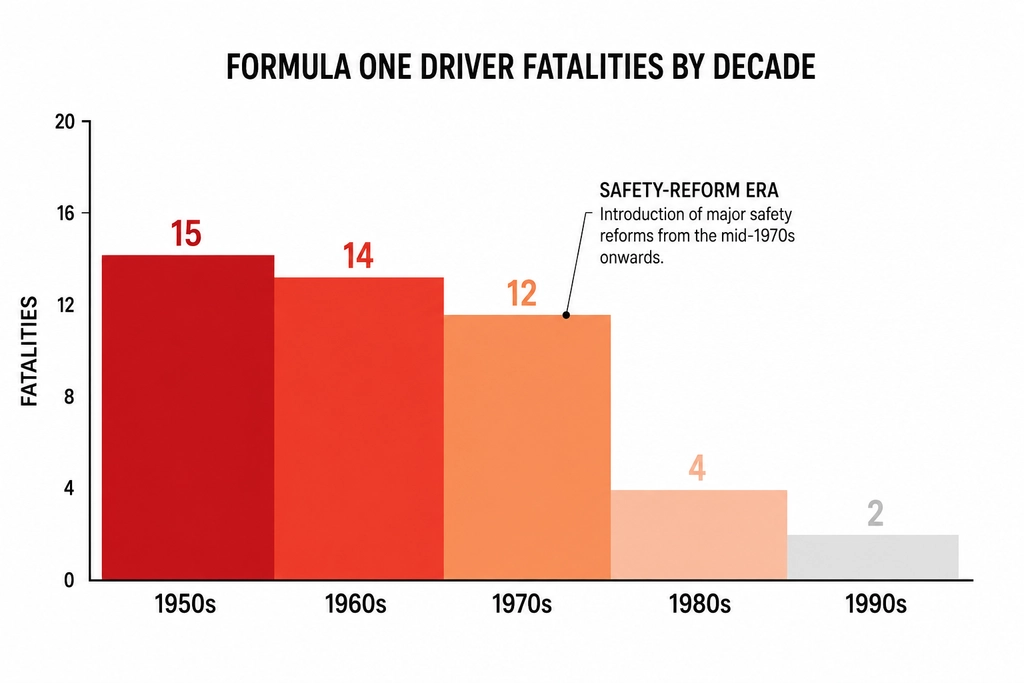
- → 15 F1 driver deaths in the 1950s versus 2 in the 1990s and 21st century combined Decade breakdown shows the sharpest fatality decline occurred after safety reforms in the late 20th century. [Formula One History]
- → 9,090 recorded motorsport fatalities logged across all disciplines Cumulative historical count of every recorded death in motorsport tracked by an independent memorial database. [Motorsport Memorial]
- → 84 people died in Pierre Levegh’s 1955 Le Mans crash The single deadliest incident in recorded motorsport history, killing the driver and 83 spectators. [Motorsport Memorial]
- → 523+ auto racing deaths in the United States between 1990 and 2014 A 25-year investigative count found more than 520 fatalities across all levels of American auto racing, with 53% occurring at short tracks. [Charlotte Observer]
- → Overall motorsport mortality rate below 0.10 per thousand participants annually Life-insurance underwriting research found circuit racing has become one of the safer sporting activities, comparable across amateur and professional levels. [RGA (Reinsurance Group of America)]
- → 18 UK nationals died in motorsport over a six-year span, down from 25 in the prior comparable six-year period (2000-2005) UK fatality figures fell even as the sport’s profile grew, reflecting improved car and circuit safety standards. [RGA (Reinsurance Group of America)]
- → Estimated annual club-racing driver fatality incidence of 7 to 14 Research by Dr. Harlen C. Hunter and Rick Stoff placed amateur race-car driving in a similar risk category to swimming and alpine ski racing. [Go Ahead – Take the Wheel (citing Motorsports Medicine)]
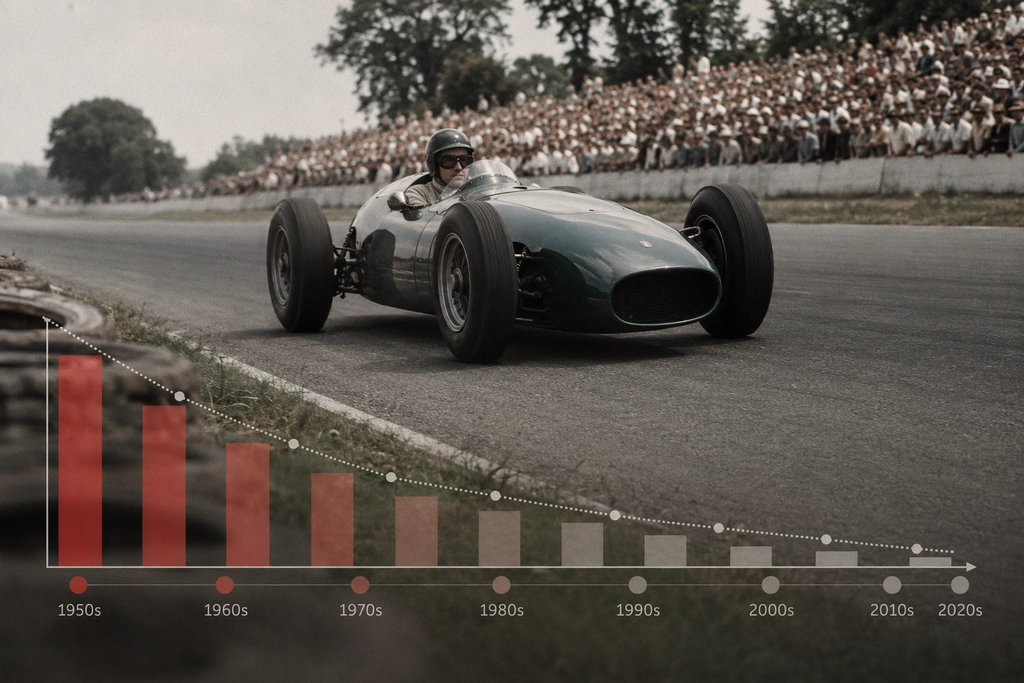
More than 50 Formula One drivers have died in accidents linked to Grand Prix cars since the championship began in 1950, with Jules Bianchi’s 2014 crash marking the most recent fatality, according to Formula One History. This figure sits inside a far larger record: Motorsport Memorial has logged 9,090 documented deaths across every racing discipline it tracks. The breakdown below separates Formula One’s fatality history from global circuit data, US racing figures, UK safety trends, and club-level risk estimates.
1How Many Formula One Drivers Have Died Since 1950?
More than 50 Formula One drivers have died since 1950, according to Formula One History. Of these, 32 deaths happened during race weekends, 7 during test sessions, and 13 at non-championship events. The 1950s recorded the highest decade total at 15 deaths, while Jules Bianchi’s 2014 fatality remains the most recent.
| METRIC | VALUE | SOURCE |
|---|---|---|
| Total F1 driver fatalities since 1950 | 50+ drivers | Formula One History |
| F1 fatalities by decade | 1950s: 15, 1960s: 14, 1970s: 12, 1980s: 4, 1990s: 2 drivers per decade | Formula One History |
| F1 fatalities by session type | 32 race weekend, 7 test session, 13 non-championship drivers | Formula One History |
| British driver fatalities in F1 | 14 drivers | Formula One History |
| Indianapolis Motor Speedway Indy 500 driver deaths | 7 drivers | Formula One History |
| Last F1 driver deaths before the modern safety era | Ayrton Senna and Roland Ratzenberger, 1994 San Marino Grand Prix event | RGA (Reinsurance Group of America) |
| Source: Formula One History | ||
Fourteen of the more than 50 fatalities involved British drivers, the largest national group in the record, a pattern worth reading alongside the broader career data in complete championship records. Seven of the deaths occurred at the Indianapolis Motor Speedway during the years the Indy 500 counted toward the World Championship. Ayrton Senna and Roland Ratzenberger died during the same 1994 San Marino Grand Prix weekend, a turning point that lines up with the sharp decade-by-decade decline visible in cross-series fatality comparisons. No driver has died at a Grand Prix event since Bianchi, a gap now stretching beyond two decades against the 15 deaths recorded in the 1950s alone.
2What Is the Full Historical Death Toll Across All Motorsport?
Motorsport Memorial has logged 9,090 recorded fatalities across all racing disciplines through 2010. Le Mans carries the highest circuit total at 116 deaths among drivers, co-drivers, and spectators, followed by the Nürburgring at 58 competitor deaths and Indianapolis Motor Speedway at 55. The deadliest single incident remains Pierre Levegh’s 1955 Le Mans crash, which killed 84 people.
| METRIC | VALUE | SOURCE |
|---|---|---|
| Total recorded motorsport fatalities (all disciplines, all-time) | 9090 fatalities | Motorsport Memorial |
| Le Mans circuit total fatalities (all persons) | 116 fatalities | Motorsport Memorial |
| Nürburgring competitor fatalities (drivers, co-drivers, navigators, mechanics) | 58 fatalities | Motorsport Memorial |
| Indianapolis Motor Speedway competitor fatalities | 55 fatalities | Motorsport Memorial |
| Deadliest single motorsport accident (Le Mans 1955) | 84 fatalities | Motorsport Memorial |
| Source: Motorsport Memorial | ||
Pierre Levegh’s Mercedes launched into the crowd during the 1955 24 Hours of Le Mans, killing the driver along with 83 spectators in a single afternoon, a toll worth comparing against the driver-specific record in Le Mans-specific driver history. That single crash accounts for more than two-thirds of the 116 total deaths ever recorded at the Circuit de la Sarthe. The Nürburgring’s 58 competitor deaths and Indianapolis’s 55 reflect decades of high-speed layouts built before modern barrier and run-off standards, a contrast worth reading alongside historic motorsport category breakdowns.
3How Many People Have Died in US Auto Racing Since 1990?
A Charlotte Observer investigation counted more than 523 auto racing deaths in the United States between 1990 and 2014. Short tracks accounted for 53% of these deaths overall, rising to roughly 70% in recent years, while drag strips accounted for 22%. The year 2001 recorded more than 40 deaths, versus an annual average near 15 in the most recent five years.
| METRIC | VALUE | SOURCE |
|---|---|---|
| US auto racing deaths, 1990-2014 | 523+ fatalities | Charlotte Observer |
| Share of US racing deaths at short tracks | 53 (overall), rising to ~70 in recent years percent | Charlotte Observer |
| Share of US racing deaths at drag strips | 22 percent | Charlotte Observer |
| US racing deaths in 2001 (single year) | 40+ fatalities | Charlotte Observer |
| Annual US racing death average, most recent five full years | ~15 (down from over 20) fatalities per year | Charlotte Observer |
| Kevin Ward Jr. sprint car fatality | 20 years old age | Charlotte Observer |
| Source: Charlotte Observer | ||
Kevin Ward Jr., a 20-year-old sprint car driver, died in one of the incidents counted within this 25-year span, a case that drew national attention to grassroots short-track safety standards also visible in NASCAR-focused driver performance data. The concentration of deaths at short tracks and drag strips, rather than at major sanctioned series events, points to inconsistent safety regulation across smaller regional promoters, a gap also visible in amateur series participation figures. The drop from over 20 annual deaths to roughly 15 in the most recent five-year stretch tracked by the Charlotte Observer suggests incremental safety gains, though the pace lags behind the steeper decline seen in Formula One’s own fatality record.
4Has UK Motorsport Become Safer in Recent Years?
UK national motorsport fatalities fell to 18 across a recent six-year window from 25 in the 2000-2005 period, according to RGA research. The UK hosts more than 5,000 motorsport events annually with over 200,000 participants, yet the overall mortality rate sits below 0.10 deaths per thousand participants per year.
| METRIC | VALUE | SOURCE |
|---|---|---|
| UK national motorsport fatalities, six-year windows | 18 (recent six years) vs 25 (2000-2005) fatalities | RGA (Reinsurance Group of America) |
| Annual UK motorsport events and participants | 5,000+ events; 200,000 participants count | RGA (Reinsurance Group of America) |
| Overall motorsport mortality rate | below 0.10 deaths per thousand participants per year | RGA (Reinsurance Group of America) |
| Source: RGA (Reinsurance Group of America) | ||
The decline from 25 deaths to 18 across comparable six-year windows tracked by RGA (Reinsurance Group of America) came even as participation numbers grew, a trend that lines up with expanded grid sizes documented in rally category growth figures. With more than 5,000 sanctioned events and 200,000 participants recorded annually, the below-0.10-per-thousand mortality rate places UK circuit and rally competition closer to the risk profile described in event official and marshal safety roles than to contact sports. Improved car construction and circuit design, rather than reduced event volume, appear to explain the falling death count despite steady growth documented across UK motorsport category listings.
5Is Amateur Club Racing More Dangerous Than Other Sports?
Research by Dr. Harlen C. Hunter and Rick Stoff estimated 7 to 14 club-racing driver deaths annually in the United States, a figure cited by Go Ahead – Take the Wheel. That places amateur race-car driving in a similar risk category to swimming and alpine ski racing, well below the fatality rates documented in professional touring and short-track series.
| METRIC | VALUE | SOURCE |
|---|---|---|
| Estimated annual club-racing driver fatality incidence | 7 to 14 fatalities per year | Go Ahead – Take the Wheel (citing Motorsports Medicine, Hunter & Stoff) |
| Source: Go Ahead – Take the Wheel (citing Motorsports Medicine, Hunter & Stoff) | ||
Hunter and Stoff’s estimate of 7 to 14 annual club-racing deaths sits well below the 523-plus fatality count the Charlotte Observer tracked across all US racing levels over 25 years, highlighting how sanctioned amateur events differ from unregulated short-track and drag-strip competition. Weekend racers considering entry into club series can compare cost and risk factors through amateur racing budget breakdowns or find local grids through regional amateur event listings. The comparison to swimming and alpine ski racing, drawn from Motorsports Medicine research, gives newcomers a data-backed way to size up the risk before committing to a season, a decision made easier through amateur racer community resources.
Complete Data Reference
Sortable table of all verified data points. Click any column header to sort.
| Metric | Value | Source | Year |
|---|---|---|---|
| Total F1 driver fatalities since 1950 | 50+ drivers | Formula One History | 2024 |
| F1 fatalities by decade | 1950s: 15, 1960s: 14, 1970s: 12, 1980s: 4, 1990s: 2 drivers per decade | Formula One History | 2024 |
| F1 fatalities by session type | 32 race weekend, 7 test session, 13 non-championship drivers | Formula One History | 2024 |
| British driver fatalities in F1 | 14 drivers | Formula One History | 2024 |
| Indianapolis Motor Speedway Indy 500 driver deaths | 7 drivers | Formula One History | 2024 |
| Total recorded motorsport fatalities (all disciplines, all-time) | 9090 fatalities | Motorsport Memorial | 2010 |
| Le Mans circuit total fatalities (all persons) | 116 fatalities | Motorsport Memorial | 2010 |
| Nürburgring competitor fatalities (drivers, co-drivers, navigators, mechanics) | 58 fatalities | Motorsport Memorial | 2010 |
| Indianapolis Motor Speedway competitor fatalities | 55 fatalities | Motorsport Memorial | 2010 |
| Deadliest single motorsport accident (Le Mans 1955) | 84 fatalities | Motorsport Memorial | 1955 |
| US auto racing deaths, 1990-2014 | 523+ fatalities | Charlotte Observer | 2014 |
| Share of US racing deaths at short tracks | 53 (overall), rising to ~70 in recent years percent | Charlotte Observer | 2014 |
| Share of US racing deaths at drag strips | 22 percent | Charlotte Observer | 2014 |
| US racing deaths in 2001 (single year) | 40+ fatalities | Charlotte Observer | 2001 |
| Annual US racing death average, most recent five full years | ~15 (down from over 20) fatalities per year | Charlotte Observer | 2014 |
| UK national motorsport fatalities, six-year windows | 18 (recent six years) vs 25 (2000-2005) fatalities | RGA (Reinsurance Group of America) | 2011 |
| Annual UK motorsport events and participants | 5,000+ events; 200,000 participants count | RGA (Reinsurance Group of America) | 2015 |
| Overall motorsport mortality rate | below 0.10 deaths per thousand participants per year | RGA (Reinsurance Group of America) | 2015 |
| Last F1 driver deaths before the modern safety era | Ayrton Senna and Roland Ratzenberger, 1994 San Marino Grand Prix event | RGA (Reinsurance Group of America) | 1994 |
| Estimated annual club-racing driver fatality incidence | 7 to 14 fatalities per year | Go Ahead – Take the Wheel (citing Motorsports Medicine, Hunter & Stoff) | 2014 |
| Kevin Ward Jr. sprint car fatality | 20 years old age | Charlotte Observer | 2014 |
Methodology
Several figures, particularly the Motorsport Memorial database totals, lack a confirmed last-update date and are treated as running historical aggregates rather than year-specific snapshots. US and UK regional figures come from investigative journalism and insurance-industry research published between 2011 and 2015, so counts predating recent seasons may not reflect the latest incidents. No source in this set post-dates 2024, meaning any fatalities occurring in 2025 or 2026 are not yet reflected.
- Sources consulted: 10
- Sources cited: 5
- Data range: 1955-2024
- Freshness: 0 current-year, 0 last-year, 5 older
- Update schedule: Quarterly
Frequently Asked Questions
How many Formula One drivers have died since the championship began?
More than 50 F1 drivers have died in accidents connected to Grand Prix cars since the championship started in 1950, according to Formula One History’s tracked records. Jules Bianchi, who succumbed to injuries from a 2014 crash, remains the most recent name added to that count, marking two decades without a further loss. [Formula One History]
Which decade was the deadliest for Formula One drivers?
The 1950s recorded 15 driver deaths, far exceeding any later decade, per Formula One History’s breakdown. By comparison, the 1990s totaled just 2. This drop reflects design changes, circuit modifications, and mandatory safety equipment introduced after early racing exposed drivers to cars with minimal protection. [Formula One History]
What is considered the deadliest single incident in motorsport history?
Pierre Levegh’s crash at the 1955 24 Hours of Le Mans killed 84 people, including the driver and 83 spectators, according to Motorsport Memorial’s records. Debris from the collision flew into the crowd, prompting sweeping safety redesigns at circuits worldwide and remaining the single largest death toll tied to one racing event. [Motorsport Memorial]
How many auto racing deaths were recorded in the United States between 1990 and 2014?
A Charlotte Observer investigation counted more than 523 auto racing fatalities across US racing levels during that 25-year span. Over half, 53%, occurred at short tracks rather than major national series, suggesting grassroots and local events carried disproportionate risk compared with televised professional circuits during the same period. [Charlotte Observer]
Has motorsport become safer over recent decades?
Insurance-industry research from RGA found the overall mortality rate for motorsport participants sits below 0.10 per thousand annually, placing circuit racing among lower-risk sporting pursuits. UK fatality figures also fell from 25 to 18 across two comparable six-year windows, a pattern researchers linked to advances in car construction and circuit design standards. [RGA (Reinsurance Group of America)]
How risky is amateur club racing compared to other recreational sports?
Research cited by Go Ahead – Take the Wheel estimated 7 to 14 club-racing driver deaths annually, placing amateur competition in a risk category similar to swimming and alpine ski racing. The findings, drawn from work by Dr. Harlen C. Hunter and Rick Stoff, suggest weekend racers face lower danger than commonly assumed. [Go Ahead – Take the Wheel (citing Motorsports Medicine)]
Which racing circuit has recorded the highest total fatality count?
Le Mans holds the highest total fatality count of any circuit tracked by Motorsport Memorial, with 116 deaths among drivers, co-drivers, and spectators combined. The Nürburgring follows with 58 recorded competitor deaths among drivers, navigators, and mechanics, reflecting both tracks’ long histories and demanding, high-speed layouts. [Motorsport Memorial]
Sources & References
- Formula One History. “List of Fatal Accidents in F1.” https://www.formulaonehistory.com/list-of-fatal-accidents-in-f1/. Accessed 2026-08-11.
- Motorsport Memorial. “Brief Statistics.” http://www.motorsportmemorial.org/misc/briefstatistics.php?db=ct. Accessed 2026-08-11.
- Charlotte Observer. “Auto Racing Deaths Investigation.” https://www.charlotteobserver.com/sports/nascar-auto-racing/thatsracin/article9152399.html. Accessed 2026-08-11.
- RGA (Reinsurance Group of America). “Motor Sports: Safer Than Ever.” https://www.rgare.com/knowledge-center/article/motor-sports-safer-than-ever. Accessed 2026-08-11.
- Go Ahead – Take the Wheel. “How Safe Is Club Racing?.” https://goaheadtakethewheel.com/racing-manuals/club-racing/how-safe-is-club-racing/. Accessed 2026-08-11.
Last updated: August 11, 2026