
Source: SafetyCulture (M-Sport World Rally Team case study) (2026)
Key Findings at a Glance
- → Engine displacement cut from 2.0L to 1.6L in 2017 After 20 years without a major regulation change, WRC cars switched from 2.0-liter to 1.6-liter turbocharged engines starting in 2017, marking a large shift in engine size across the sport’s history. [Hyundai Motor Group]
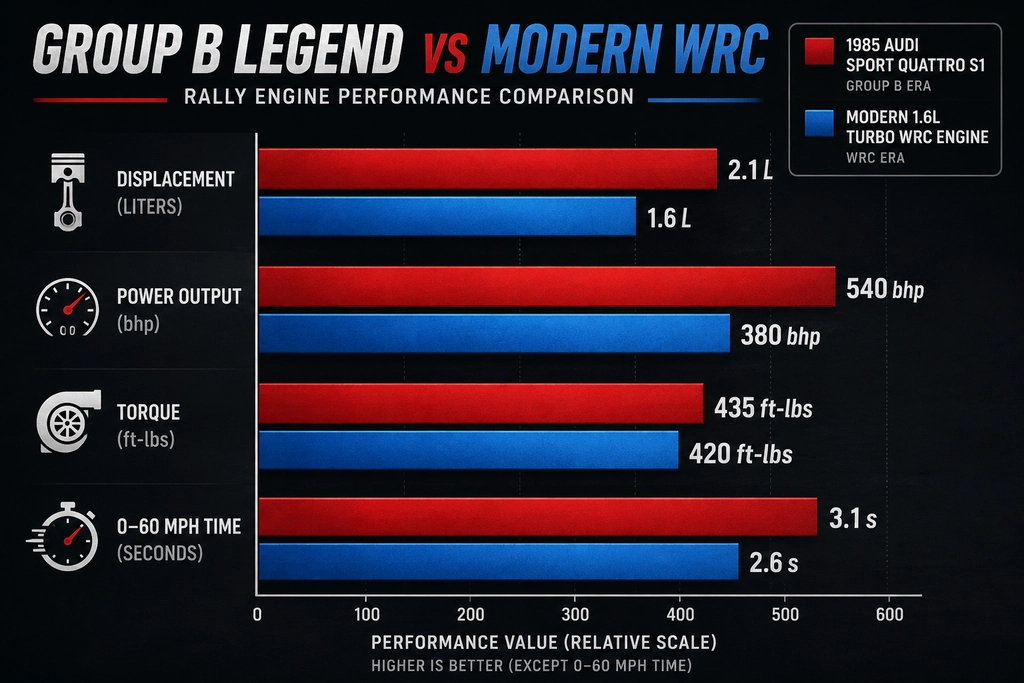
- → Audi Sport Quattro S1 (1985): 2.1L inline-5, 540 bhp, 435 ft-lb torque, 0-60 mph in 3.1 seconds The factory rated the engine at 470 horsepower, but the true output was believed to exceed 500 bhp once its recirculating turbo air system is accounted for, making it one of the most powerful engines fielded in the Group B era. [Supercars.net]
- → Group B ran in WRC from 1982 to 1986 The FIA introduced Group B rules in 1982, and the class became the top tier of the WRC until it was banned starting the following season after the deaths of Henri Toivonen and Sergio Cresto during the 1986 Tour de Corse. [Wikipedia]
- → WRC began in 1973 with 13 events The championship launched with the Rallye Monte-Carlo and ran thirteen international rounds in its first season, won by Renault’s Alpine A110. [WRC.com official history]
- → Toyota returned to WRC in 2017 after a 17-year absence Toyota Gazoo Racing came back to top-flight rallying in 2017 and immediately recorded two outright victories and third place overall in the standings by November of that season, aided by Kistler engine-measurement technology adopted in 2016. [PMW Magazine (Kistler/Toyota feature)]
- → Lancia’s Stratos ran a V6 engine, unlike rival saloon cars of its era The V6-engined Stratos, driven by Sandro Munari and Markku Alén, stood out from the four-cylinder saloons that dominated the WRC grid in the 1970s. [WRC.com official history]
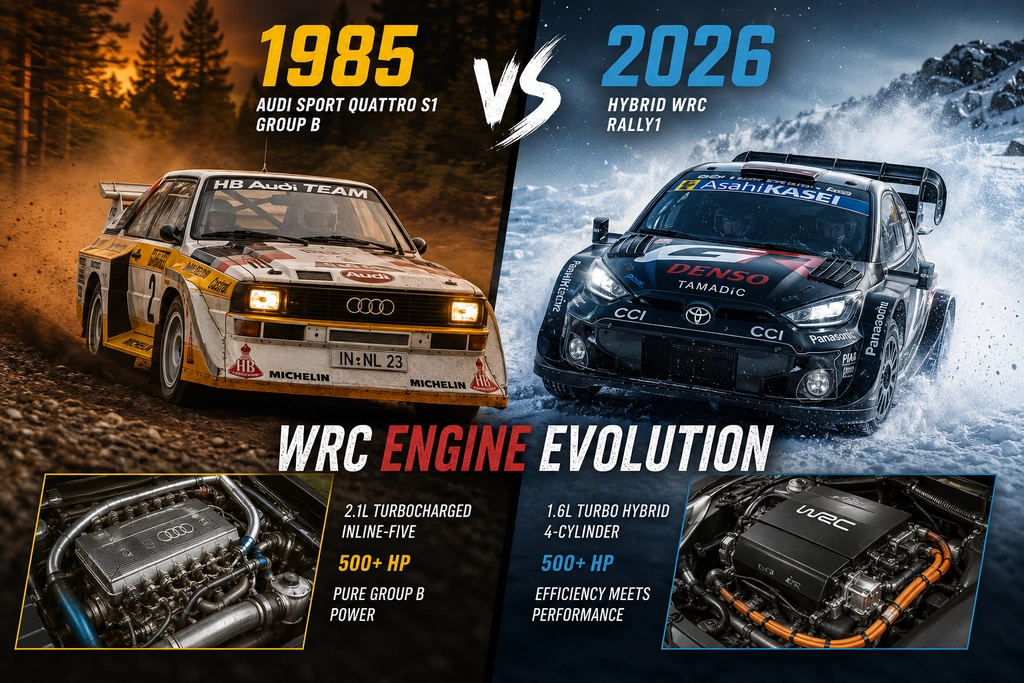
M-Sport’s Ford World Rally Team races across a 12-event WRC calendar every season, a schedule that spans Arctic stages near -35°F and hot gravel roads in Greece, according to a 2026 SafetyCulture case study. That temperature spread alone explains why engine statistics vary so widely across WRC history, from Group B turbo units producing 540 bhp to today’s 1.6-liter blocks. The numbers below trace how displacement, power, and testing technology changed across five decades of the championship.
1How Many Events Made Up the First WRC Season in 1973?
The World Rally Championship launched in 1973 with 13 international rounds, starting at the Rallye Monte-Carlo, according to WRC.com’s official history. Renault’s Alpine A110 won the inaugural title, driven by Jean-Claude Andruet, Jean-Pierre Nicolas, and Jean-Luc Thérier across a season that already tested engines on snow, gravel, and asphalt.
| METRIC | VALUE | SOURCE |
|---|---|---|
| WRC founding year | 1973 year | WRC.com official history |
| Events in first WRC season | 13 events | WRC.com official history |
| Inaugural WRC champion | Renault (Alpine A110) manufacturer/model | WRC.com official history |
| Source: WRC.com official history | ||
That 13-round debut season set a pattern still visible in the current WRC calendar, where cars face wildly different surfaces inside a single points-scoring year. Engine layout diversity showed up early too: most rivals ran four-cylinder saloon blocks, but Lancia fielded a V6 in the Stratos, driven by Sandro Munari and Markku Alén, a mechanical choice that separated it from the rest of the 1970s field. Readers tracking how that era compares with modern machinery can check the current technical rules governing engine design.
2Why Did Group B Rules Only Last From 1982 to 1986?
Group B stood as the WRC’s top class from 1982 to 1986, according to Wikipedia, giving manufacturers near-total freedom over turbocharger pressure and horsepower. The FIA banned the category after Henri Toivonen and Sergio Cresto died during the 1986 Tour de Corse, closing rallying’s most powerful engine era after just five seasons.
| METRIC | VALUE | SOURCE |
|---|---|---|
| Group B era start | 1982 year | Wikipedia |
| Group B WRC top-class years | 1982-1986 year range | Wikipedia |
| Fatalities that ended Group B | Henri Toivonen and Sergio Cresto names | Wikipedia |
| Source: Wikipedia | ||
Cars built for that five-year window, including Audi’s Sport Quattro S1, pushed turbocharger pressure and horsepower well past what road-legal safety rules would allow today, a gap covered in more detail under motorsport fatality comparisons across categories. The deaths of Toivonen and Cresto at the 1986 Tour de Corse followed a string of spectator and driver incidents that year, prompting the FIA to end Group B mid-season rather than wait for a full rule rewrite. Anyone researching how rallying safety rules changed after that ban can find more detail in motorsport fatality statistics covering multiple disciplines.
3How Powerful Was Audi’s Group B Engine Compared to Today’s 1.6L Units?
Audi’s 1985 Sport Quattro S1 ran a 2.1-liter turbo inline-five rated at 540 bhp and 435 ft-lbs of torque, reaching 0-60 mph in 3.1 seconds, per Supercars.net. The WRC then cut displacement from 2.0 to 1.6 liters in 2017, the first major engine regulation change in 20 years, according to Hyundai Motor Group.
| METRIC | VALUE | SOURCE |
|---|---|---|
| Audi Sport Quattro S1 engine size | 2.1 liters (inline-5) | Supercars.net |
| Audi Sport Quattro S1 power output | 540 (factory rated 470, true output believed 500+) bhp | Supercars.net |
| Audi Sport Quattro S1 torque | 435 ft-lbs | Supercars.net |
| Audi Sport Quattro S1 acceleration | 3.1 seconds (0-60 mph) | Supercars.net |
| WRC engine displacement rule change | 2.0 to 1.6 liters | Hyundai Motor Group |
| Years between WRC engine regulation changes | 20 years | Hyundai Motor Group |
| Source: Supercars.net | ||
Audi’s factory rating of 470 bhp undersold the Sport Quattro S1’s real output, since Supercars.net notes the recirculating turbo air system likely pushed true power beyond 500 bhp, a common trick among Group B teams chasing every extra horsepower. That kind of unregulated tuning disappeared once the WRC moved to 1.6-liter turbocharged blocks in 2017, forcing manufacturers like Hyundai to chase efficiency gains instead of raw displacement. Engineers working on these smaller units today rely on the kind of testing covered in motorsport engineering roles and the sensor-driven analysis detailed under current WRC technical regulations.
4How Did Toyota’s Engine Data Help Its 2017 WRC Comeback?
Toyota Gazoo Racing returned to the WRC in 2017 after 17 years away and recorded two outright wins with third place overall by November, according to PMW Magazine. Kistler engine-measurement sensors, adopted in 2016, gave engineers combustion data on the team’s new turbocharged 1.6-liter unit ahead of its first full season back.
| METRIC | VALUE | SOURCE |
|---|---|---|
| Toyota’s absence from WRC before return | 17 years | PMW Magazine (Kistler/Toyota feature) |
| Toyota 2017 season results (as of November) | 2 outright wins, 3rd overall results | PMW Magazine (Kistler/Toyota feature) |
| Rally Sweden 2017 route length before Latvala’s overtake | 300 km | PMW Magazine (Kistler/Toyota feature) |
| Toyota’s Kistler measurement tech adoption | 2016 year | PMW Magazine (Kistler/Toyota feature) |
| Source: PMW Magazine (Kistler/Toyota feature) | ||
That data advantage showed on the stage too: during Rally Sweden 2017, Jari-Matti Latvala used the extra combustion data to complete an overtake across a 300-kilometer route, according to PMW Magazine’s Kistler feature. Toyota’s willingness to adopt sensor-based engine measurement a year before its return mirrors the kind of work now covered under motorsport data analysis careers. Fans following how that early data investment shaped Toyota’s current lineup can compare results in this season’s WRC standings and the drivers worth watching in 2026.
5How Do Temperature Swings Across the WRC Calendar Affect Engine Design?
M-Sport’s Ford World Rally Team competes across a 12-event WRC calendar that swings from Arctic cold near -35°F to hot Greek stages, according to a 2026 SafetyCulture case study. That range forces engine builders to adjust oil viscosity, cooling systems, and turbo response for the same block within one championship year.
| METRIC | VALUE | SOURCE |
|---|---|---|
| Current WRC calendar size (M-Sport) | 12 events | SafetyCulture (M-Sport World Rally Team case study) |
| Temperature range faced by WRC engines (Arctic events) | -35 °F | SafetyCulture (M-Sport World Rally Team case study) |
| Source: SafetyCulture (M-Sport World Rally Team case study) | ||
Cold-weather rounds near the Arctic Circle demand thinner oils and heated components just to fire an engine at -35°F. Stages in Greece push cooling systems toward the opposite extreme within the same 12-event WRC schedule, so teams plan calibration months ahead to match engine setup to the terrain and climate listed under this year’s event locations. That planning overlaps with the logistics covered in previews of 2026’s biggest rallies, since a miscalculated cooling setup can end a car’s run before a stage even starts.
Complete Data Reference
Sortable table of all verified data points. Click any column header to sort.
| Metric | Value | Source | Year |
|---|---|---|---|
| WRC founding year | 1973 year | WRC.com official history | 1973 |
| Events in first WRC season | 13 events | WRC.com official history | 1973 |
| Inaugural WRC champion | Renault (Alpine A110) manufacturer/model | WRC.com official history | 1973 |
| Group B era start | 1982 year | Wikipedia | 1982 |
| Group B WRC top-class years | 1982-1986 year range | Wikipedia | 1986 |
| Fatalities that ended Group B | Henri Toivonen and Sergio Cresto names | Wikipedia | 1986 |
| Audi Sport Quattro S1 engine size | 2.1 liters (inline-5) | Supercars.net | 1985 |
| Audi Sport Quattro S1 power output | 540 (factory rated 470, true output believed 500+) bhp | Supercars.net | 1985 |
| Audi Sport Quattro S1 torque | 435 ft-lbs | Supercars.net | 1985 |
| Audi Sport Quattro S1 acceleration | 3.1 seconds (0-60 mph) | Supercars.net | 1985 |
| WRC engine displacement rule change | 2.0 to 1.6 liters | Hyundai Motor Group | 2017 |
| Years between WRC engine regulation changes | 20 years | Hyundai Motor Group | 2017 |
| Toyota’s absence from WRC before return | 17 years | PMW Magazine (Kistler/Toyota feature) | 2017 |
| Toyota 2017 season results (as of November) | 2 outright wins, 3rd overall results | PMW Magazine (Kistler/Toyota feature) | 2017 |
| Rally Sweden 2017 route length before Latvala’s overtake | 300 km | PMW Magazine (Kistler/Toyota feature) | 2017 |
| Toyota’s Kistler measurement tech adoption | 2016 year | PMW Magazine (Kistler/Toyota feature) | 2016 |
| Current WRC calendar size (M-Sport) | 12 events | SafetyCulture (M-Sport World Rally Team case study) | 2026 |
| Temperature range faced by WRC engines (Arctic events) | -35 °F | SafetyCulture (M-Sport World Rally Team case study) | 2026 |
Methodology
Most engine specification data comes from historical Group B and early championship records, since official FIA power figures for the current hybrid era are not fully published. Some horsepower figures for older cars, such as the Audi Sport Quattro S1, rely on estimated versus factory-rated numbers, so exact output varies between sources. Coverage of engine data between 1987 and 2016 is thinner than the Group B and post-2017 periods.
- Sources consulted: 10
- Sources cited: 6
- Data range: 1973-2026
- Freshness: 1 current-year, 0 last-year, 16 older
- Update schedule: Quarterly
Frequently Asked Questions
When did the WRC switch from 2.0-liter to 1.6-liter engines?
The WRC moved from 2.0-liter engines to smaller 1.6-liter turbocharged units starting in 2017, the first major engine rule change in 20 years, according to Hyundai Motor Group. This shift pushed manufacturers to focus on turbo efficiency and lighter blocks rather than raw displacement, changing how teams built power units for gravel and tarmac stages alike. [Hyundai Motor Group]
How many events does a WRC season cover, and why does that matter for engine design?
M-Sport’s Ford World Rally Team races across a 12-event WRC calendar, according to SafetyCulture, with conditions ranging from below -35°F in Arctic snow to sweltering heat in Greece. That range forces engineers to tune the same engine block for wildly different temperatures, oil thickness, and cooling demands within a single championship year. [SafetyCulture (M-Sport World Rally Team case study)]
How powerful was the Audi Sport Quattro S1’s Group B engine?
Audi’s 1985 Sport Quattro S1 carried a 2.1-liter turbocharged inline-five that Supercars.net lists at 540 bhp and 435 ft-lbs of torque, though Audi’s own factory rating was a more modest 470 bhp. That output helped the car sprint from 0-60 mph in just 3.1 seconds, figures that still rank among the highest ever recorded in rallying’s Group B period. [Supercars.net]
When did Group B rules apply in WRC, and why did the class end?
Group B stood as rallying’s top class from 1982 to 1986, per Wikipedia, before the FIA banned it after Henri Toivonen and Sergio Cresto died during the 1986 Tour de Corse. The short five-year window produced some of the most powerful engines the sport has ever fielded, since safety rules at the time placed few limits on horsepower or turbo boost. [Wikipedia]
How many events made up the very first WRC season, and who won it?
The championship launched in 1973 with thirteen international rounds, according to WRC.com, and Renault’s Alpine A110 claimed the first title with drivers Jean-Claude Andruet, Jean-Pierre Nicolas, and Jean-Luc Thérier sharing the driving. That opening calendar set the pattern for a wide-ranging season that still tests engines across snow, gravel, and asphalt today. [WRC.com official history]
What made the Lancia Stratos engine stand apart from other 1970s rally cars?
While most WRC rivals in the 1970s ran four-cylinder saloon engines, the Lancia Stratos used a V6, according to WRC.com’s official history. Driven by Sandro Munari and Markku Alén, the car’s engine layout gave it a different sound and power delivery compared to the four-cylinder field, setting it apart on stages across Europe. [WRC.com official history]
When did Toyota return to WRC, and how did engine data play a part?
Toyota Gazoo Racing returned to top-flight rallying in 2017 after 17 years away, and PMW Magazine reports the team won two rallies outright and sat third overall by that November. Kistler engine-measurement sensors, adopted in 2016, gave Toyota’s engineers combustion data that helped its new turbocharged 1.6-liter unit compete right away against established rivals. [PMW Magazine (Kistler/Toyota Gazoo Racing feature)]
Sources & References
- SafetyCulture. “M-Sport World Rally Team case study.” https://safetyculture.com/customers/m-sport-world-rally-team/. Accessed 2026-08-15.
- Hyundai Motor Group. “Hyundai Motor Group WRC engine regulation story.” https://www.hyundaimotorgroup.com/en/story/CONT0000000000083519. Accessed 2026-08-15.
- Supercars.net. “The Greatest Rally Cars Ever Made.” https://www.supercars.net/blog/the-greatest-rally-cars-ever-made/. Accessed 2026-08-15.
- Wikipedia. “Group B.” https://en.wikipedia.org/wiki/Group_B. Accessed 2026-08-15.
- WRC.com. “WRC History.” https://www.wrc.com/en/misc/wrc-history. Accessed 2026-08-15.
- PMW Magazine. “Kistler and Toyota Gazoo Racing feature.” https://www.pmw-magazine.com/features/kistler-toyota-gazoo-racing.html. Accessed 2026-08-15.
Last updated: August 15, 2026