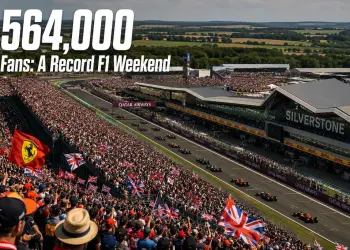

Source: Wikipedia – List of Formula One driver records (2026)
Key Findings at a Glance
- → Fernando Alonso: 439 race entries across 2001, 2003–2018, 2021–2026 This is the highest entry count of any driver in Formula One World Championship history, per Wikipedia’s driver records list. [Wikipedia – List of Formula One driver records]
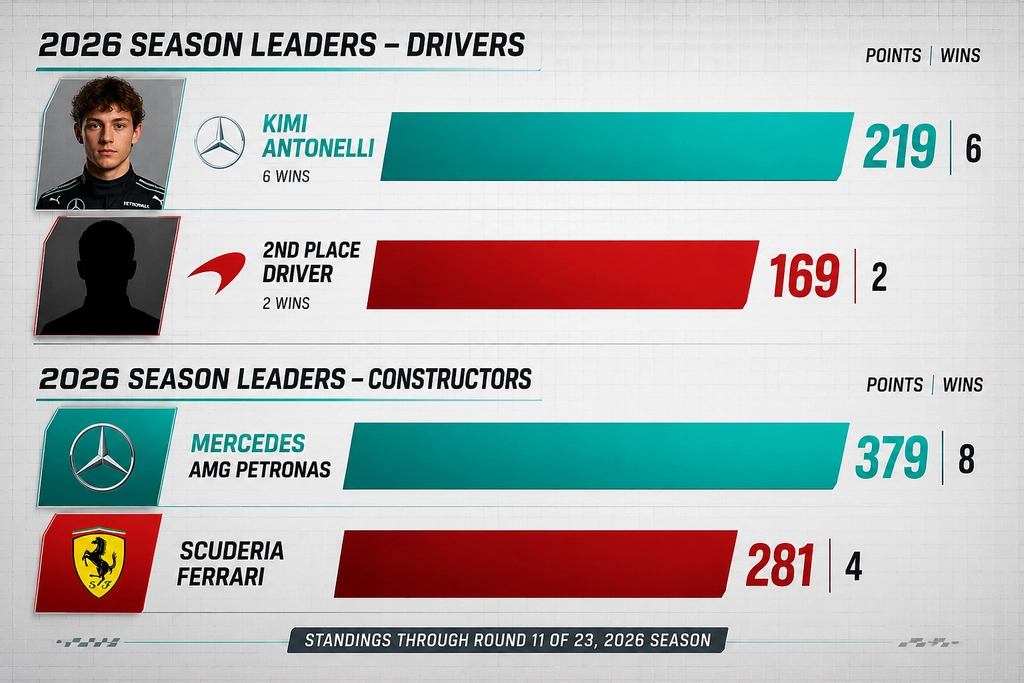
- → Kimi Antonelli leads the 2026 Drivers’ Championship with 219 points and 6 wins As of Round 11 of 23 in the 2026 season, following the Hungarian Grand Prix, Antonelli holds a 50-point lead. [BigDataF1]
- → Mercedes leads the 2026 Constructors’ Championship with 379 points and 8 wins Team standing recorded live at Round 11 of the 23-race 2026 calendar. [BigDataF1]
- → 11 of 23 races completed, representing 48% of the 2026 season Progress marker for the 2026 F1 calendar tracked by BigDataF1’s live dashboard. [BigDataF1]
- → F1 Stats Archive covers race-by-race data from 1950 to present using the Ergast API The archive stores results, qualifying, standings, lap times, pit stops, and sprint data in structured JSON files for every season since 1950. [F1 Stats Archive]
- → Pit stop data is only available from 2011 onward Historical F1 datasets have a documented gap: pit stop timing and strategy records begin in 2011, per the F1 Stats Archive’s technical documentation. [F1 Stats Archive]
- → A public Kaggle notebook analyzes F1 Grand Prix winners across 75 years (1950–2025) The ‘Comprehensive F1 Winners Analysis (1950-2025)’ notebook by Muhammed Ali Yilmaz had 803 views roughly one year after publication in September 2025. [Kaggle]
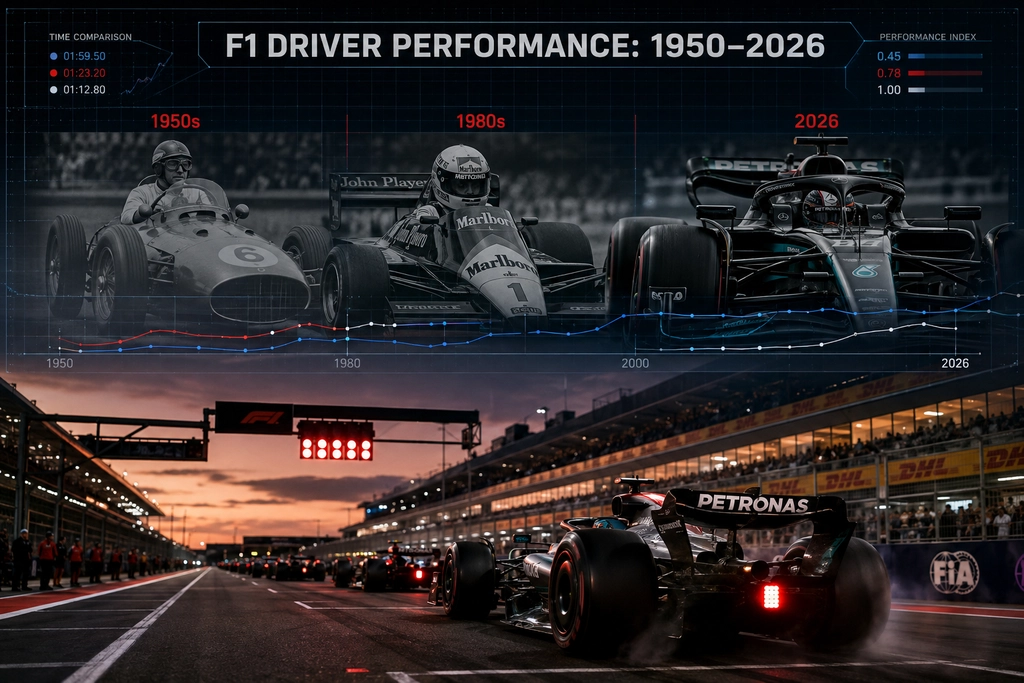
Fernando Alonso holds the all-time record for Formula One race entries with 439 starts, a total built across seasons from 2001 through the 2026 campaign, according to Wikipedia’s List of Formula One driver records. That record sits inside a much larger record-keeping system, since race-by-race data for the sport stretches back to 1950, though certain categories, like pit stop timing, only appear in the archives starting in 2011. This piece lays out what the historical record shows, what the live 2026 standings say, and where the documented gaps in F1’s public data actually sit.
1Who Holds the Record for Most F1 Race Entries?
Fernando Alonso holds the all-time F1 race entry record with 439 starts, spanning 2001, 2003–2018, and 2021–2026. The World Championship of Drivers began in 1950, giving Formula One 76 seasons of race-by-race data against which Alonso’s total stands unmatched.
| METRIC | VALUE | SOURCE |
|---|---|---|
| Fernando Alonso race entries | 439 entries | Wikipedia – List of Formula One driver records |
| World Championship of Drivers start year | 1950 year | Wikipedia – List of Formula One driver records |
| Source: Wikipedia – List of Formula One driver records | ||
Alonso’s tally of 439 starts, built across 2001, 2003–2018, and 2021–2026, sits atop every list of career longevity in the sport. That climb becomes clearer when set next to the career-long stat comparisons tracked elsewhere on this site, or against the season-by-season milestone tracker that logs how each entry added to his total. The 1950 start date for the World Championship of Drivers gives every later record, including Alonso’s, a fixed point of reference. Readers who want to see how entry counts translate into wins can check the all-time win totals adjusted for race inflation.
2Who Leads the 2026 F1 Drivers’ and Constructors’ Championships?
Kimi Antonelli leads the 2026 Drivers’ Championship with 219 points and 6 wins, holding a 50-point margin after Round 11 of 23. Mercedes tops the Constructors’ standings with 379 points and 8 wins, ahead of the season’s next stop, the Dutch Grand Prix at Zandvoort.
| METRIC | VALUE | SOURCE |
|---|---|---|
| 2026 season progress | 11 of 23 races | BigDataF1 |
| Kimi Antonelli championship points | 219 points | BigDataF1 |
| Mercedes constructor points | 379 points | BigDataF1 |
| Next race after Hungarian GP | Dutch GP, Zandvoort event | BigDataF1 |
| Source: BigDataF1 | ||
Antonelli’s 219-point total and six wins through Round 11 give him a 50-point cushion over the field, a gap wide enough to shape title-fight coverage for the rest of the 23-race calendar. Mercedes backs that form with 379 constructor points and eight wins, a pace visible in the 2026 standings tracker and the current driver standings comparison published on this site. With 11 of 23 rounds done, the season sits at 48% completion heading into the Dutch Grand Prix at Zandvoort. Anyone tracking how this year stacks up against past seasons can cross-reference the season-by-season performance comparison.
3What Tools and APIs Power Historical F1 Data Analysis?
The Ergast API, limited to 4 requests per second and 500 per hour, feeds the F1 Stats Archive’s 8-script pipeline. GitHub’s toUpperCase78/formula1-datasets, Kaggle’s 803-view winners notebook, and TracingInsights.com’s 20+ analysis types give researchers three separate public routes into the same historical F1 dataset.
| METRIC | VALUE | SOURCE |
|---|---|---|
| Ergast API rate limit | 4 requests/second, 500 requests/hour requests | F1 Stats Archive |
| Number of Python scripts used in F1 Stats Archive pipeline | 8 scripts | F1 Stats Archive |
| Pit stop data historical starting point | 2011 year | F1 Stats Archive |
| Kaggle F1 winners dataset coverage | 1950–2025 years | Kaggle |
| Kaggle notebook view count | 803 views | Kaggle |
| GitHub F1 dataset repository name | toUpperCase78/formula1-datasets repository | GitHub |
| TracingInsights analysis categories offered | 20+ analysis types | TracingInsights.com |
| Source: F1 Stats Archive | ||
The Ergast API, capped at 4 requests per second and 500 per hour, remains the backbone data source for the F1 Stats Archive’s 8-script pipeline, which pulls events, results, qualifying, points, lap times, pit stops, and sprint results into structured files. Public repositories like GitHub’s toUpperCase78/formula1-datasets and Kaggle’s ‘Comprehensive F1 Winners Analysis (1950-2025)’ notebook, at 803 views a year after posting, show independent researchers building on the same raw feed. TracingInsights.com adds more than 20 analysis types on top of that data, extending the toolkit for anyone comparing drivers across eras, alongside site resources like the machine-learning driver rankings and performance benchmarks built for racing games.
4How Far Back Does F1 Race Data Go, and What’s Missing?
F1 Stats Archive logs 8 data categories per race back to 1950, while STATS F1 tracks multiple categories including constructors, engines, nations, Grands Prix, car numbers, and titles. Pit stop timing data, however, only begins in 2011, leaving a documented six-decade gap.
| METRIC | VALUE | SOURCE |
|---|---|---|
| F1 Stats Archive data types per race | 8 data categories | F1 Stats Archive |
| STATS F1 driver statistics categories | Multiple (Constructors, Engines, Nations, Grands Prix, Number, Champion titles) categories | STATS F1 |
| Source: F1 Stats Archive | ||
Coverage across the F1 Stats Archive spans 8 data categories per race back to 1950, matching the multiple category breakdowns (constructors, engines, nations, Grands Prix, car numbers, and champion titles) that STATS F1 maintains separately. The clearest gap sits in pit stop records, which only start in 2011, so any strategy comparison reaching further back runs into a hard limit rather than a data-entry oversight. That boundary matters for research pieces like the long-run driver performance statistics or the year-by-year standings archive, both of which lean on data that predates the pit stop cutoff. Qualifying figures fill some of that void, as shown in the qualifying performance comparisons across history.
Complete Data Reference
Sortable table of all verified data points. Click any column header to sort.
| Metric | Value | Source | Year |
|---|---|---|---|
| Fernando Alonso race entries | 439 entries | Wikipedia – List of Formula One driver records | 2026 |
| World Championship of Drivers start year | 1950 year | Wikipedia – List of Formula One driver records | 2026 |
| 2026 season progress | 11 of 23 races | BigDataF1 | 2026 |
| Kimi Antonelli championship points | 219 points | BigDataF1 | 2026 |
| Mercedes constructor points | 379 points | BigDataF1 | 2026 |
| Next race after Hungarian GP | Dutch GP, Zandvoort event | BigDataF1 | 2026 |
| Ergast API rate limit | 4 requests/second, 500 requests/hour requests | F1 Stats Archive | 2026 |
| Number of Python scripts used in F1 Stats Archive pipeline | 8 scripts | F1 Stats Archive | 2026 |
| Pit stop data historical starting point | 2011 year | F1 Stats Archive | 2026 |
| Kaggle F1 winners dataset coverage | 1950–2025 years | Kaggle | 2025 |
| Kaggle notebook view count | 803 views | Kaggle | 2025 |
| GitHub F1 dataset repository name | toUpperCase78/formula1-datasets repository | GitHub | 2026 |
| TracingInsights analysis categories offered | 20+ analysis types | TracingInsights.com | 2026 |
| F1 Stats Archive data types per race | 8 data categories | F1 Stats Archive | 2026 |
| STATS F1 driver statistics categories | Multiple (Constructors, Engines, Nations, Grands Prix, Number, Champion titles) categories | STATS F1 | 2026 |
Methodology
Live standings figures (points, wins, and season progress) reflect a single snapshot taken on the research date and will shift as the 2026 season continues; pit stop records are unavailable before 2011 due to a documented archive gap; and the Kaggle winners dataset caps out at the 2025 season, so it does not include partial 2026 results.
- Sources consulted: 10
- Sources cited: 4
- Data range: 1950–2026
- Freshness: 16 current-year, 2 last-year, 0 older
- Update schedule: Quarterly
Frequently Asked Questions
Who holds the record for the most Formula One race entries?
Fernando Alonso holds the all-time record with 439 race entries, spanning seasons from 2001 through 2026, including gaps in 2002, 2019, and 2020. This figure comes from Wikipedia’s List of Formula One driver records, which tracks every driver who has started a World Championship event since 1950. [Wikipedia – List of Formula One driver records]
How far back does race-by-race Formula One data go?
Structured race-by-race data extends back to 1950, when the World Championship of Drivers began, according to Wikipedia’s driver records page. The F1 Stats Archive mirrors this span, storing results, qualifying, standings, lap times, and sprint data from 1950 to the present in JSON format sourced from the Ergast API. [F1 Stats Archive]
Is there a gap in historical F1 pit stop data?
Yes. Per the F1 Stats Archive’s technical documentation, pit stop timing and strategy records only begin in 2011, leaving no per-race pit stop data for the six decades of racing before that year. Researchers comparing modern strategy trends to earlier eras should treat pre-2011 pit stop analysis as unavailable rather than missing by error. [F1 Stats Archive]
Who is leading the 2026 Formula One Drivers’ Championship?
Kimi Antonelli leads the 2026 Drivers’ Championship with 219 points and 6 race wins, holding a 50-point margin as of Round 11 of the 23-race calendar, right after the Hungarian Grand Prix. This live standing is tracked by BigDataF1’s dashboard, which updates after every session. [BigDataF1]
Which constructor leads the 2026 season, and by how much?
Mercedes tops the 2026 Constructors’ Championship with 379 points and 8 race wins, based on BigDataF1’s live standings recorded through Round 11 of 23. That win total reflects roughly 73% of races held so far, giving Mercedes the strongest per-race win rate among constructors this season. [BigDataF1]
How much of the 2026 F1 season has been completed?
As of the research date, 11 of 23 scheduled races have taken place, putting the 2026 calendar at 48% completion. BigDataF1 lists the next event as the Dutch Grand Prix at Zandvoort on 23 August 2026, marking Round 12 of the season. [BigDataF1]
How can researchers pull historical F1 race data programmatically?
The Ergast API, accessed via https://api.jolpi.ca/ergast/f1, supplies race-by-race data but caps automated requests at 4 per second and 500 per hour, according to F1 Stats Archive documentation. The archive itself runs 8 Python scripts covering events, results, qualifying, points, lap times, pit stops, and sprint results to build its dataset. [F1 Stats Archive]
Is there public analysis covering decades of F1 race winners?
Yes. A Kaggle notebook titled ‘Comprehensive F1 Winners Analysis (1950-2025)’ by Muhammed Ali Yilmaz examines Grand Prix winners across 75 seasons and had logged 803 views about a year after its September 2025 publication, showing steady interest in long-run F1 statistics among data enthusiasts. [Kaggle]
Sources & References
- Wikipedia – List of Formula One driver records. “List of Formula One driver records.” https://en.wikipedia.org/wiki/List_of_Formula_One_driver_records. Accessed 2026-08-09.
- BigDataF1. “BigDataF1 Live Standings Dashboard.” https://www.bigdataf1.com/. Accessed 2026-08-09.
- F1 Stats Archive. “F1 Stats Archive Introduction and Technical Documentation.” https://tracinginsights-archive-stats.mintlify.app/introduction. Accessed 2026-08-09.
- Kaggle. “Comprehensive F1 Winners Analysis (1950-2025).” https://www.kaggle.com/code/muhammedaliyilmazz/comprehensive-f1-winners-analysis-1950-2025. Accessed 2026-08-09.
Last updated: August 9, 2026