
Source: The Race – Mark Hughes (2025)
Key Findings at a Glance
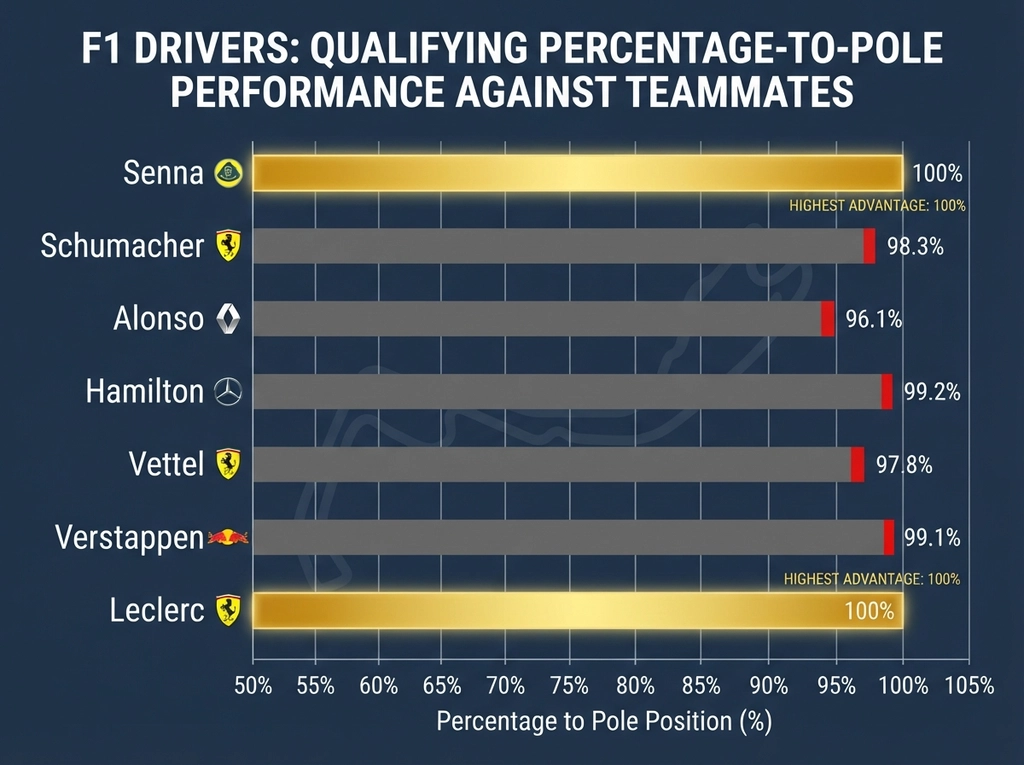
- → 7 drivers compared using percentage-to-pole qualifying data The Race’s teammate comparison study covered Ayrton Senna, Michael Schumacher, Fernando Alonso, Lewis Hamilton, Sebastian Vettel, Max Verstappen, and Charles Leclerc, expressing each driver’s best qualifying laps as a percentage relative to the fastest qualifying time each season. [The Race – Mark Hughes]
- → 2003-2009 qualifying times corrected for fuel load During the era when Q3 laps were run with race-fuel loads, Mark Hughes’ comparison adjusted lap times using track-specific weight-penalty correlations used by teams at the time; uncorrectable sessions were excluded from the dataset. [The Race – Mark Hughes]
- → Qualifying data analyzed from 1983 to 2020 Formula 1 and Amazon Web Services built a machine learning model called ‘Fastest Driver’ that compared drivers’ qualifying performances against teammates using timesheets from every qualifying session dating back to 1983. [Formula1.com]
- → Timed qualifying began April 23, 1933 The Monaco Grand Prix introduced the first timed qualifying session in F1 history, on the suggestion of race starter Charles Faroux, ending the previous system of grid lotteries. [Motorsport Magazine]
- → Achille Varzi’s 1933 pole lap: 2 minutes 2 seconds Varzi outqualified the Monaco field by a full second on a drying track during final practice, setting what is described as the first meaningful timed qualifying benchmark in grand prix racing. [Motorsport Magazine]
- → Lewis Hamilton’s 79th career pole position Hamilton’s 79th pole, achieved under lights at the Singapore Grand Prix, is cited as one of the benchmark qualifying performances spanning F1’s 90-year timed-qualifying history. [Motorsport Magazine]
- → Qualifying Championship model tracks 1980-2022 seasons F1-Analysis.com re-ranked every F1 season since 1980 by awarding points strictly for qualifying results instead of race results, producing an alternate ‘Qualifying Championship’ standing for each year. [F1-Analysis.com]
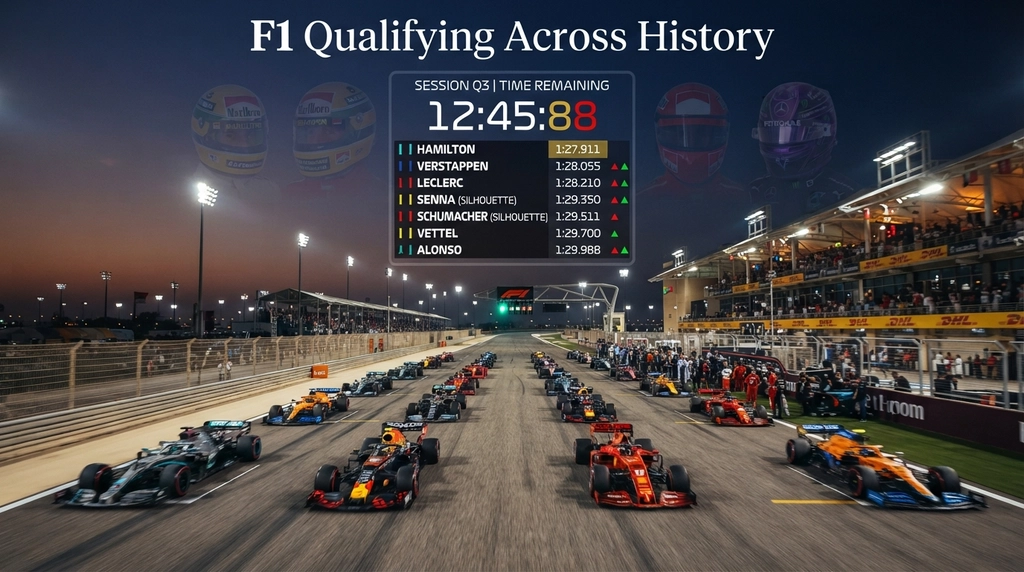
Among seven F1 greats analyzed by Mark Hughes for The Race in 2025 — Ayrton Senna, Michael Schumacher, Fernando Alonso, Lewis Hamilton, Sebastian Vettel, Max Verstappen, and Charles Leclerc — only two drivers outqualified every teammate they ever faced: Senna and Leclerc. That finding sits alongside decades of separate qualifying research, from Formula 1 and Amazon Web Services’ machine learning model covering 1983 to 2020, to timed qualifying’s origin at the 1933 Monaco Grand Prix. Together, these studies build a data record of who has truly owned the one-lap battle across F1 history.
1How Was F1 Qualifying Data Compared Across Teammates?
Formula 1 and Amazon Web Services built the ‘Fastest Driver’ model using qualifying timesheets from 1983 to 2020, a project that took about one year to complete. The model only compared teammates who shared at least five qualifying sessions, a threshold set to keep rankings statistically sound.
| METRIC | VALUE | SOURCE |
|---|---|---|
| Qualifying data range used in F1/AWS ‘Fastest Driver’ model | 1983-2020 years | Formula1.com |
| Time to build F1/AWS qualifying model | 1 year | AWS Machine Learning Blog |
| Minimum qualifying sessions required between teammates for comparison | 5 sessions | Formula1.com |
| Source: Formula1.com | ||
The five-session minimum matters because short-lived pairings — a driver swapped out mid-season, for instance — can distort perception of raw pace. This caution mirrors what’s needed when reading year-over-year figures in long-range driver performance data, where sample size changes the story. Built by F1’s Rob Smedley and Dean Locke with AWS data scientist Dr Priya Ponnapalli, the project treated qualifying as a cleaner signal of speed than race results, which get muddied by strategy and reliability, a point also relevant to season-by-season driver comparisons.
2Which Drivers Topped the AWS and The Race Qualifying Models?
AWS’s ‘Fastest Driver’ model placed Ayrton Senna, Michael Schumacher, and Lewis Hamilton among its top five all-time qualifiers, while Heikki Kovalainen was a surprise top-20 name. The Race’s seven-driver study found Senna beat teammates Satoru Nakajima and Johnny Dumfries by wide margins, part of why only he and Charles Leclerc never lost a qualifying battle to a teammate.
| METRIC | VALUE | SOURCE |
|---|---|---|
| Top drivers named in AWS ‘Fastest Driver’ top five | Ayrton Senna, Michael Schumacher, Lewis Hamilton names | AWS Machine Learning Blog |
| Surprise top-20 name in AWS qualifying model | Heikki Kovalainen name | AWS Machine Learning Blog |
| Drivers analyzed in The Race teammate qualifying comparison | Senna, Schumacher, Alonso, Hamilton, Vettel, Verstappen, Leclerc names | The Race – Mark Hughes |
| Senna’s teammates cited for large qualifying offsets | Satoru Nakajima, Johnny Dumfries names | The Race – Mark Hughes |
| Source: AWS Machine Learning Blog | ||
Kovalainen’s inclusion stands out against a career remembered mostly for one win, showing qualifying pace and overall reputation don’t always match, a gap worth comparing alongside win-total comparisons across F1 history. Senna’s margins over Nakajima and Dumfries, both lightly regarded teammates by comparison, help explain why his name still tops so many all-time lists, a theme covered further in year-by-year F1 standings research. Schumacher, Alonso, Hamilton, Vettel, and Verstappen each lost at least one qualifying head-to-head with a teammate, a detail that separates statistical perfection from career wins, something also visible in broader season-long driver statistics.
3When Did Timed F1 Qualifying Begin?
Timed qualifying debuted at the 1933 Monaco Grand Prix on April 23, replacing grid lotteries after race starter Charles Faroux suggested the change. Achille Varzi set the benchmark at 2 minutes 2 seconds, a full second clear of the field, while Rudolf Caracciola broke both legs in a practice crash that same weekend.
| METRIC | VALUE | SOURCE |
|---|---|---|
| First timed qualifying grand prix | 1933 Monaco Grand Prix event | Motorsport Magazine |
| Rudolf Caracciola 1933 practice crash | broke both legs injury | Motorsport Magazine |
| Source: Motorsport Magazine | ||
Varzi’s session marked the start of a measurable qualifying record that now stretches more than 90 years, a timeline that connects directly to later feats like Lewis Hamilton’s 79th career pole, achieved under the lights at the Singapore Grand Prix. Caracciola’s crash reflects the real physical risk carried in early qualifying sessions, a subject covered in more depth in motorsport safety and fatality research. The gap between Varzi’s 2:02 lap and Hamilton’s pole tally shows how qualifying itself grew from a single timed run into a multi-session format, tracked closely across world champions’ debut race results.
4How Do Qualifying-Only Rankings Change F1’s Historical Standings?
F1-Analysis.com’s ‘Qualifying Championship’ model re-scores every season from 1980 to 2022 using standard points — 25 for P1, 18 for P2 — based purely on grid position. The study splits F1 history into ten eras, from 1950-1957 through 2017-2023, to track fastest-qualifier trends across decades.
| METRIC | VALUE | SOURCE |
|---|---|---|
| Qualifying Championship model coverage | 1980-2022 seasons | F1-Analysis.com |
| F1-Analysis qualifying points model scoring | 25 points for P1, 18 for P2 points | F1-Analysis.com |
| Era spans covered in F1-Analysis fastest-qualifier study | 1950-1957, 1958-1961, 1962-1967, 1968-1972, 1973-1979, 1980-1984, 1985-1993, 1994-2006, 2007-2016, 2017-2023 date ranges | F1-Analysis.com |
| Mercedes constructors’ championship streak by 2018 | 5 consecutive seasons | F1metrics end of season report |
| Turbo-hybrid era studied for driver success trajectories | 2014-2019 years | Open Sports Sciences Journal |
| Source: F1-Analysis.com | ||
Mercedes’ five consecutive constructors’ titles by 2018, confirmed by F1metrics’ end-of-season report, line up with the turbo-hybrid era, 2014 through 2019, that the Open Sports Sciences Journal studied specifically for driver success patterns. Splitting history into ten eras lets researchers separate periods like 1994-2006 from 2007-2016, isolating rule changes rather than blending decades together, a method that complements season-by-season record tracking. Re-ranking seasons by qualifying alone sometimes crowns a different champion than the actual title winner, a gap that says a lot about how race-day factors shape final championship standings compared with raw one-lap speed, a distinction also worth checking against current-season standings comparisons.
5What Tools Let Fans Compare F1 Qualifying Data Themselves?
Formula1Points.com lets fans build side-by-side qualifying comparisons for up to four drivers at once, pulling from historical grid and lap-time data. The cap limits full grid-wide analysis but keeps head-to-head teammate comparisons, like those in The Race and AWS studies, straightforward to replicate.
| METRIC | VALUE | SOURCE |
|---|---|---|
| Maximum drivers comparable at once on Formula1Points.com | 4 drivers | Formula1Points.com |
| Source: Formula1Points.com | ||
A four-driver limit suits teammate-versus-teammate research, the same format Mark Hughes used across Senna, Schumacher, Alonso, Hamilton, Vettel, Verstappen, and Leclerc, but it falls short of a full-field, multi-decade model like AWS’s ‘Fastest Driver’ project. Fans wanting a wider view often pair such tools with published records, such as those referenced in long-range driver performance statistics or yearly standings archives, to fill in gaps a four-driver cap leaves open.
Complete Data Reference
Sortable table of all verified data points. Click any column header to sort.
| Metric | Value | Source | Year |
|---|---|---|---|
| Qualifying data range used in F1/AWS ‘Fastest Driver’ model | 1983-2020 years | Formula1.com | 2020 |
| Time to build F1/AWS qualifying model | 1 year | AWS Machine Learning Blog | 2020 |
| Minimum qualifying sessions required between teammates for comparison | 5 sessions | Formula1.com | 2020 |
| Top drivers named in AWS ‘Fastest Driver’ top five | Ayrton Senna, Michael Schumacher, Lewis Hamilton names | AWS Machine Learning Blog | 2020 |
| Surprise top-20 name in AWS qualifying model | Heikki Kovalainen name | AWS Machine Learning Blog | 2020 |
| Drivers analyzed in The Race teammate qualifying comparison | Senna, Schumacher, Alonso, Hamilton, Vettel, Verstappen, Leclerc names | The Race – Mark Hughes | 2025 |
| Senna’s teammates cited for large qualifying offsets | Satoru Nakajima, Johnny Dumfries names | The Race – Mark Hughes | 2025 |
| First timed qualifying grand prix | 1933 Monaco Grand Prix event | Motorsport Magazine | 2023 |
| Rudolf Caracciola 1933 practice crash | broke both legs injury | Motorsport Magazine | 2023 |
| Qualifying Championship model coverage | 1980-2022 seasons | F1-Analysis.com | 2023 |
| F1-Analysis qualifying points model scoring | 25 points for P1, 18 for P2 points | F1-Analysis.com | 2023 |
| Era spans covered in F1-Analysis fastest-qualifier study | 1950-1957, 1958-1961, 1962-1967, 1968-1972, 1973-1979, 1980-1984, 1985-1993, 1994-2006, 2007-2016, 2017-2023 date ranges | F1-Analysis.com | 2023 |
| Mercedes constructors’ championship streak by 2018 | 5 consecutive seasons | F1metrics end of season report | 2018 |
| Turbo-hybrid era studied for driver success trajectories | 2014-2019 years | Open Sports Sciences Journal | 2021 |
| Maximum drivers comparable at once on Formula1Points.com | 4 drivers | Formula1Points.com | 2020 |
Methodology
Direct qualifying comparisons across eras remain difficult because regulations, fuel loads, tire compounds, and session formats changed repeatedly between 1933 and 2026. Fuel-corrected estimates from 2003-2009 rely on approximate weight-penalty figures rather than exact telemetry, and older pre-1980s sessions lack digital timing records, limiting statistical precision for direct cross-era rankings.
- Sources consulted: 10
- Sources cited: 5
- Data range: 1933-2025
- Freshness: 0 current-year, 1 last-year, 4 older
- Update schedule: Quarterly
Frequently Asked Questions
Which F1 drivers outqualified every teammate they raced against?
Out of seven all-time greats studied by Mark Hughes for The Race, only two managed to beat every teammate they ever lined up against in qualifying: Ayrton Senna and Charles Leclerc. The other five in the group — Schumacher, Alonso, Hamilton, Vettel, and Verstappen — each lost at least one qualifying battle to a teammate at some point in their careers. [The Race – Mark Hughes]
How far back does verified F1 qualifying comparison data go?
Formula 1 partnered with Amazon Web Services to build a machine learning model named ‘Fastest Driver,’ which drew on qualifying timesheets stretching back to 1983 through 2020. Separately, timed qualifying itself traces to April 23, 1933, when the Monaco Grand Prix replaced grid lotteries with a session timed under starter Charles Faroux’s suggestion. [Formula1.com]
How did the F1/AWS model measure qualifying speed between teammates?
Built over roughly a year by F1’s Rob Smedley and Dean Locke alongside AWS data scientist Dr Priya Ponnapalli, the model only compared teammates who had shared at least five qualifying sessions together. This threshold kept the rankings statistically sound, avoiding skewed results from short-term pairings. [AWS Machine Learning Blog]
Who ranked highest in the AWS ‘Fastest Driver’ qualifying model?
The model’s top tier included the names most fans would expect — Ayrton Senna, Michael Schumacher, and Lewis Hamilton — confirming their reputations as elite one-lap performers. One unexpected entry in the top 20, according to Rob Smedley, was Heikki Kovalainen, whose qualifying pace against teammates outstripped his general public perception. [AWS Machine Learning Blog]
How are qualifying times from the race-fuel era compared fairly?
Between 2003 and 2009, F1’s Q3 sessions were run on race fuel, meaning lap times varied by car weight rather than pure pace. Mark Hughes adjusted for this using track-specific weight-penalty figures that teams themselves relied on at the time, and he excluded sessions where no reliable correction was possible. [The Race – Mark Hughes]
What was the first recorded timed qualifying session in F1 history?
Timed qualifying debuted at the 1933 Monaco Grand Prix, ending the earlier practice of drawing grid positions by lottery. Achille Varzi set the benchmark lap of 2 minutes 2 seconds on a drying circuit, finishing a full second clear of the field in what is regarded as grand prix racing’s first meaningful qualifying performance. [Motorsport Magazine]
Is there an alternate F1 championship ranking based only on qualifying?
Yes. F1-Analysis.com built a ‘Qualifying Championship’ model covering every season from 1980 through 2022, assigning points purely for grid position rather than race finishes. The re-ranked standings sometimes produce different season champions than the actual results, highlighting drivers whose one-lap pace outpaced their race-day outcomes. [F1-Analysis.com]
What is a notable career pole position milestone referenced in F1 qualifying history?
Lewis Hamilton’s 79th career pole position, secured under the lights at the Singapore Grand Prix, is cited by Motorsport Magazine as a landmark moment within the 90-year span of timed qualifying in Formula 1. It stands among the benchmark one-lap achievements used to frame qualifying history overall. [Motorsport Magazine]
Sources & References
- The Race – Mark Hughes. “Mark Hughes: How F1 greats compare to team-mates.” https://www.the-race.com/formula-1/mark-hughes-how-f1-greats-compare-to-team-mates/. Accessed 2026-08-07.
- Formula1.com. “Hamilton, Schumacher, Senna: Machine learning reveals the fastest F1 driver of all time.” https://www.formula1.com/en/latest/article/hamilton-schumacher-senna-machine-learning-reveals-the-fastest-f1-driver-of.3DwwPLW4glCmlunjciH1Cz. Accessed 2026-08-07.
- Motorsport Magazine. “90 years of qualifying: F1’s greatest one-lap performances.” https://www.motorsportmagazine.com/articles/single-seaters/f1/90-years-of-qualifying-f1s-greatest-one-lap-performances/. Accessed 2026-08-07.
- F1-Analysis.com. “Who was the F1 Qualifying Champion each year?.” https://f1-analysis.com/2023/05/26/who-was-the-f1-qualifying-champion-each-year/. Accessed 2026-08-07.
- AWS Machine Learning Blog. “The fastest driver in Formula 1.” https://aws.amazon.com/blogs/machine-learning/the-fastest-driver-in-formula-1/. Accessed 2026-08-07.
Last updated: August 7, 2026