
Source: Coffee Corner Motorsport (2026)
Key Findings at a Glance
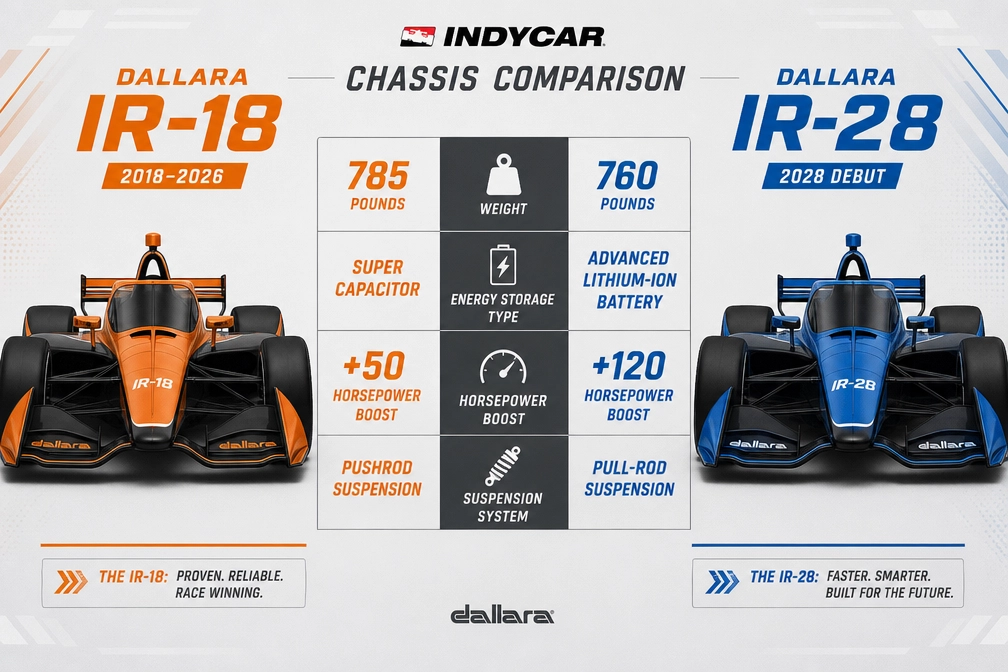
- → ~100 lbs (45kg) lighter The IR-28 chassis sheds around 100 pounds compared to the current car, with the new hybrid unit and Xtrac gearbox both contributing lighter parts to that total weight cut. [Coffee Corner Motorsport]
- → Helix (UK) named hybrid drive partner Helix, a UK-based hybrid systems company that already works with Formula 1 and Formula E teams, will build the IR-28’s hybrid drive unit, packaged inside the bellhousing. [Coffee Corner Motorsport]
- → Only major series with front and rear third-element inertance The IR-28’s new AXIS Inertance Control Suspension System makes INDYCAR the only major motorsport championship allowing both front and rear third-element inertance. [Coffee Corner Motorsport]
- → Extra 100hp from hybrid system The current hybrid unit can add up to an extra 100 horsepower in short bursts, with the energy store recharged under braking in a KERS-like way, controlled by the driver from the steering wheel. [motorsport.tech]
- → 15th season for the Dallara DW12 The 2026 Indianapolis 500 marks the 15th time the Dallara DW12 chassis, named for late test driver Dan Wheldon, has run at the Brickyard. [Motor Sport Magazine]
- → ~32,000 race tires per season Firestone builds around 32,000 Firehawk race tires for the NTT INDYCAR SERIES each season, including more than 5,000 tires for the Indianapolis 500 alone. [Firestone Racing]
- → 550-750 horsepower depending on track The current 2.2-liter twin-turbo V6, built by Honda or Chevrolet, is tuned to produce between 550hp and 750hp depending on whether the track is a superspeedway, speedway, or road course. [motorsport.tech]
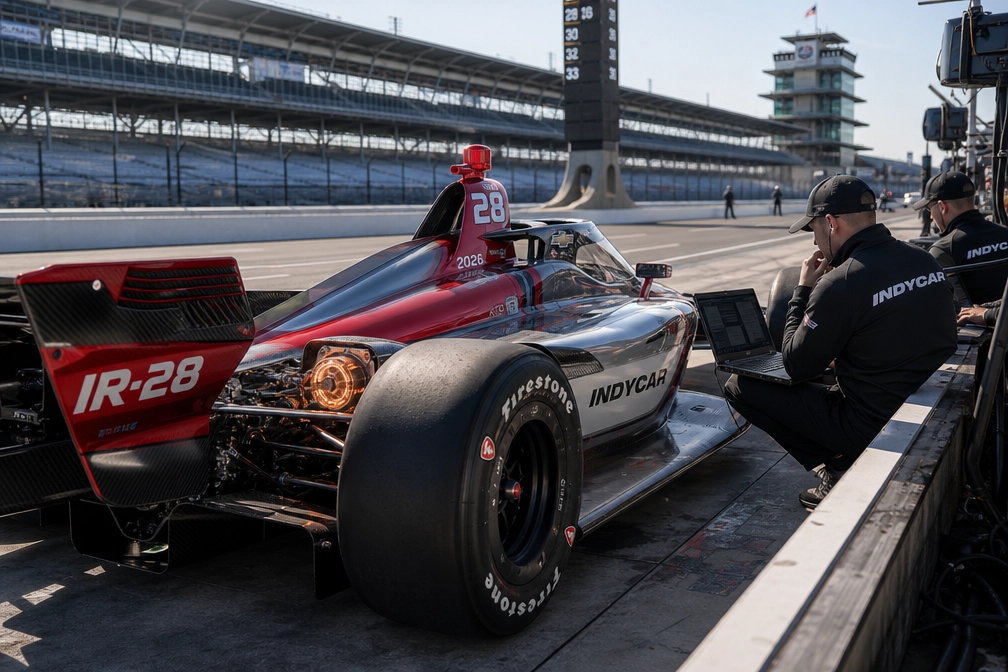
INDYCAR’s next chassis, the IR-28, carries a battery-based Energy Storage System from BOLD Technology that stores roughly 14 times more energy than the supercapacitor unit it replaces, according to Coffee Corner Motorsport. That upgrade lands alongside a new hybrid drive unit from Helix, a lighter Xtrac gearbox, and a suspension system that no other major series runs at both ends of the car. This piece breaks down what’s confirmed for 2026 and beyond, from the current Dallara chassis specs to Firestone’s tire count for the season.
1What Is the IR-28 and When Does It Race?
The IR-28 is INDYCAR’s next chassis, debuting at the start of the 2028 season. Its BOLD Technology Energy Storage System holds about 14 times the current supercapacitor’s capacity, while the car sheds roughly 100 pounds thanks to Helix’s hybrid unit and a new Xtrac gearbox, per Coffee Corner Motorsport.
| METRIC | VALUE | SOURCE |
|---|---|---|
| IR-28 competitive debut | start of 2028 season season | Coffee Corner Motorsport |
| ESS energy storage capacity increase | roughly 14x multiple vs current supercapacitor | Coffee Corner Motorsport |
| Overall weight reduction | ~100 pounds (~45kg) | Coffee Corner Motorsport |
| Hybrid drive supplier | Helix company name (UK) | Coffee Corner Motorsport |
| IR-28 test locations | Indianapolis Motor Speedway (road course and oval), Sebring International Raceway track names | Coffee Corner Motorsport |
| IR-28 trailer narrator | Matt Damon person name | Coffee Corner Motorsport |
| INDYCAR President quoted on IR-28 | J. Douglas Boles person name | Coffee Corner Motorsport |
| Source: Coffee Corner Motorsport | ||
Engineers have already run the IR-28 through test sessions at both the road course and oval configurations of Indianapolis Motor Speedway, plus additional laps at Sebring International Raceway, according to Coffee Corner Motorsport. Actor Matt Damon narrated the car’s reveal trailer, while INDYCAR President J. Douglas Boles spoke publicly about the project’s goals. Teams following the current 2026 race calendar will need to wait two more seasons before the new chassis reaches grid, giving drivers profiled in driver performance breakdowns time to adjust setups ahead of the switch.
2What Does the Current IndyCar Chassis Look Like?
Today’s cars use the Dallara IR-18 chassis, introduced in 2018, powered by a 2.2-liter twin-turbocharged V6 built by Honda or Chevrolet. The chassis design traces back to 2012, per motorsport.tech, meaning the core design has stayed on track for over a decade before the IR-28 takes over.
| METRIC | VALUE | SOURCE |
|---|---|---|
| Current chassis model and launch year | Dallara IR-18, introduced 2018 chassis name / year | INDYCAR official site |
| Current engine displacement and layout | 2.2-liter twin-turbocharged V6 engine spec | INDYCAR official site |
| Car chassis design lineage | 2012 year of original design | motorsport.tech |
| Source: INDYCAR official site | ||
The IR-18 name reflects INDYCAR’s habit of tagging chassis updates by model year, even though the core tub dates to the original 2012 design cited by motorsport.tech. That long service life keeps parts costs predictable for teams, a topic described on pages about motorsport engineering careers and technical roles within race teams. Horsepower from the twin-turbo V6 still swings widely by circuit type, a detail covered further in the historical section below.
3How Did Ray Harroun Change the Indy 500 in 1911?
Ray Harroun won the first Indianapolis 500 in 1911 driving the Marmon ‘Wasp,’ becoming the race’s first winner to use a rear-view mirror. He finished 1 minute and 43 seconds ahead of the field, per Motor Sport Magazine, a margin that stood as proof his single-seat setup and mirror trick worked.
| METRIC | VALUE | SOURCE |
|---|---|---|
| Ray Harroun’s 1911 Indy 500 win margin | 1 minute 43 seconds time margin | Motor Sport Magazine |
| First Indy 500 winner using a rear-view mirror | Ray Harroun, Marmon ‘Wasp’ driver/car name | Motor Sport Magazine |
| Source: Motor Sport Magazine | ||
That mirror let Harroun run the Marmon Wasp without a riding mechanic watching for traffic behind him, a small change that altered cockpit design for decades. More than a century later, the Dallara DW12 chassis, named for late test driver Dan Wheldon, reached its 15th season at the Brickyard in 2026, according to Motor Sport Magazine. Readers who want more on the track’s modern challenges can check J.R. Hildebrand’s take on Indy 500 racing.
4How Many Tires Does Firestone Supply for IndyCar?
Firestone builds around 32,000 Firehawk race tires each NTT INDYCAR SERIES season, including more than 5,000 for the Indianapolis 500 alone. The company enters its 27th consecutive season as exclusive tire supplier in 2026 and counts 76 Indy 500 wins, per Firestone Racing.
| METRIC | VALUE | SOURCE |
|---|---|---|
| Firestone’s tenure as exclusive INDYCAR tire supplier | 27th consecutive season | Firestone Racing |
| Firestone Indy 500 wins | 76 wins | Firestone Racing |
| INDY NXT by Firestone tire production | 5,200 tires, 16 specifications tires / specs | Firestone Racing |
| Source: Firestone Racing | ||
Beyond the top series, Firestone also supplies 5,200 tires across 16 specifications for INDY NXT by Firestone, its feeder-series program, according to Firestone Racing. That volume of rubber production runs alongside broader motorsport tire trends covered in engine and component comparisons across rally series. Firestone’s 76 Indy 500 victories place the brand’s tire program among the longest-running technical partnerships in American racing.
5What New Tools Help INDYCAR Officials Inspect Cars?
INDYCAR officials now use a new technical inspection truck fitted with laser scanning technology to check cars for rules compliance, according to a RACER report shared on Facebook. The equipment replaces older manual measurement methods, giving race stewards faster and more precise readings during race weekends.
| METRIC | VALUE | SOURCE |
|---|---|---|
| New technical inspection tools | New inspection truck plus laser scanning technology equipment | RACER (via Facebook) |
| Source: RACER (via Facebook) | ||
Laser scanning cuts down the time crews spend checking body panels and underwing components by hand, a shift that mirrors technology upgrades in motorsport safety and compliance work. Faster inspections matter most on qualifying days, when tight schedules leave little room for manual re-checks. Teams building strategy around car legality increasingly rely on data roles similar to those described on pages about motorsport data analysis careers.
Complete Data Reference
Sortable table of all verified data points. Click any column header to sort.
| Metric | Value | Source | Year |
|---|---|---|---|
| IR-28 competitive debut | start of 2028 season season | Coffee Corner Motorsport | 2026 |
| ESS energy storage capacity increase | roughly 14x multiple vs current supercapacitor | Coffee Corner Motorsport | 2026 |
| Overall weight reduction | ~100 pounds (~45kg) | Coffee Corner Motorsport | 2026 |
| Hybrid drive supplier | Helix company name (UK) | Coffee Corner Motorsport | 2026 |
| IR-28 test locations | Indianapolis Motor Speedway (road course and oval), Sebring International Raceway track names | Coffee Corner Motorsport | 2026 |
| IR-28 trailer narrator | Matt Damon person name | Coffee Corner Motorsport | 2026 |
| INDYCAR President quoted on IR-28 | J. Douglas Boles person name | Coffee Corner Motorsport | 2026 |
| Current chassis model and launch year | Dallara IR-18, introduced 2018 chassis name / year | INDYCAR official site | 2018 |
| Current engine displacement and layout | 2.2-liter twin-turbocharged V6 engine spec | INDYCAR official site | 2026 |
| Car chassis design lineage | 2012 year of original design | motorsport.tech | 2012 |
| Ray Harroun’s 1911 Indy 500 win margin | 1 minute 43 seconds time margin | Motor Sport Magazine | 1911 |
| First Indy 500 winner using a rear-view mirror | Ray Harroun, Marmon ‘Wasp’ driver/car name | Motor Sport Magazine | 1911 |
| Firestone’s tenure as exclusive INDYCAR tire supplier | 27th consecutive season | Firestone Racing | 2026 |
| Firestone Indy 500 wins | 76 wins | Firestone Racing | 2026 |
| INDY NXT by Firestone tire production | 5,200 tires, 16 specifications tires / specs | Firestone Racing | 2026 |
| New technical inspection tools | New inspection truck plus laser scanning technology equipment | RACER (via Facebook) | 2026 |
Methodology
Most next-generation chassis details rely on a single motorsport outlet (Coffee Corner Motorsport), so figures such as the 14x energy storage jump and the 100-pound weight cut may shift as INDYCAR finalizes the IR-28 ahead of its 2028 debut. Current-car specs are cross-checked against INDYCAR’s own site and two independent outlets for added confidence. Some engine and chassis figures span a range because output changes by track type.
- Sources consulted: 10
- Sources cited: 5
- Data range: 2018-2026
- Freshness: 14 current-year, 0 last-year, 1 older
- Update schedule: Quarterly
Frequently Asked Questions
What is the IndyCar IR-28 and when will it debut?
The IR-28 is INDYCAR’s next chassis, built with a battery-based Energy Storage System from BOLD Technology that holds about 14 times more energy than the current supercapacitor unit. Renderings and a trailer arrived in 2026, along with test runs at Indianapolis Motor Speedway and Sebring. Racing debut is set for the start of the 2028 season, per Coffee Corner Motorsport. [Coffee Corner Motorsport]
How much lighter is the IR-28 compared to the current IndyCar chassis?
The IR-28 sheds close to 100 pounds (about 45 kilograms) compared to today’s car, according to Coffee Corner Motorsport. Both the new hybrid drive unit, built by UK firm Helix, and a fresh Xtrac gearbox add to that weight cut. Less mass on track usually means quicker acceleration and braking, which should sharpen racing on every type of circuit. [Coffee Corner Motorsport]
How much extra horsepower does the IndyCar hybrid system provide?
Today’s hybrid unit can add up to 100 extra horsepower in short bursts, based on motorsport.tech’s reporting. Energy gets stored under braking, much like a KERS setup in Formula 1, and drivers trigger the boost from a button on the steering wheel. This gives racers a passing tool that changes how they approach overtakes on ovals and road courses alike. [motorsport.tech]
What makes the AXIS suspension system on the IR-28 different from other race cars?
The new AXIS Inertance Control Suspension System lets front and rear third-element inertance work together, a setup no other major motorsport championship allows across both ends of the car, per Coffee Corner Motorsport. Third-element inertance parts add a tuned mass that reacts to sharp bumps, smoothing the ride without hurting cornering grip, so drivers should get steadier handling over curbs and rough patches. [Coffee Corner Motorsport]
How many tires does Firestone supply for an IndyCar season?
Firestone builds roughly 32,000 Firehawk race tires across a full NTT INDYCAR SERIES season, and more than 5,000 of those go toward the Indianapolis 500 alone, according to Firestone Racing. That volume covers every practice run, qualifying attempt, and race stint, since teams switch compounds often to match track surface, temperature, and grip levels through a weekend. [Firestone Racing]
What engine powers the current IndyCar chassis?
Every car in the field runs a 2.2-liter twin-turbo V6 built by either Honda or Chevrolet, tuned to make between 550 and 750 horsepower depending on track type, per motorsport.tech. Superspeedways call for lower boost to control speed, while short ovals and road courses allow higher output, giving each engine builder room to adjust setup for the track ahead. [motorsport.tech]
How old is the Dallara chassis IndyCar teams race today?
The current Dallara DW12 chassis, named for late test driver Dan Wheldon, first raced in 2018 as the IR-18 and reached its 15th season at the Indianapolis 500 in 2026, per Motor Sport Magazine and INDYCAR’s official site. That long run shows how one spec chassis can stay competitive for years before the IR-28 takes over in 2028. [Motor Sport Magazine]
Sources & References
- Coffee Corner Motorsport. “IndyCar’s IR-28: Next-Gen Chassis Renderings and Specs.” https://coffeecornermotorsport.com/indycar-ir-28/. Accessed 2026-08-16.
- motorsport.tech. “The Technology of IndyCar: A Rich Heritage.” https://motorsport.tech/motorsport/indycar/the-technology-of-indycar-a-rich-heritage. Accessed 2026-08-16.
- Motor Sport Magazine. “The Indy 500’s Greatest Innovations: Lotus, Brabham and Penske.” https://www.motorsportmagazine.com/articles/us-scene/indycar/the-indy-500s-greatest-innovations-lotus-brabham-and-penske/. Accessed 2026-08-16.
- Firestone Racing. “IndyCar Experience – Firestone Racing.” https://www.firestonetire.com/firestone-racing/indycar-experience/. Accessed 2026-08-16.
- INDYCAR official site. “INDYCAR 101: Cars.” http://www.indycar.com/Fan-Info/INDYCAR-101/Cars. Accessed 2026-08-16.
Last updated: August 16, 2026