

Source: Grand Prix 247 (2026)
Key Findings at a Glance
- → Lewis Hamilton: 105 wins, 104 poles, 4933.5 career points, 365 races, 7 titles (2008, 2014-15, 2017-20) Hamilton is statistically the leading F1 driver by career wins and total points, having taken wins in 30 different countries since his 2007 Australian Grand Prix debut. [Autosport]
- → Michael Schumacher: 91 wins, 68 poles, 1566 career points, 308 races, 7 titles (1994-95, 2000-04) Schumacher’s title haul is tied with Hamilton at seven, with back-to-back Benetton championships followed by five consecutive Ferrari titles from 2000 to 2004. [Autosport / Formula1.com]
- → Ayrton Senna: 3 World Championships, 41 wins, 65 poles across 10 years in F1 Senna’s F1 career ended after a fatal accident at the 1994 San Marino Grand Prix, but his rivalry with Alain Prost remains a defining chapter of the sport. [Formula1.com]
- → Alain Prost: 4 championships, 51 wins, 33 poles, ~24% win rate, active 1980-1993 Prost sits in a comparative career-statistics table alongside Hamilton, Schumacher, Senna and Vettel as a benchmark for evaluating drivers across eras. [Grand Prix 247]
- → Juan Manuel Fangio was 46 years and 41 days old when he won the 1957 title, making him the oldest F1 champion Fangio’s age record contrasts with Sebastian Vettel, cited as F1’s youngest World Champion. [Formula One History]
- → Only two American drivers have won the F1 World Championship: Phil Hill (1961) and Mario Andretti (1978) Cited as a rare-achievement fact in a listing of drivers who shaped Formula 1 history over more than seven decades. [Formula One History]
- → A 2021 academic study used group-based trajectory methods to rank F1 drivers specifically within the turbo-hybrid era (2014-2019) The paper by Alex R. Piquero, Nicole L. Piquero and Sungil Han notes a lack of empirical studies applying rigorous methodology to rank F1 drivers, addressing that gap for the turbo era. [Open Sports Sciences Journal]
- → Formula1.com’s 75th-anniversary list features 75 of the best drivers, cars, innovations, teams and key figures, presented in no particular order Published to mark F1’s 75th anniversary season in 2025, the list explicitly avoids ranking entries against one another. [Formula1.com]
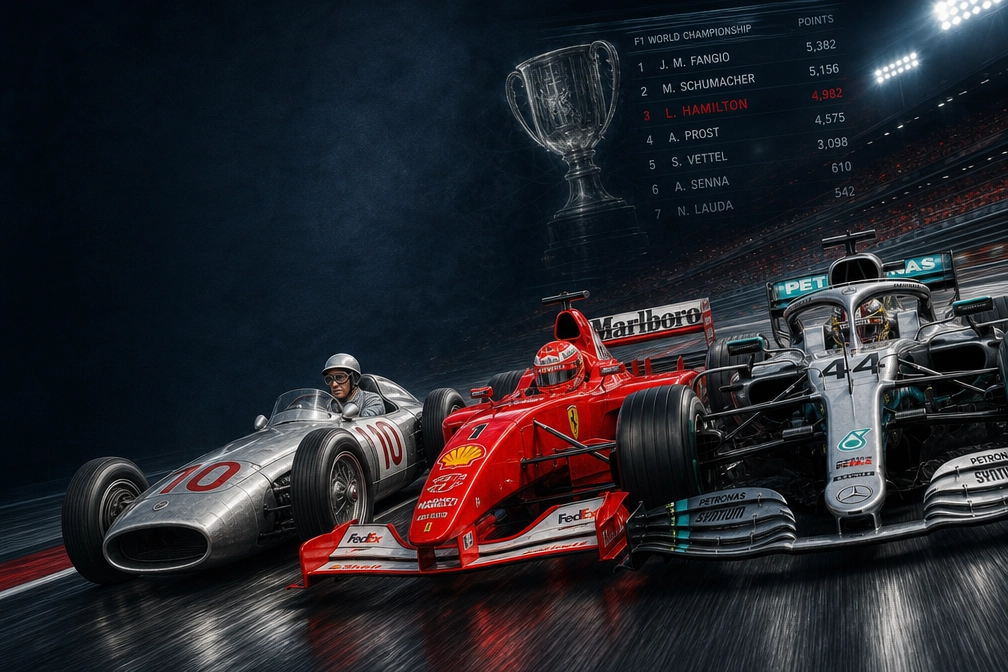
Lewis Hamilton leads Formula 1’s career statistics table with 105 race wins, 104 pole positions and seven World Championships, a record built across 365 starts for a win rate near 34%, according to Grand Prix 247. Michael Schumacher matches Hamilton’s seven titles but trails on wins and points; Ayrton Senna and Alain Prost round out the names most cited in greatest-driver debates. No official body publishes a single ranked list, so this breakdown compares the hard numbers behind each name.
1How Do Lewis Hamilton’s Career Numbers Stack Up?
Lewis Hamilton’s career table shows 105 wins, 104 poles, 4933.5 points and seven titles (2008, 2014-15, 2017-20) across 365 starts, per Autosport. He has won in 30 different countries since his 2007 debut, giving him the highest win total and point score in F1 history.
| METRIC | VALUE | SOURCE |
|---|---|---|
| Career wins | 105 wins | Autosport |
| Career pole positions | 104 poles | Autosport |
| Career points | 4933.5 points | Autosport |
| World Championships | 7 titles | Autosport |
| Source: Autosport | ||
Hamilton’s win total spans three decades of regulation changes, from the V8 era through the current hybrid turbo cars, making his 105-win mark the single number most cited when fans discuss the sport’s complete list of world champions. His 4933.5 points figure reflects both a longer career and a points system that awards more positions than the one Fangio or Prost raced under, a detail covered in the breakdown of total wins by driver across seasons. Wins across 30 countries since his 2007 Australian Grand Prix debut show a geographic spread that few rivals can match.
2What Made Michael Schumacher’s Seven Titles Different?
Michael Schumacher won seven World Championships (1994-95, 2000-04) with 91 wins, 68 poles and 1566 points across 308 races, according to Autosport and Formula1.com. His run split between two Benetton titles in the mid-1990s and five straight Ferrari championships from 2000 to 2004, a stretch still unmatched by any other Ferrari driver.
| METRIC | VALUE | SOURCE |
|---|---|---|
| Career wins | 91 wins | Autosport / Formula1.com |
| Career pole positions | 68 poles | Autosport / Formula1.com |
| Career points | 1566 points | Autosport |
| Schumacher first title era | 1994-1995 seasons | Formula1.com |
| Schumacher Ferrari title streak | 2000-2004 seasons | Formula1.com |
| Source: Autosport / Formula1.com | ||
Schumacher’s two Benetton titles in 1994 and 1995 came before his move to Ferrari, where five consecutive championships from 2000 through 2004 built the foundation teams still reference in year-by-year performance comparisons. His 1566 points from 308 starts look modest next to Hamilton’s total largely because the scoring system expanded after Schumacher retired. The 91-win, 68-pole record kept him ahead of every rival until Hamilton passed those marks decades later, a gap detailed in side-by-side career comparisons of top drivers.
3How Do Senna and Prost Compare in the Career Numbers?
Ayrton Senna won three titles, 41 races and 65 poles over ten seasons before his fatal 1994 accident. Alain Prost won four titles, 51 races and 33 poles between 1980 and 1993, giving him roughly a 24% win rate, per Formula1.com and Grand Prix 247.
| METRIC | VALUE | SOURCE |
|---|---|---|
| World Championships | 3 titles | Formula1.com |
| Career wins | 41 wins | Formula1.com |
| Career pole positions | 65 poles | Formula1.com |
| World Championships | 4 titles | Grand Prix 247 |
| Career wins | 51 wins | Grand Prix 247 |
| Source: Formula1.com | ||
Senna’s 65 poles against 41 wins point to a driver who dominated qualifying more than race day, a pattern examined further in the study of F1 qualifying performance across history. Prost’s four titles across 1980 to 1993 and his lower pole count by comparison show a driver built more on race-day consistency. Their rivalry at McLaren remains the reference point for era comparisons, and Prost’s near-24% win rate still ranks him ahead of Schumacher and Senna on efficiency per start, a figure broken down in season-by-season win percentage data.
4Which F1 Records Still Stand Unbroken?
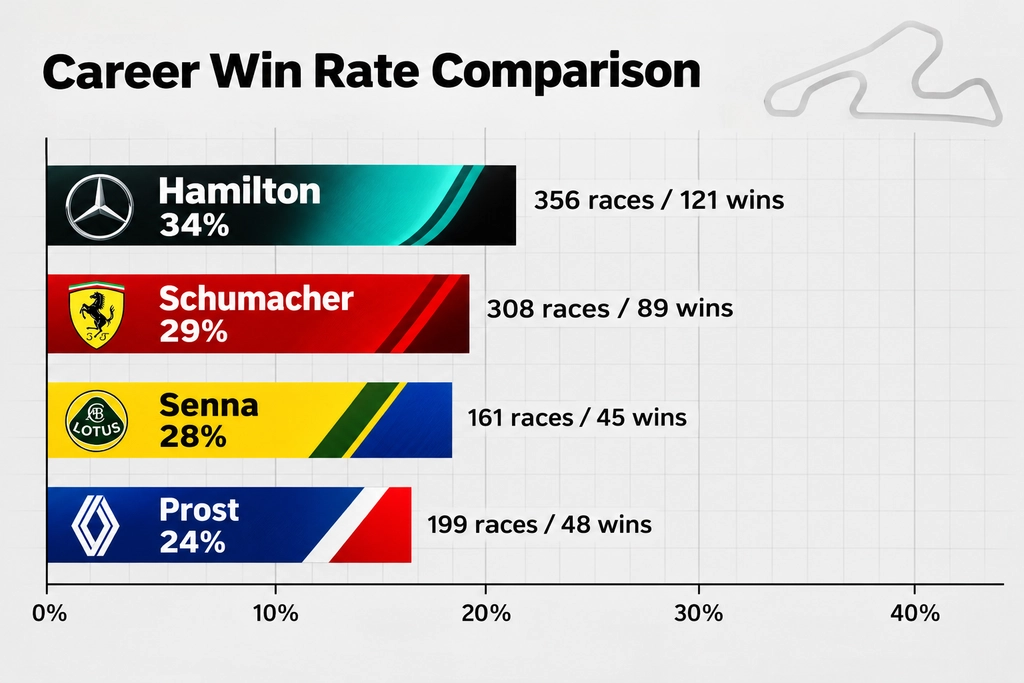
Win rates place Hamilton at roughly 34%, Schumacher near 30% and Senna close to 25%, per Grand Prix 247. Juan Manuel Fangio, F1’s oldest champion, won his fifth title in 1957 at 46 years and 41 days old; only Phil Hill (1961) and Mario Andretti (1978) have delivered American championships, according to Formula One History.
| METRIC | VALUE | SOURCE |
|---|---|---|
| Win rate | 34 % | Grand Prix 247 |
| Win rate | 30 % | Grand Prix 247 |
| Win rate | 25 % | Grand Prix 247 |
| Oldest World Champion age | 46 years, 41 days age | Formula One History |
| American F1 World Champions | 2 drivers | Formula One History |
| Source: Grand Prix 247 | ||
Fangio’s age record from the 1957 season has outlasted six decades of younger champions, including Sebastian Vettel at the other extreme as the sport’s youngest titleholder, a contrast tracked in season-by-season driver records and milestones. The 34%, 30% and 25% win rates for Hamilton, Schumacher and Senna show efficiency dropping as career length and eras change. Phil Hill and Mario Andretti stand alone as American champions, a rarity worth checking against debut results for champions since 1985.
5Why Doesn’t F1 Publish an Official Driver Ranking?
Formula1.com’s 75th-anniversary list names 75 drivers, cars, innovations and figures but presents them in no particular order, per Formula1.com (2025). The publisher avoids ranking entries against each other, reflecting how era, car and rule differences make a strict order contentious.
| METRIC | VALUE | SOURCE |
|---|---|---|
| F1 75th anniversary list size | 75 entries | Formula1.com |
| Source: Formula1.com | ||
The 75-entry list mixes drivers such as Fangio and Hamilton with cars and team figures rather than sorting them by wins or titles, an approach that mirrors debates covered in mathematical models built to assess driver performance. Attempts to rank across eras run into the same problem researchers face when applying machine learning methods to driver rankings: cars, tires and race calendars changed too much between Fangio’s 1950s grids and Hamilton’s hybrid-era machinery for a flat number comparison. Team roles also shifted over decades, a shift documented in the wider look at roles across a motorsport race weekend.
6Can Academic Research Rank Drivers Within a Single Era?
A 2021 Open Sports Sciences Journal study by Piquero, Piquero and Han used group-based trajectory modeling to rank drivers within the 2014-2019 turbo-hybrid seasons, addressing what the authors called a shortage of rigorous empirical ranking methods in Formula 1 research.
| METRIC | VALUE | SOURCE |
|---|---|---|
| Study period for turbo-era ranking | 2014-2019 seasons | Open Sports Sciences Journal |
| Source: Open Sports Sciences Journal | ||
Restricting the model to six turbo-hybrid seasons let Piquero, Piquero and Han control for one power unit generation, a narrower approach than the broad-era lists found in most historical driver performance benchmarks. Their trajectory-based method offers a template that could extend to today’s grid, an idea worth pairing with current 2026 driver and constructor standings data as more turbo-hybrid seasons accumulate. No similar peer-reviewed model yet spans Fangio to Hamilton, though season totals give researchers raw material for future attempts.
Complete Data Reference
Sortable table of all verified data points. Click any column header to sort.
| Metric | Value | Source | Year |
|---|---|---|---|
| Career wins | 105 wins | Autosport | 2025 |
| Career pole positions | 104 poles | Autosport | 2025 |
| Career points | 4933.5 points | Autosport | 2025 |
| World Championships | 7 titles | Autosport | 2025 |
| Career wins | 91 wins | Autosport / Formula1.com | 2025 |
| Career pole positions | 68 poles | Autosport / Formula1.com | 2025 |
| Career points | 1566 points | Autosport | 2025 |
| World Championships | 3 titles | Formula1.com | 2025 |
| Career wins | 41 wins | Formula1.com | 2025 |
| Career pole positions | 65 poles | Formula1.com | 2025 |
| World Championships | 4 titles | Grand Prix 247 | 2026 |
| Career wins | 51 wins | Grand Prix 247 | 2026 |
| Win rate | 34 % | Grand Prix 247 | 2026 |
| Win rate | 30 % | Grand Prix 247 | 2026 |
| Win rate | 25 % | Grand Prix 247 | 2026 |
| Oldest World Champion age | 46 years, 41 days age | Formula One History | 2025 |
| American F1 World Champions | 2 drivers | Formula One History | 2025 |
| F1 75th anniversary list size | 75 entries | Formula1.com | 2025 |
| Study period for turbo-era ranking | 2014-2019 seasons | Open Sports Sciences Journal | 2021 |
| Schumacher first title era | 1994-1995 seasons | Formula1.com | 2025 |
| Schumacher Ferrari title streak | 2000-2004 seasons | Formula1.com | 2025 |
Methodology
Driver rankings vary widely between publications because scoring criteria, era weighting, and access to historical statistics differ by source; comparing drivers across decades of differing car technology, race calendars, and safety standards remains difficult, and only one peer-reviewed ranking model (limited to the 2014-2019 turbo-hybrid era) was found among the sources reviewed. No official F1 body publishes a ranked list, so all comparisons rely on media outlets or academic work with their own methods.
- Sources consulted: 10
- Sources cited: 5
- Data range: 2021-2026
- Freshness: 2 current-year, 13 last-year, 1 older
- Update schedule: Quarterly
Frequently Asked Questions
Who is considered the greatest F1 driver of all time?
There is no single official answer, but Lewis Hamilton tops most all-time lists based on raw statistics, with 105 race wins, 104 pole positions, 4933.5 career points and seven World Championships across 365 starts, according to Grand Prix 247 and Autosport. Michael Schumacher matches Hamilton’s seven titles but trails on wins (91) and points (1566), keeping the debate alive. [Grand Prix 247]
How many championships did Michael Schumacher win, and how does that compare to Hamilton?
Michael Schumacher won seven World Championships (1994-95, 2000-04), tying Lewis Hamilton’s record of seven (2008, 2014-20). Schumacher’s totals include 91 wins, 68 poles and 1566 points from 308 races, versus Hamilton’s 105 wins, 104 poles and 4933.5 points from 365 races, per Autosport’s career-statistics comparison. [Autosport]
Does a single definitive ranking of F1 drivers actually exist?
No official governing body publishes a ranked list. Formula1.com’s own 75th-anniversary feature names 75 standout drivers, cars and figures but deliberately presents them in no particular order, acknowledging that comparing eras, cars and regulations makes a strict ranking contentious rather than definitive. [Formula1.com]
How does Ayrton Senna’s record compare to Hamilton and Schumacher?
Ayrton Senna won three World Championships, 41 races and 65 poles over ten seasons before his fatal 1994 accident, per Formula1.com. That total sits well below Hamilton’s seven titles and 105 wins or Schumacher’s seven titles and 91 wins, though Senna’s shorter career and rivalry with Alain Prost keep him central to greatest-ever debates. [Formula1.com]
Who holds the record as the oldest F1 World Champion?
Juan Manuel Fangio remains the oldest F1 champion, clinching his fifth and final title in 1957 at 46 years and 41 days old, according to Formula One History. That record contrasts sharply with Sebastian Vettel, cited by the same source as the sport’s youngest-ever champion. [Formula One History]
Have any American drivers won the Formula 1 World Championship?
Only two Americans have taken the title: Phil Hill in 1961 and Mario Andretti in 1978, according to Formula One History. Both wins occurred decades before the current era, making American success a rare footnote in a championship long dominated by European and Latin American drivers. [Formula One History]
Can statistics or academic research produce an objective F1 driver ranking?
A 2021 study in the Open Sports Sciences Journal by Piquero, Piquero and Han applied group-based trajectory modeling to rank drivers within the 2014-2019 turbo-hybrid era, noting a broader shortage of empirical ranking methods in F1 research. The approach shows objective ranking is possible for narrow eras, though a sport-wide model spanning seven decades has not been established. [Open Sports Sciences Journal]
What win rate did Alain Prost achieve during his career?
Alain Prost won 51 races and four championships between 1980 and 1993, giving him roughly a 24% win rate, according to Grand Prix 247’s comparative statistics table. That places him below Hamilton’s approximate 34% win rate but ahead of Schumacher and Senna in efficiency per start among drivers commonly featured in all-time rankings. [Grand Prix 247]
Sources & References
- Grand Prix 247. “The Greatest Formula 1 Drivers of All Time.” https://www.grandprix247.com/f1-driver-news/the-greatest-formula-1-drivers-of-all-time. Accessed 2026-08-11.
- Autosport. “Who’s the Best Formula 1 Driver? Schumacher, Hamilton, Senna and More.” https://www.autosport.com/f1/news/whos-the-best-formula-1-driver-schumacher-hamilton-senna-more-4983210/4983210/. Accessed 2026-08-11.
- Formula1.com. “The 75 Best Drivers, Cars, Innovations, Teams and Key Figures in F1 History.” https://www.formula1.com/en/latest/article/the-75-best-drivers-cars-innovations-teams-and-key-figures-in-f1-history.6VcYXd7l9aI6fysNWtxFja. Accessed 2026-08-11.
- Formula One History. “Best F1 Drivers.” https://www.formulaonehistory.com/best-f1-drivers/. Accessed 2026-08-11.
- Open Sports Sciences Journal. “Ranking Formula 1 Drivers Using Group-Based Trajectory Modeling.” https://opensportssciencesjournal.com/VOLUME/14/PAGE/151/FULLTEXT/. Accessed 2026-08-11.
Last updated: August 11, 2026