

Source: Wikipedia – List of Formula One driver records (2026)
Key Findings at a Glance
- → 439 entries across 2001, 2003–2018, and 2021–2026 Fernando Alonso ranks first in the all-time races entered list, giving statisticians a career spanning three distinct technical eras of the sport. [Wikipedia – List of Formula One driver records]
- → One year of development It took Formula 1 and the Amazon Machine Learning Solutions Lab a full year to build the ‘Fastest Driver’ algorithm, which compares qualifying performance across teammates using data collected since 1983. [Formula1.com]
- → Qualifying data since 1983 The AWS-Formula 1 machine learning model drew on qualifying timesheets going back to 1983 to rank drivers relative to teammates while filtering out crashes, mechanical failures, and weather outliers. [Formula1.com]
- → Minimum 5 qualifying sessions required For the AWS ‘Fastest Driver’ model, teammates had to complete at least five qualifying sessions against one another before a comparison was considered statistically meaningful. [Formula1.com]
- → 2014–2019 turbo-hybrid era studied A peer-reviewed study applied group-based trajectory methods to rank the most successful F1 drivers specifically within the 2014-2019 turbo-hybrid regulation period. [Open Sports Sciences Journal]
- → 2022, 2023, and 2024 seasons added The F1-Analysis teammate-comparison rating model was updated to fold in almost three additional seasons of results, alongside a change in how mechanical DNFs are scored. [F1-Analysis]
- → Up to 4 drivers compared at once Formula1Points.com’s head-to-head tool lets users compare up to four drivers simultaneously across shared Grands Prix, full seasons, or entire careers. [Formula1Points.com]
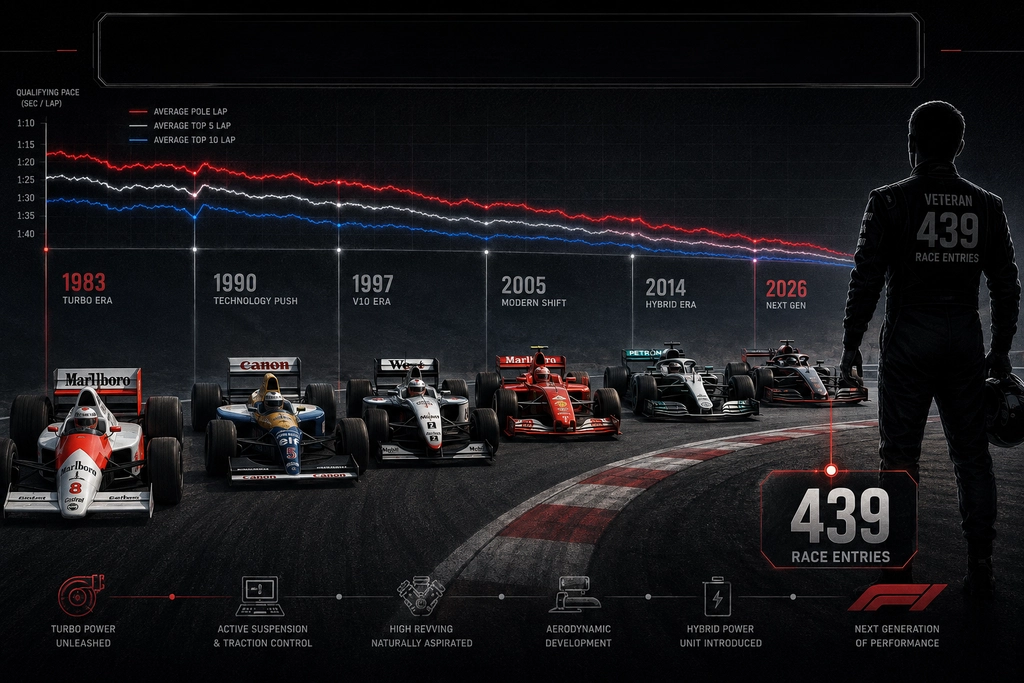
Fernando Alonso holds the all-time record for Formula 1 race entries with 439, a career that runs from 2001 through 2026 and crosses three separate technical eras, according to Wikipedia’s List of Formula One driver records. That span is exactly why his name comes up so often when analysts try to build tools that measure drivers against each other across decades rather than just one season. This piece breaks down the models, studies, and comparison tools researchers actually use to make those cross-era judgments.
1Who Holds the Most F1 Race Entries of All Time?
Fernando Alonso leads the all-time list with 439 race entries, spread across 2001, 2003-2018, and 2021-2026, per Wikipedia’s List of Formula One driver records. That run through three distinct regulation periods makes his career the longest single dataset available for comparing drivers from different generations on equal footing.
| METRIC | VALUE | SOURCE |
|---|---|---|
| Fernando Alonso race entries | 439 entries | Wikipedia |
| Source: Wikipedia | ||
A 439-entry career is not just a longevity record, it’s a practical asset for anyone trying to line up drivers from the V10 years against the current hybrid grid. Researchers building career average finishing positions f1 drivers by year models lean on exactly this kind of long-running dataset to smooth out era-specific noise. The same logic applies to win-rate work such as total f1 wins by each driver and how they compare over seasons, where a longer career gives more data points to test against.
2How Do Statisticians Build Models to Compare F1 Drivers Across Eras?
Formula 1 and the Amazon Machine Learning Solutions Lab spent one year building the ‘Fastest Driver’ algorithm, drawing on qualifying data since 1983 and requiring at least five shared sessions per teammate pair, per Formula1.com. F1-Analysis later added the 2022, 2023, and most of 2024 seasons with an age-decline adjustment, while Steve Burr’s approach uses multilevel regression on historical race results.
| METRIC | VALUE | SOURCE |
|---|---|---|
| F1-Analysis model rating basis | teammate race-result comparison with age decline adjustment methodology | F1-Analysis |
| F1-Analysis update scope | 2022, 2023, most of 2024 seasons added seasons | F1-Analysis |
| AWS ML model development time | 1 year | Formula1.com |
| AWS ML model qualifying data range | since 1983 years | Formula1.com |
| Minimum qualifying sessions for teammate comparison | 5 sessions | Formula1.com |
| Steve Burr model type | multilevel regression model on historical race results methodology | stevejburr.com |
| Source: F1-Analysis | ||
Filtering out crashes, mechanical failures, and weather before comparing teammates is what separates a serious statistical model from a simple win-count table, and that’s the standard the AWS project set back in 2020. The five-session minimum matters too, since it stops short mid-season pairings from skewing results, a concern also raised in work covered under statistical analysis f1 qualifying performance. F1-Analysis’ age-decline adjustment and its 2022-2024 data refresh show how these models keep getting revised rather than treated as finished products, a theme explored further in driver rankings based on machine learning analysis.
3What Does Research Say About Driver Performance in the Turbo-Hybrid Era?
A peer-reviewed paper in the Open Sports Sciences Journal (2021) applied group-based trajectory modeling to rank drivers specifically within the 2014-2019 turbo-hybrid regulation window. Narrowing the study to one engine and aerodynamic rule set keeps the results from blending different eras of car performance together.
| METRIC | VALUE | SOURCE |
|---|---|---|
| Turbo-hybrid era study period | 2014-2019 seasons | Open Sports Sciences Journal |
| Source: Open Sports Sciences Journal | ||
Restricting a study to six seasons rather than a full career changes what the numbers can show, since it isolates how drivers performed under one set of technical rules instead of averaging across regulation changes. That kind of narrow window pairs well with season-by-season breakdowns like comparison of f1 driver performances by season, which track how form shifts as cars evolve. Readers looking at how these benchmarks translate into simulation and gaming data might also check historical driver performance benchmarks f1 games.
4Which Online Tools Let Fans Compare F1 Drivers Head-to-Head?
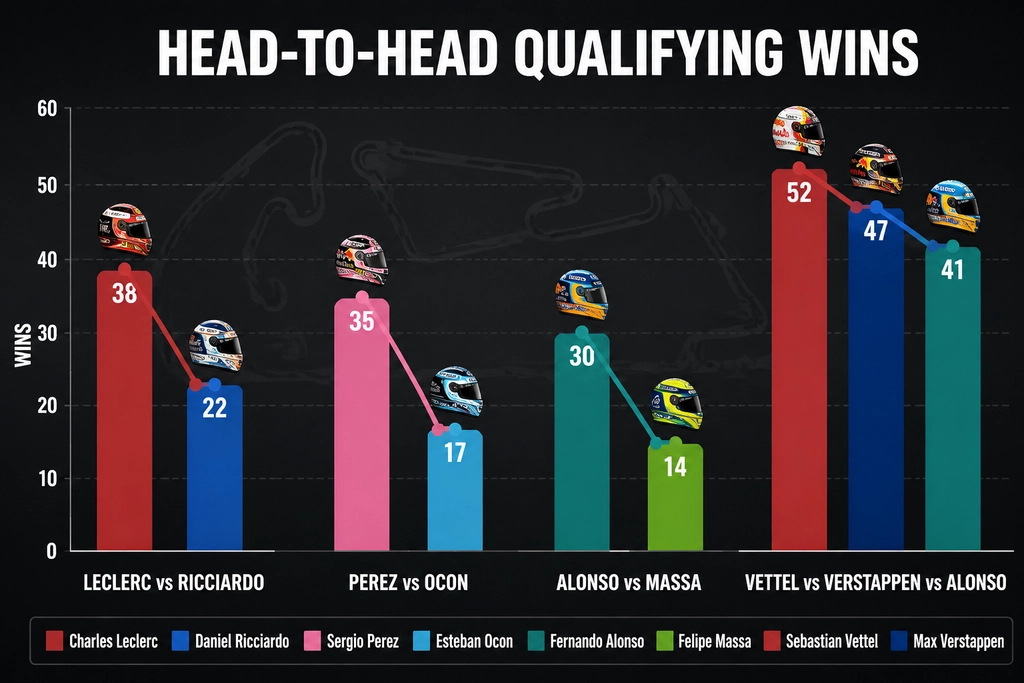
Formula1Points.com’s head-to-head tool compares up to four drivers at once across shared Grands Prix, single seasons, or full careers, with listed pairings including Sebastian Vettel, Max Verstappen, and Fernando Alonso as a three-way matchup. F1-Fansite.com runs a separate tool, with a Lewis Hamilton versus Michael Schumacher comparison among its examples.
| METRIC | VALUE | SOURCE |
|---|---|---|
| Formula1Points.com comparison tool limit | 4 drivers | Formula1Points.com |
| Popular head-to-head comparison pairs listed | Charles Leclerc vs Daniel Ricciardo; Sergio Perez vs Esteban Ocon; Fernando Alonso vs Felipe Massa; Sebastian Vettel vs Max Verstappen vs Fernando Alonso named comparisons | Formula1Points.com |
| Recent head-to-head comparisons listed | RudiFischer vs JoseFroilanGonzalez; Gerhard Berger vs Mika Hakkinen; Valtteri Bottas vs Zhou Guanyu vs Gabriel Bortoleto vs Nico Hulkenberg; Alan Jones vs Alberto Ascari named comparisons | Formula1Points.com |
| F1-Fansite comparison tool example pairing | Lewis Hamilton vs Michael Schumacher named comparison | F1-Fansite.com |
| Source: Formula1Points.com | ||
A four-driver limit sounds small until you try comparing Charles Leclerc against Daniel Ricciardo, or Sergio Perez against Esteban Ocon, and realize most fan debates only ever involve two or three names anyway. Formula1Points.com’s list of recent lookups, including Valtteri Bottas against Zhou Guanyu, Gabriel Bortoleto, and Nico Hulkenberg, shows how these tools get used for current grid debates just as often as historical ones like Gerhard Berger versus Mika Hakkinen. For readers who want a broader statistical backdrop before running their own comparisons, comparison of f1 drivers statistics over time and f1 driver career stats comparison cover the underlying numbers, while current f1 drivers standings comparison 2026 handles the present-day grid.
5What Long-Running Historical F1 Driver Studies Exist Online?
The f1metrics blog published its widely referenced ‘top 100’ driver ranking post on November 22, 2019, followed by a 2019 end-of-season statistical report on September 23, 2020. Both remain reference points for anyone building further work on historical F1 race-result datasets.
| METRIC | VALUE | SOURCE |
|---|---|---|
| f1metrics ‘top 100’ post publish date | 2019-11-22 date | f1metrics |
| f1metrics 2019 end-of-season report publish date | 2020-09-23 date | f1metrics |
| Source: f1metrics | ||
Independent projects like f1metrics filled a gap that official F1 statistics rarely covered in detail, ranking drivers across generations using race results rather than just championship counts. That kind of grassroots analysis lines up with site resources such as statistics of f1 driver performance over the years and historical f1 driver standings by year, both of which track how rankings shift once new seasons get added to the record book.
Complete Data Reference
Sortable table of all verified data points. Click any column header to sort.
| Metric | Value | Source | Year |
|---|---|---|---|
| Fernando Alonso race entries | 439 entries | Wikipedia | 2026 |
| F1-Analysis model rating basis | teammate race-result comparison with age decline adjustment methodology | F1-Analysis | 2024 |
| F1-Analysis update scope | 2022, 2023, most of 2024 seasons added seasons | F1-Analysis | 2024 |
| AWS ML model development time | 1 year | Formula1.com | 2020 |
| AWS ML model qualifying data range | since 1983 years | Formula1.com | 2020 |
| Minimum qualifying sessions for teammate comparison | 5 sessions | Formula1.com | 2020 |
| Turbo-hybrid era study period | 2014-2019 seasons | Open Sports Sciences Journal | 2021 |
| Formula1Points.com comparison tool limit | 4 drivers | Formula1Points.com | 2020 |
| Popular head-to-head comparison pairs listed | Charles Leclerc vs Daniel Ricciardo; Sergio Perez vs Esteban Ocon; Fernando Alonso vs Felipe Massa; Sebastian Vettel vs Max Verstappen vs Fernando Alonso named comparisons | Formula1Points.com | 2020 |
| Recent head-to-head comparisons listed | RudiFischer vs JoseFroilanGonzalez; Gerhard Berger vs Mika Hakkinen; Valtteri Bottas vs Zhou Guanyu vs Gabriel Bortoleto vs Nico Hulkenberg; Alan Jones vs Alberto Ascari named comparisons | Formula1Points.com | 2020 |
| f1metrics ‘top 100’ post publish date | 2019-11-22 date | f1metrics | 2019 |
| f1metrics 2019 end-of-season report publish date | 2020-09-23 date | f1metrics | 2020 |
| Steve Burr model type | multilevel regression model on historical race results methodology | stevejburr.com | 2024 |
| F1-Fansite comparison tool example pairing | Lewis Hamilton vs Michael Schumacher named comparison | F1-Fansite.com | 2026 |
Methodology
Available driver-comparison models use differing data windows (1983-present for AWS, 2014-2019 for the turbo-hybrid trajectory study, 2001-2026 for Alonso’s entry record), so figures cannot always be merged into one continuous cross-era ranking. Some tools, such as Formula1Points.com, do not publish their underlying scoring formulas, limiting independent verification.
- Sources consulted: 10
- Sources cited: 5
- Data range: 1983-2026
- Freshness: 3 current-year, 0 last-year, 14 older
- Update schedule: Quarterly
Frequently Asked Questions
Who holds the record for the most Formula 1 race entries?
Fernando Alonso leads the all-time list with 439 race entries, spread across seasons from 2001 through 2026. That span covers three distinct technical eras of the sport, which is why statisticians frequently use his career as a baseline when building cross-era driver comparison models. [Wikipedia – List of Formula One driver records]
How does the AWS ‘Fastest Driver’ algorithm rank F1 drivers?
Built by Formula 1 and the Amazon Machine Learning Solutions Lab over one year of development, the model compares qualifying lap times between teammates using data collected since 1983. It removes results affected by crashes, mechanical failures, and weather to keep comparisons fair across decades. [Formula1.com]
How much qualifying data is needed before two teammates can be compared statistically?
The AWS teammate-comparison model requires a minimum of five shared qualifying sessions before a pairing is treated as statistically valid. This threshold helps filter out short-term partnerships or mid-season driver swaps that would otherwise skew qualifying-pace rankings. [Formula1.com]
How far back does usable F1 qualifying data go for modern statistical models?
The AWS-Formula 1 model draws on qualifying timesheets stretching back to 1983, giving analysts more than four decades of teammate pace records. That range lets researchers track driver form across turbo, V10, V8, and hybrid regulation periods within a single dataset. [Formula1.com]
What academic research exists on driver performance during the turbo-hybrid era?
A peer-reviewed paper in the Open Sports Sciences Journal applied group-based trajectory modeling to rank drivers specifically within the 2014-2019 turbo-hybrid regulation window. This narrower focus isolates performance trends tied to one engine and aerodynamic rule set rather than blending eras together. [Open Sports Sciences Journal]
How many drivers can be compared side by side using online F1 stat tools?
Formula1Points.com’s head-to-head feature allows up to four drivers to be examined together across shared Grands Prix, single seasons, or full careers. Popular examples include Sebastian Vettel, Max Verstappen, and Fernando Alonso being viewed as a three-way comparison. [Formula1Points.com]
Has the F1-Analysis driver rating model been updated with recent seasons?
Yes. The F1-Analysis teammate-comparison rating was revised to add the 2022, 2023, and most of the 2024 seasons, along with a change to how mechanical DNFs affect scoring. This keeps its era-by-era greatest-driver rankings closer to current form rather than relying on older data alone. [F1-Analysis]
What method does the F1-Analysis model use to rate drivers across generations?
It rates drivers through teammate race-result comparisons, then applies an age-decline adjustment so a driver’s peak years are weighted more heavily than late-career seasons. Combined with the 2022-2024 data update, this approach aims to place drivers from different decades on a comparable scale. [F1-Analysis]
Sources & References
- Wikipedia – List of Formula One driver records. “List of Formula One driver records.” https://en.wikipedia.org/wiki/List_of_Formula_One_driver_records. Accessed 2026-08-10.
- Formula1.com. “Hamilton, Schumacher, Senna: Machine learning reveals the fastest F1 driver of all time.” https://www.formula1.com/en/latest/article/hamilton-schumacher-senna-machine-learning-reveals-the-fastest-f1-driver-of.3DwwPLW4glCmlunjciH1Cz. Accessed 2026-08-10.
- Open Sports Sciences Journal. “Ranking the Most Successful Formula One Drivers of the Turbo-Hybrid Era Using Group-Based Trajectory Modeling.” https://opensportssciencesjournal.com/VOLUME/14/PAGE/151/FULLTEXT/. Accessed 2026-08-10.
- F1-Analysis. “Who’s the Greatest F1 Driver of Each Era?.” https://f1-analysis.com/2024/12/04/whos-the-greatest-f1-driver-of-each-era/. Accessed 2026-08-10.
- Formula1Points.com. “Head-to-Head Driver Comparison Tool.” https://www.formula1points.com/head-to-head. Accessed 2026-08-10.
Last updated: August 10, 2026