

Source: NASCAR.com Cup Series Standings (2026)
Key Findings at a Glance
- → Denny Hamlin: 23 starts, 4 wins, 13 top-5s, 15 top-10s, 0 DNFs, 877 laps led Season stat line for the current 2026 NASCAR points leader through Race 23 of 36 (as of August 9, 2026). [NASCAR.com Cup Series Standings]
- → Ty Gibbs: 23 starts, 2 wins, 10 top-5s, 15 top-10s, 4 DNFs, 278 laps led Second-place driver in the 2026 NASCAR Cup standings, trailing Hamlin by 103 points despite matching his top-10 count. [NASCAR.com Cup Series Standings]
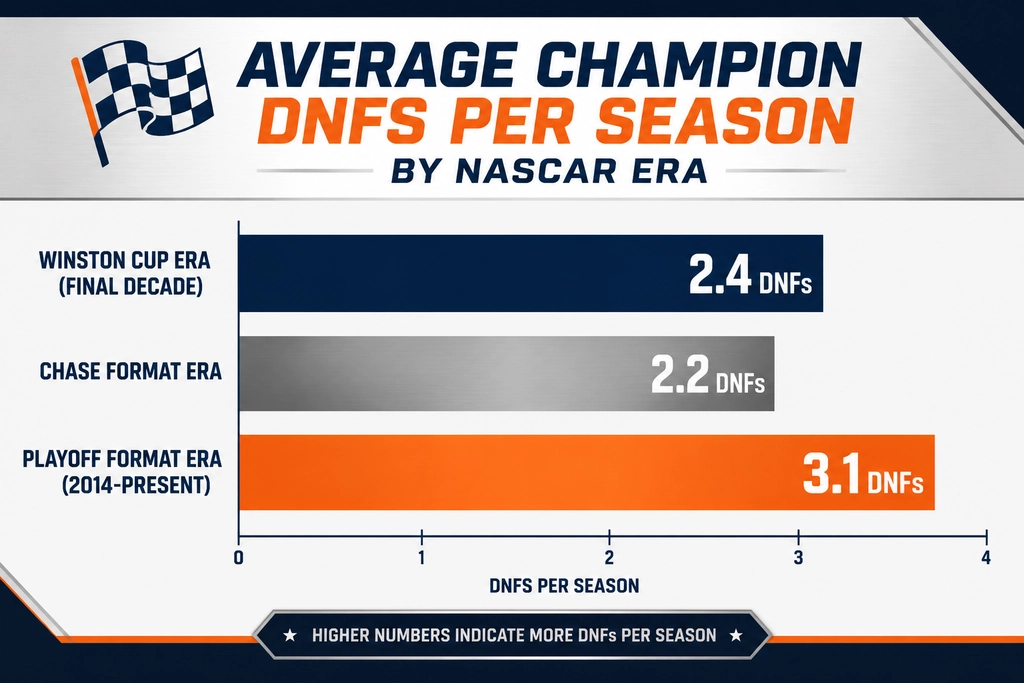
- → NASCAR champions have averaged 3.1 DNFs per season since the Playoff format began in 2014 That figure is up slightly from 2.2 DNFs per season under the old Chase format and 2.4 under the final decade of the Winston Cup system. [The Daily Downforce]
- → Fernando Alonso holds the F1 record for race entries with 439, spanning seasons from 2001 through 2026 His career includes gaps in 2002 and 2019-2020, plus a run continuing into the 2026 season. [Wikipedia – List of Formula One driver records]
- → Niki Lauda failed to finish 6 of his first 9 races during his championship-winning 1984 season Lauda is described as having the highest DNF rate among the ten F1 drivers compared in the study, with his 1980s comeback years being especially rough on reliability. [F1-Analysis.com]
- → Jim Clark finished on the podium in almost every race his car survived, but DNF’d in roughly one-third of his starts Across 73 entries, Clark scored 25 wins and only 1 second-place finish, a pattern the analysis credits to his cars either winning or breaking down entirely. [F1-Analysis.com]
- → Jackie Stewart won 43% of the races he finished across 100 entries, a rate no later driver has matched His 27 career victories stood as the all-time record for 14 years after his retirement. [F1-Analysis.com]

Denny Hamlin leads the 2026 NASCAR Cup Series standings with 923 points and zero DNFs through 23 races, the cleanest record among the season’s top contenders, according to NASCAR.com. Finishing positions and DNF counts decide championships in NASCAR and Formula One alike, from Hamlin’s spotless 2026 run to Niki Lauda’s rocky 1984 title season. This breakdown covers current standings, historical DNF averages, and the F1 drivers whose records still set the bar for consistency.
1Who Leads the 2026 NASCAR Standings in Points and DNFs?
Denny Hamlin leads the 2026 NASCAR Cup Series with 923 points, 4 wins, 13 top-5s, 15 top-10s, and 0 DNFs through 23 starts. Ty Gibbs sits second with 820 points, 2 wins, 10 top-5s, 15 top-10s, and 4 DNFs, trailing Hamlin by 103 points as of August 9, 2026.
| METRIC | VALUE | SOURCE |
|---|---|---|
| Denny Hamlin – points | 923 points | NASCAR.com Cup Series Standings |
| Denny Hamlin – DNFs | 0 count | NASCAR.com Cup Series Standings |
| Denny Hamlin – wins/top5/top10 | 4 wins, 13 top-5s, 15 top-10s count | NASCAR.com Cup Series Standings |
| Ty Gibbs – points | 820 points | NASCAR.com Cup Series Standings |
| Ty Gibbs – DNFs | 4 count | NASCAR.com Cup Series Standings |
| Source: NASCAR.com Cup Series Standings | ||
Hamlin’s 877 laps led back up his points total, showing that his edge comes from speed as well as avoiding trouble. Gibbs matches Hamlin’s 15 top-10 finishes, proof his car is fast enough to compete, but four DNFs have erased points he otherwise would have banked. That gap fits patterns covered in statistical breakdowns of NASCAR driver performance, where reliability separates title contenders from the rest of the grid. Readers tracking the wider field can cross-reference these figures against the 2026 driver and constructor standings.
2How Many DNFs Do NASCAR Champions Average Per Season?
NASCAR champions crowned under the Playoff format, running since 2014, average 3.1 DNFs per season, according to The Daily Downforce. That’s higher than the 2.2 DNFs per season seen during the Chase era and the 2.4 average from the final decade of the old Winston Cup points system.
| METRIC | VALUE | SOURCE |
|---|---|---|
| Winston Cup era average DNFs per season | 2.4 DNFs/season | The Daily Downforce |
| Chase format average DNFs per season | 2.2 DNFs/season | The Daily Downforce |
| Playoff era champion average DNFs per season | 3.1 DNFs/season | The Daily Downforce |
| Source: The Daily Downforce | ||
The climb from 2.2 to 3.1 DNFs points to playoff-format racing rewarding aggressive driving, since one bad points day can be wiped clean in a later round rather than dragging down an entire season. Hamlin’s zero DNFs through 23 races in 2026 already sits well below every era’s average, a number worth watching once the playoff rounds begin. Anyone building models off these figures can find comparable methods in statistical performance reviews of motorsport drivers and among the skill sets listed under motorsport data analysis roles.
3Who Holds the F1 Record for Most Race Entries?
Fernando Alonso holds the Formula One record with 439 career race entries, spanning 2001 through 2026, according to Wikipedia’s list of F1 driver records. His career includes gaps in 2002 and 2019-2020, plus a run that continues into the 2026 season.
| METRIC | VALUE | SOURCE |
|---|---|---|
| Fernando Alonso – career race entries | 439 entries | Wikipedia – List of Formula One driver records |
| Source: Wikipedia – List of Formula One driver records | ||
A quarter-century behind the wheel means Alonso has logged more finishing positions, and inevitably more DNFs, than almost any driver in the sport’s history. His entry count is tracked season by season in records and milestones broken down by F1 season, alongside similar longevity data in historical F1 standings by year. Comparing his win rate against total starts also fits the approach used in comparisons of F1 driver performance across seasons.
4How Do DNF Rates Compare Among F1’s Greatest Drivers?
Niki Lauda failed to finish 6 of his first 9 races in his title-winning 1984 season, the highest DNF rate among ten F1 greats studied by F1-Analysis.com. Jim Clark DNF’d in roughly one-third of his 73 starts, while Jackie Stewart won 43% of the races he finished across 100 entries.
| METRIC | VALUE | SOURCE |
|---|---|---|
| Juan Manuel Fangio – career entries | 52 entries | F1-Analysis.com |
| Jim Clark – career entries and wins | 73 entries, 25 wins count | F1-Analysis.com |
| Jackie Stewart – career entries and wins | 100 entries, 27 victories count | F1-Analysis.com |
| Niki Lauda – career entries | 177 entries | F1-Analysis.com |
| Source: F1-Analysis.com | ||
Clark’s 73 entries produced 25 wins but only a single second-place finish, a pattern that suggests his Lotus either dominated or broke down completely, with little in between. Stewart’s 27 wins across 100 starts stood as Formula One’s all-time record for 14 years, while Juan Manuel Fangio needed only 52 entries to build his own legend. These numbers line up with the deeper breakdowns in career average finishing positions for F1 drivers by year and historical performance comparisons of legendary F1 drivers, both of which track how reliability shaped championship outcomes long before modern parts cut down on mechanical failures.
5What Data Exists to Track Driver Finishing Positions and DNFs?
Stanford’s RelBench F1 database holds 97,606 rows across 9 tables and 77 columns covering driver results. Its driver-position prediction task works on a 2-month window, while its driver-DNF prediction task uses a 1-month window, according to RelBench’s 2025 documentation.
| METRIC | VALUE | SOURCE |
|---|---|---|
| RelBench F1 database size | 97,606 rows, 9 tables, 77 columns count | RelBench (Stanford) |
| RelBench driver-position prediction task window | 2 months | RelBench (Stanford) |
| RelBench driver-dnf prediction task window | 1 month | RelBench (Stanford) |
| Source: RelBench (Stanford) | ||
A dataset built from 9 linked tables and 77 columns gives researchers enough detail to model both where a driver finishes and whether they finish at all. The shorter 1-month window for DNF prediction versus the 2-month window for position forecasting reflects how mechanical failures cluster differently than a driver’s form over a stretch of races. Analysts working on similar tools can find related approaches in mathematical models for driver performance assessment and driver rankings built from machine learning analysis, work that overlaps with roles listed under motorsport IT and software careers.
Complete Data Reference
Sortable table of all verified data points. Click any column header to sort.
| Metric | Value | Source | Year |
|---|---|---|---|
| Denny Hamlin – points | 923 points | NASCAR.com Cup Series Standings | 2026 |
| Denny Hamlin – DNFs | 0 count | NASCAR.com Cup Series Standings | 2026 |
| Denny Hamlin – wins/top5/top10 | 4 wins, 13 top-5s, 15 top-10s count | NASCAR.com Cup Series Standings | 2026 |
| Ty Gibbs – points | 820 points | NASCAR.com Cup Series Standings | 2026 |
| Ty Gibbs – DNFs | 4 count | NASCAR.com Cup Series Standings | 2026 |
| Winston Cup era average DNFs per season | 2.4 DNFs/season | The Daily Downforce | 2025 |
| Chase format average DNFs per season | 2.2 DNFs/season | The Daily Downforce | 2025 |
| Playoff era champion average DNFs per season | 3.1 DNFs/season | The Daily Downforce | 2025 |
| Fernando Alonso – career race entries | 439 entries | Wikipedia – List of Formula One driver records | 2026 |
| Juan Manuel Fangio – career entries | 52 entries | F1-Analysis.com | 2021 |
| Jim Clark – career entries and wins | 73 entries, 25 wins count | F1-Analysis.com | 2021 |
| Jackie Stewart – career entries and wins | 100 entries, 27 victories count | F1-Analysis.com | 2021 |
| Niki Lauda – career entries | 177 entries | F1-Analysis.com | 2021 |
| RelBench F1 database size | 97,606 rows, 9 tables, 77 columns count | RelBench (Stanford) | 2025 |
| RelBench driver-position prediction task window | 2 months | RelBench (Stanford) | 2025 |
| RelBench driver-dnf prediction task window | 1 month | RelBench (Stanford) | 2025 |
Methodology
NASCAR figures reflect standings through race 23 of the 36-race 2026 season and will shift as more events are run. The DNF-per-season era averages come from a single independent site rather than an official NASCAR database, so exact counts may vary slightly by source. Historical F1 finishing-position comparisons draw on a 2021 analysis site rather than the official Formula One statistics archive, and driver career totals such as Fernando Alonso’s entry count will keep rising as the 2026 season continues.
- Sources consulted: 10
- Sources cited: 4
- Data range: 2021-2026
- Freshness: 10 current-year, 4 last-year, 3 older
- Update schedule: Quarterly
Frequently Asked Questions
What does DNF mean in racing, and why does it matter for season standings?
DNF stands for "Did Not Finish." A driver earns a DNF when a crash, mechanical failure, or other problem stops them from completing a race. DNFs matter because they often mean few or no points for that event. Denny Hamlin’s zero DNFs across 23 starts in 2026 helped him build a 923-point lead in the NASCAR Cup standings. [NASCAR.com Cup Series Standings]
Who is leading the 2026 NASCAR Cup Series standings, and what is his DNF record?
Denny Hamlin tops the 2026 NASCAR Cup Series standings with 923 points through 23 races, and he has not recorded a single DNF this season. His clean record, paired with 4 wins, 13 top-5 finishes, and 877 laps led, gives him a 103-point lead over second-place Ty Gibbs as of August 9, 2026. [NASCAR.com Cup Series Standings]
How does Ty Gibbs’ 2026 season compare to Denny Hamlin’s?
Ty Gibbs sits second in the 2026 NASCAR standings with 820 points, 103 behind leader Denny Hamlin. Gibbs has 2 wins, 10 top-5s, and 15 top-10s across 23 starts, matching Hamlin’s top-10 total. Four DNFs this year, though, have cost him points that Hamlin’s spotless record avoided. [NASCAR.com Cup Series Standings]
Do modern NASCAR champions have more DNFs than champions from past eras?
Yes. Champions crowned under the current Playoff format (since 2014) average 3.1 DNFs per season, according to The Daily Downforce. That is higher than the 2.2 DNFs per season seen during the Chase era and the 2.4 average from the final decade of the old Winston Cup points system, showing reliability still plays a role in a playoff-based sport. [The Daily Downforce]
Who holds the record for the most Formula One race entries, and how does that relate to DNFs?
Fernando Alonso holds the F1 record with 439 career race entries, spanning 2001 through 2026 with gaps in 2002 and 2019-2020, per Wikipedia’s list of Formula One driver records. A career this long naturally includes many finishing positions and DNFs, making him a useful example for tracking reliability trends across two decades of racing. [Wikipedia – List of Formula One driver records]
Did past F1 champions have high DNF rates, like Niki Lauda in 1984?
Yes. Niki Lauda failed to finish six of his first nine races during his title-winning 1984 season, based on data from F1-Analysis.com. Lauda’s early-season reliability problems make him the driver with the highest DNF rate among the ten F1 greats studied, yet he still claimed the championship by season’s end. [F1-Analysis.com]
How did Jim Clark’s finishing record compare to his win total?
Jim Clark’s career shows an unusual pattern: across 73 race entries, he scored 25 wins but only one second-place finish, according to F1-Analysis.com. He also failed to finish roughly one-third of his races. This suggests his cars either led easily or broke down completely, leaving little room for a middle-of-the-pack result. [F1-Analysis.com]
What was Jackie Stewart’s win rate when he actually finished a race?
Jackie Stewart won 43% of the races he completed across 100 career entries, a rate no later driver has matched, according to F1-Analysis.com. His 27 wins stood as the all-time F1 record for 14 years after he retired, showing how strong his results were whenever his car held together. [F1-Analysis.com]
Sources & References
- NASCAR.com Cup Series Standings. “NASCAR Cup Series Standings.” https://www.nascar.com/standings/nascar-cup-series/. Accessed 2026-08-15.
- The Daily Downforce. “Do DNFs Matter in Modern NASCAR?.” https://dailydownforce.com/do-dnfs-matter-in-modern-nascar/. Accessed 2026-08-15.
- Wikipedia – List of Formula One driver records. “List of Formula One driver records.” https://en.wikipedia.org/wiki/List_of_Formula_One_driver_records. Accessed 2026-08-15.
- F1-Analysis.com. “Finishing Positions: Comparing F1 Greats.” https://f1-analysis.com/2021/09/19/finishing-positions-f1-greats/. Accessed 2026-08-15.
Last updated: August 15, 2026