
Source: F1-Fansite All-Time F1 Driver Rankings (2026)
Key Findings at a Glance
- → Max Verstappen: 244 GP starts, 71 wins, 48 poles, 3553.5 points Verstappen ranks second on the all-time points list, achieving his totals in far fewer starts than Hamilton, indicating a higher win-rate per race entered. [F1-Fansite All-Time F1 Driver Rankings]
- → Fernando Alonso: 439 career race entries Alonso holds the record for most total F1 entries across seasons from 2001 to 2026, ahead of Hamilton’s 391. [Wikipedia – List of Formula One driver records]
- → Michael Schumacher: 91 wins, 68 poles, 77 fastest laps, 7 DTs, 307 starts Schumacher’s 91 wins and 7 Drivers’ Championships (matching Hamilton) place him among the top two most successful drivers by career silverware, despite fewer starts than several current-era rivals. [F1-Fansite All-Time F1 Driver Rankings]
- → 88% of race-result variance explained by constructor A Bayesian multilevel rank-ordered logit model applied to the 2014-2021 hybrid-era F1 seasons found that approximately 88% of variance in race finishing positions is explained by the constructor rather than driver skill. [Bayesian analysis of Formula One race results (PMC)]
- → Hamilton and Verstappen rated best drivers of hybrid era (2014-2021) The same Bayesian modeling study concluded that Hamilton and Verstappen were the top-rated drivers of the hybrid era, with Mercedes, Ferrari and Red Bull clearly outperforming other constructors. [Bayesian analysis of Formula One race results (PMC)]
- → Ayrton Senna: 65 pole positions from only 161 starts Senna’s pole-position ratio (65 poles in 161 GP starts) remains one of the strongest qualifying records relative to career length among drivers listed in the all-time rankings table. [F1-Fansite All-Time F1 Driver Rankings]
- → Alain Prost: 51 wins, 33 poles, 41 fastest laps, 4 titles from 199 starts Prost’s career efficiency, 51 wins from just 199 starts, places him among the highest win-rate drivers on the all-time list despite competing in an earlier era with fewer races per season. [F1-Fansite All-Time F1 Driver Rankings]
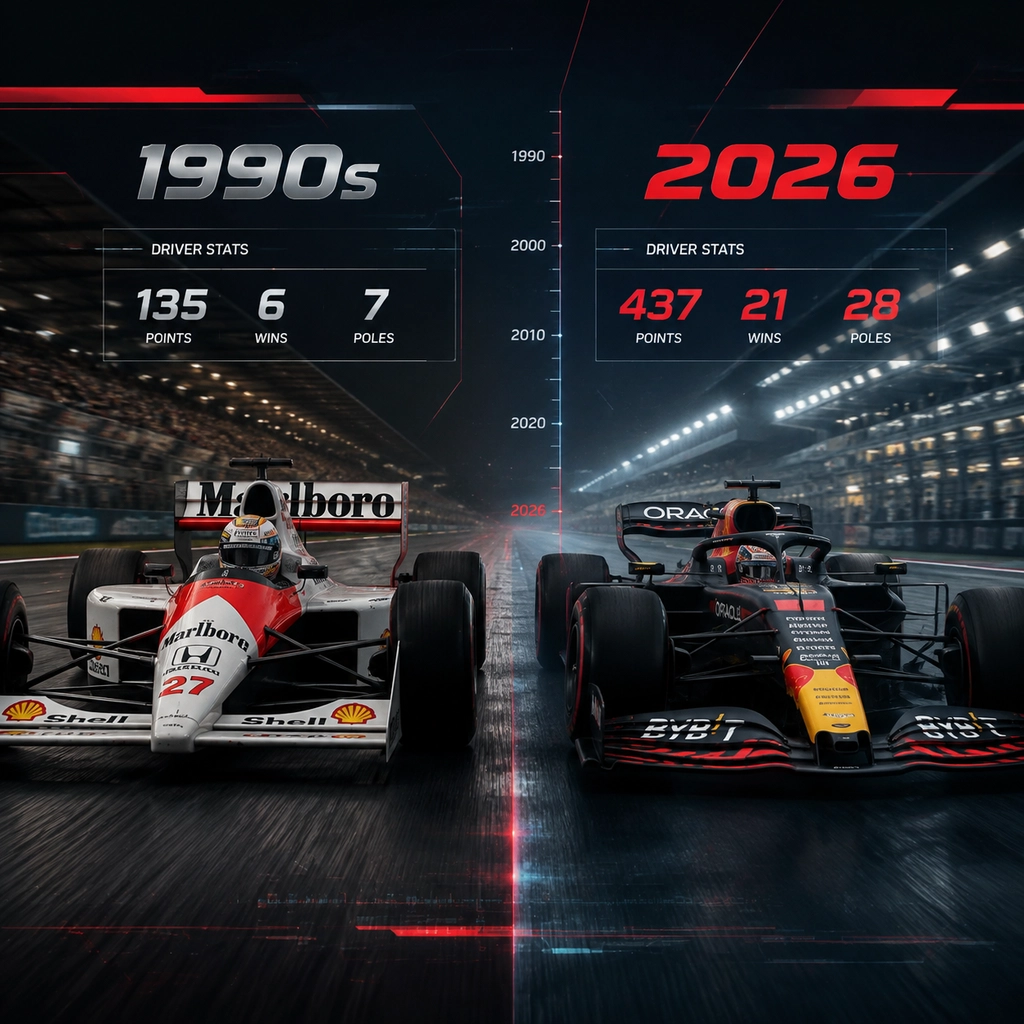
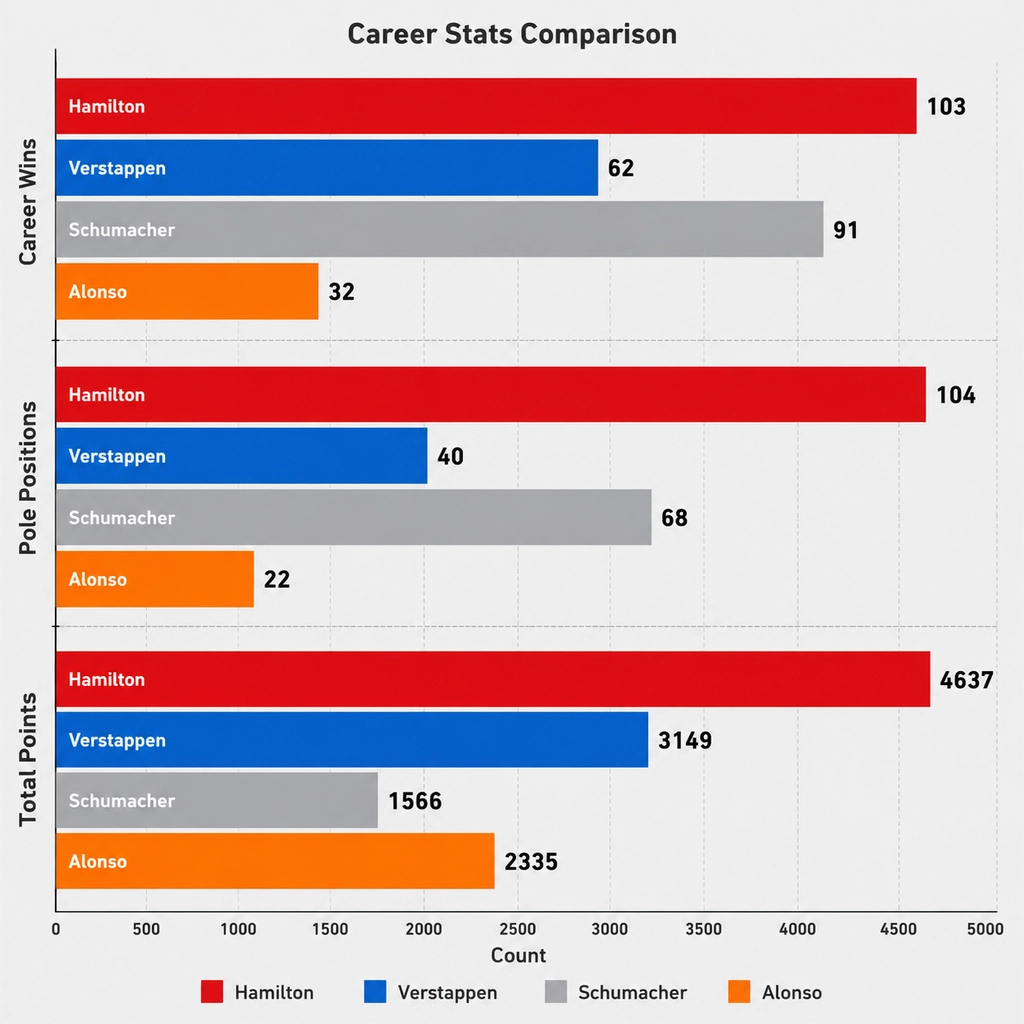
Lewis Hamilton leads the all-time Formula One rankings with 5184.5 career points, 106 wins and 105 pole positions from 391 Grand Prix starts, according to F1-Fansite’s 2026 driver database. This comparison sets Hamilton’s numbers against Max Verstappen, Michael Schumacher, Fernando Alonso and other names across the sport’s history, using points, win rates and starts to show how each career stacks up. A separate statistical model of the hybrid era adds another layer, measuring how much of each result comes down to the car rather than the driver behind the wheel.
1Who Leads the All-Time F1 Points Table?
Lewis Hamilton tops the all-time F1 rankings with 5184.5 career points, 106 wins and 105 poles from 391 starts. Max Verstappen sits second with 3553.5 points from 244 starts. The third and fourth-place drivers on F1-Fansite’s 2026 list hold 3098 and 2394 points.
| METRIC | VALUE | SOURCE |
|---|---|---|
| Career points | 5184.5 points | F1-Fansite All-Time F1 Driver Rankings |
| Career wins | 106 wins | F1-Fansite All-Time F1 Driver Rankings |
| Career pole positions | 105 poles | F1-Fansite All-Time F1 Driver Rankings |
| Career points | 3553.5 points | F1-Fansite All-Time F1 Driver Rankings |
| Career points | 3098 points | F1-Fansite All-Time F1 Driver Rankings |
| Career points | 2394 points | F1-Fansite All-Time F1 Driver Rankings |
| Source: F1-Fansite All-Time F1 Driver Rankings | ||
Verstappen’s 71 wins and 48 poles came from 244 starts, less than two-thirds of Hamilton’s total race count, a gap examined in the site’s machine-learning driver ranking model. The points spread between the top two and the third and fourth spots on the list narrows once win totals are set against races entered, a trend also tracked in the cumulative stats database for the 2024 season. Readers comparing win totals against career length can find a broader breakdown in the piece on drivers with more wins than their rivals combined.
2How Do Schumacher, Senna and Prost Compare With Today’s Drivers?
Michael Schumacher finished with 91 wins, 68 poles, 77 fastest laps and seven titles from 307 starts. Ayrton Senna claimed 65 poles from just 161 starts. Alain Prost took 51 wins and four titles from 199 starts, one of the strongest win rates on the all-time list.
| METRIC | VALUE | SOURCE |
|---|---|---|
| Career wins | 91 wins | F1-Fansite All-Time F1 Driver Rankings |
| Career pole positions | 65 poles | F1-Fansite All-Time F1 Driver Rankings |
| Career wins | 51 wins | F1-Fansite All-Time F1 Driver Rankings |
| Source: F1-Fansite All-Time F1 Driver Rankings | ||
Schumacher’s seven titles match Hamilton’s total, though his 307 starts sit well below the totals racked up by Alonso and Hamilton in the current era, a contrast covered in season-by-season performance ratings. Senna’s 65 poles from 161 starts give him a pole-per-race rate that stands out even against qualifying leaders profiled in the historical qualifying comparison. Prost’s 51 wins from 199 starts arrived during a period with far fewer races per season than today’s calendar, a factor addressed in the driver records breakdown by season.
3Who Has Started the Most Grand Prix Races?
Fernando Alonso holds the record with 439 race entries across seasons from 2001 to 2026. Lewis Hamilton ranks second with 391 starts. A third driver on Wikipedia’s list of F1 driver records sits at 353 career entries, well behind Alonso’s mark.
| METRIC | VALUE | SOURCE |
|---|---|---|
| Total career race entries | 439 entries | Wikipedia – List of Formula One driver records |
| Total career race entries | 391 entries | Wikipedia – List of Formula One driver records |
| Total career race entries | 353 entries | Wikipedia – List of Formula One driver records |
| Source: Wikipedia – List of Formula One driver records | ||
Alonso’s 439 starts outpace Hamilton’s 391 by 48 races, a gap built up over more than two decades on the grid, a career arc traced in the season-by-season milestone tracker. Alonso’s win total of 32 stays far below Hamilton’s 106, showing that career length alone does not translate into victory totals, a point also raised in the long-run driver performance review.
4How Do the Top Active Drivers Compare on Points?
Among current-grid drivers tracked on F1-Fansite’s 2026 list, point totals of 1806, 1553 and 888 mark the third, fourth and fifth positions on the active leaderboard, a level still far behind Hamilton’s 5184.5 career points and Verstappen’s 3553.5, showing the size of the gap at the very top of the sport.
| METRIC | VALUE | SOURCE |
|---|---|---|
| Career points | 1806 points | F1-Fansite All-Time F1 Driver Rankings |
| Career points | 1553 points | F1-Fansite All-Time F1 Driver Rankings |
| Career points | 888 points | F1-Fansite All-Time F1 Driver Rankings |
| Source: F1-Fansite All-Time F1 Driver Rankings | ||
These point totals trail far behind Hamilton and Verstappen, reflecting how much separation builds up over a decade of full-time racing rather than a handful of strong seasons, a gap laid out further in the current standings comparison. The spread among active drivers below the top two also lines up with constructor form tracked in this season’s driver and constructor standings.
5Does the Car Matter More Than the Driver in F1?
A Bayesian multilevel model of the 2014-2021 hybrid era found that constructor choice explains about 88% of the variance in race finishing positions. Within that window, Hamilton and Verstappen rated as the top drivers, with Mercedes, Ferrari and Red Bull outperforming other constructors on track.
| METRIC | VALUE | SOURCE |
|---|---|---|
| Variance in race results explained by constructor | 88 percent | Bayesian analysis of Formula One race results (PMC) |
| Source: Bayesian analysis of Formula One race results (PMC) | ||
That 88% figure means only a small share of race outcomes traces back to raw driving talent once car performance is accounted for, a finding that lines up with the approach used in the year-by-year standings archive. Mercedes, Ferrari and Red Bull’s dominance during the hybrid years also shows up in the season-by-season performance comparison, where Hamilton and Verstappen post the strongest marks relative to their machinery.
Complete Data Reference
Sortable table of all verified data points. Click any column header to sort.
| Metric | Value | Source | Year |
|---|---|---|---|
| Career points | 5184.5 points | F1-Fansite All-Time F1 Driver Rankings | 2026 |
| Career wins | 106 wins | F1-Fansite All-Time F1 Driver Rankings | 2026 |
| Career pole positions | 105 poles | F1-Fansite All-Time F1 Driver Rankings | 2026 |
| Career points | 3553.5 points | F1-Fansite All-Time F1 Driver Rankings | 2026 |
| Career points | 3098 points | F1-Fansite All-Time F1 Driver Rankings | 2026 |
| Career points | 2394 points | F1-Fansite All-Time F1 Driver Rankings | 2026 |
| Career wins | 91 wins | F1-Fansite All-Time F1 Driver Rankings | 2026 |
| Career pole positions | 65 poles | F1-Fansite All-Time F1 Driver Rankings | 2026 |
| Career wins | 51 wins | F1-Fansite All-Time F1 Driver Rankings | 2026 |
| Total career race entries | 439 entries | Wikipedia – List of Formula One driver records | 2026 |
| Total career race entries | 391 entries | Wikipedia – List of Formula One driver records | 2026 |
| Total career race entries | 353 entries | Wikipedia – List of Formula One driver records | 2026 |
| Career points | 1806 points | F1-Fansite All-Time F1 Driver Rankings | 2026 |
| Career points | 1553 points | F1-Fansite All-Time F1 Driver Rankings | 2026 |
| Career points | 888 points | F1-Fansite All-Time F1 Driver Rankings | 2026 |
| Variance in race results explained by constructor | 88 percent | Bayesian analysis of Formula One race results (PMC) | 2023 |
Methodology
Career totals reflect standings as of the 2026 season and will shift as active drivers such as Verstappen and Alonso add further starts, wins, and points. The constructor-versus-driver variance figure comes from a single academic study covering only the 2014-2021 hybrid era and may not generalize to earlier or later periods with different technical regulations. Historical point totals for pre-2010 drivers are calculated on the current scoring scale rather than the scale used during their active seasons, which affects direct cross-era comparison.
- Sources consulted: 10
- Sources cited: 3
- Data range: 2023-2026
- Freshness: 2 current-year, 0 last-year, 1 older
- Update schedule: Quarterly
Frequently Asked Questions
Who holds the record for the most career points in Formula One history?
Lewis Hamilton sits atop the all-time list with 5184.5 career points, 106 wins and 105 pole positions from 391 Grand Prix starts, according to F1-Fansite rankings current through the 2026 season. No other driver has matched his combined totals in points, wins and poles across a full career. [F1-Fansite All-Time F1 Driver Rankings]
Who has started the most Grand Prix races?
Fernando Alonso holds the record for total race entries, with 439 starts across seasons from 2001 to 2026, per Wikipedia’s list of Formula One driver records. That figure surpasses Hamilton’s 391 starts, though Alonso’s win total of 32 remains well below the sport’s top scorers. [Wikipedia – List of Formula One driver records]
How does Max Verstappen’s win rate compare with Hamilton’s?
Verstappen has recorded 71 wins and 3553.5 points from 244 Grand Prix starts, compared with Hamilton’s 106 wins from 391 starts, per F1-Fansite data. Verstappen’s ratio of wins per start runs higher, pointing to a faster pace of victory accumulation relative to career length. [F1-Fansite All-Time F1 Driver Rankings]
Does the car matter more than driver skill in Formula One results?
A Bayesian multilevel study of the 2014-2021 hybrid era found that constructor choice accounts for roughly 88% of variance in race finishing positions, leaving a smaller share tied to individual driving talent. Within that period, Hamilton and Verstappen were rated the top performers relative to their machinery. [Bayesian analysis of Formula One race results (PMC)]
How many wins and titles did Michael Schumacher finish with?
Michael Schumacher closed his career with 91 wins, 68 poles, 77 fastest laps and seven Drivers’ Championships from 307 starts, matching Hamilton’s title count, according to F1-Fansite rankings. His win total ranks second all-time, trailing only Hamilton’s 106. [F1-Fansite All-Time F1 Driver Rankings]
Who had the strongest qualifying record relative to career length?
Ayrton Senna claimed 65 pole positions from only 161 Grand Prix starts, giving him one of the highest pole-per-start ratios among drivers listed in the all-time rankings table. That mark holds up against rivals with far longer careers on the grid. [F1-Fansite All-Time F1 Driver Rankings]
How efficient was Alain Prost’s career compared with drivers of longer seasons?
Alain Prost won 51 races and four titles from just 199 starts, per F1-Fansite career data, a rate that compares favorably against drivers racing in modern calendars packed with far more events per year. His per-start win figure remains among the strongest on record. [F1-Fansite All-Time F1 Driver Rankings]
Sources & References
- F1-Fansite All-Time F1 Driver Rankings. “All-Time F1 Driver Rankings.” https://www.f1-fansite.com/f1-results/all-time-f1-driver-rankings/. Accessed 2026-08-08.
- Wikipedia – List of Formula One driver records. “List of Formula One driver records.” https://en.wikipedia.org/wiki/List_of_Formula_One_driver_records. Accessed 2026-08-08.
- Bayesian analysis of Formula One race results (PMC). “Bayesian analysis of Formula One race results.” https://pmc.ncbi.nlm.nih.gov/articles/PMC10660124/. Accessed 2026-08-08.
Last updated: August 8, 2026